RCS Campaign Ops
Launch better RCS journeys with zero guesswork.
RCSX gives developers and marketing teams a production-like iPhone emulator, event console, and payload validator in one focused workflow. Prototype faster, test deeper, and ship with confidence.
- Schema validation
- Real-time callbacks
- High-fidelity iPhone preview
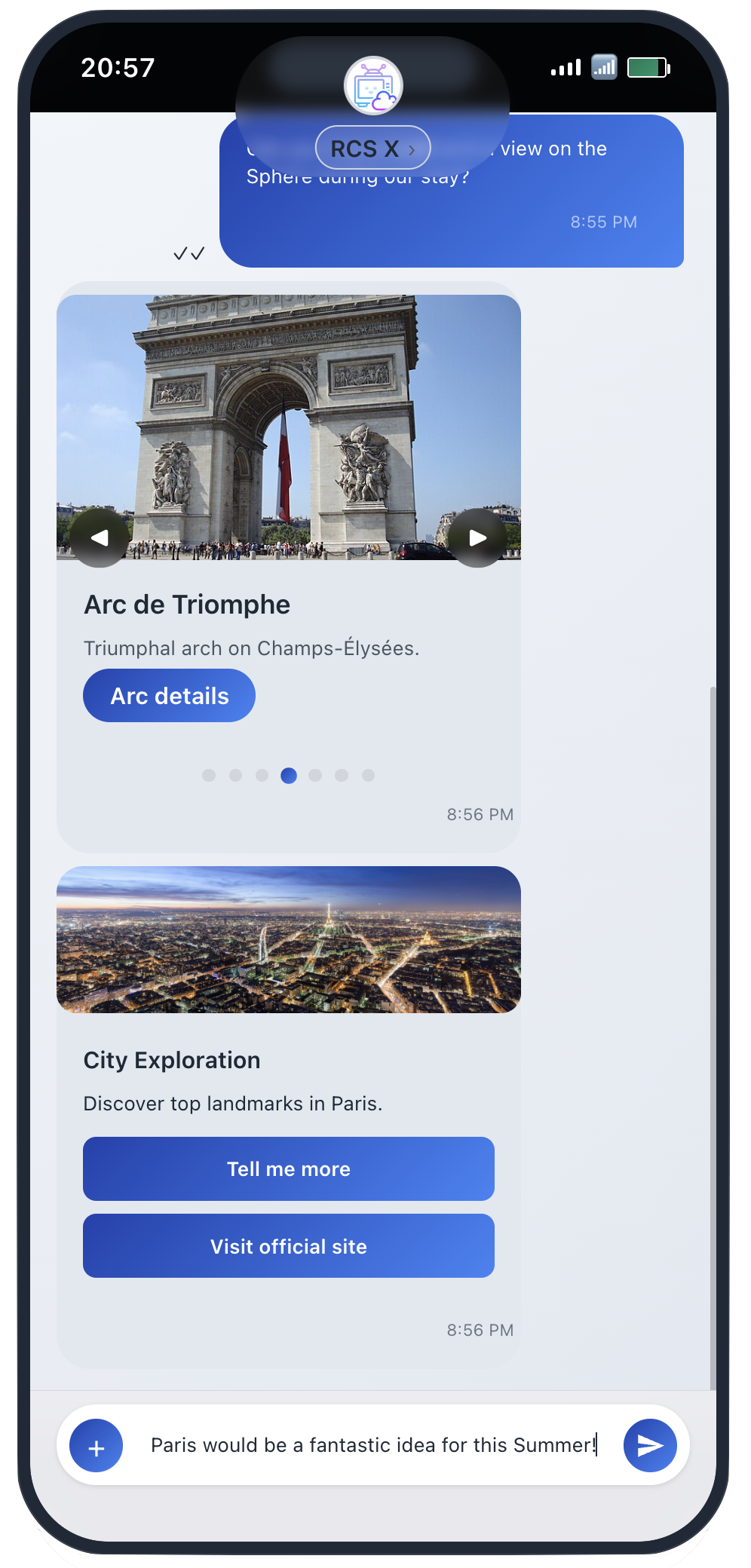
No whitelisting needed.
Built for the Next Era of Business Messaging
RCS X is an AI-native platform for teams building, testing, and scaling RCS Business Messaging — without the infrastructure complexity that has held the channel back.
Every carrier is different
Different approval workflows, UP versions, and throttling rules. Teams waste 40%+ of effort navigating these differences.
Iteration takes days, not minutes
RCS testing requires carrier agreements, SIM provisioning, and real device farms. You shouldn't need enterprise infrastructure to prototype.
The tribal knowledge problem
The channel moves fast but documentation doesn't. We built the platform we wished existed — now it's yours.
AI-First, by Design
RCS X is operated by a distributed team of RCS, AI Agents, and Business Communications enthusiasts. We built the platform we wished existed — one where a single developer can simulate carrier approval workflows, stress-test message rendering across devices, and move from prototype to production without enterprise overhead.
We're not a traditional SaaS company with a sales team and customer success managers. We're engineers and builders who ship fast, write honestly on our blog, and let the product speak.
- Individual developers first, enterprise teams second — Every feature starts with the solo builder.
- We ship weekly — Follow along on our blog or DEV Community.
- Transparent by default — We publish methodology, pricing, and what doesn't work.
Find problems before your users do
Realistic carrier simulation means you validate early and often.
Skip the procurement overhead
Test every scenario locally. No SIM farms, no whitelisting delays.
We publish what works — and what doesn't
Methodology, pricing, and roadmap are all public.
Interoperability isn't a feature
It's the foundation. We build for the RCS ecosystem, not against it.
Who Builds RCS X
RCS X is developed and operated by a small, distributed group of engineers and communications specialists united by a single obsession: making RCS development tractable for the average team.
We don't have a headquarters or a traditional org chart. We communicate openly, build in public, and make decisions based on what the RCS ecosystem actually needs — not what sounds good in a press release.
Ready to stop fighting your RCS toolchain?
Start testing in minutes. No carrier agreements, no SIM farms, no waiting.
Built for Every RCS Team
One platform for campaign strategy, payload implementation, and enterprise-grade validation workflows.
Prototype high-converting campaigns
Preview rich cards, media, and conversation journeys before launch. Iterate messaging fast without production waits.
Validate payloads and callbacks
Use JSON validation, simulator rendering, and event visibility in one loop to catch issues before release.
De-risk rollout with test coverage
Standardize QA across teams, reduce campaign errors, and launch high-volume programs with more confidence.
From Payload to Event Signal
RCSX compresses the build-and-verify loop into three deterministic steps so teams can move from idea to validated campaign without waiting on carrier cycles.
1
Compose
Draft or paste your RCS payload and validate schema instantly.
2
Render
Preview the exact conversation in a high-fidelity iPhone simulation.
3
Observe
Capture engagement and callback signals in real time for QA and optimization.
Simple Usage-Based Plans
Start free, then scale by message throughput and team size. No lock-in, no hidden setup tier.
Most teams start with Pro and upgrade when throughput grows.
Free
$0
1 seat
10 msgs/day
100 msgs/month
Pro
$10 /month
1 seat
100 msgs/day
1,000 msgs/month
Team
$30 /month
5 seats
1,000 msgs/day
10,000 msgs/month
Enterprise
$200 /month
Unlimited seats
10,000 msgs/day
100,000 msgs/month
Common Questions
Answers to the key decisions teams make before adopting RCS testing infrastructure.
What is RCSX?
An RCS emulator for developers and campaign teams to test business messaging flows before production.
How does the iPhone emulator help?
It provides a realistic mobile rendering surface so teams can validate conversation quality and interaction behavior before launch.
Can I test cards and carousels?
Yes. Rich cards, carousel layouts, media payloads, and interactions are supported.
Is API automation supported?
Yes. Your backend and QA scripts can trigger sends and validate flows programmatically.
Can teams collaborate on QA?
Yes. Product, marketing, and engineering can review the same flows and verify behavior before a campaign goes live.
How are authentication and API keys handled?
Dashboard sessions use JWT authentication, and message APIs use scoped keys with an rcs_* prefix for secure operations.
Can I test user interactions?
Yes. Suggested actions, quick replies, and click flows can be exercised end to end with callback visibility.
Is there a free tier?
Yes. You can start at no cost and upgrade as throughput and collaboration needs grow.
Ready to test your next campaign with confidence?
Set up in minutes, validate rendering, and ship with fewer surprises.
From the RCS X Blog
Release notes, architecture decisions, and feature deep-dives from the team shipping RCS testing infrastructure.
The MCP-Native Messaging Stack: Why Agent-First RCS Validation Requires MCP-First Infrastructure
BridgeX and FoxBox are shipping MCP-native agentic messaging. REST-afterthought wrappers don't fit the agent model. RCS X's session-as-object primitive is the canonical carrier-grade validation surface — but only if it's exposed MCP-first, not REST-bolted-on.
BridgeX and FoxBox are both shipping MCP-native agentic messaging now. That makes the paradigm shift obvious: agents don't "send messages" — they discover routes, hold execution context, observe delivery, and manage stateful sessions. REST-afterthought wrappers don't fit that model.
RCS X's session-as-object primitive — transcript, channel, carrier context, and delivery receipt, all one addressable unit — is the canonical example of how to design messaging infrastructure for autonomous systems. But it only wins if it's exposed as MCP-first: discoverable capabilities, execution observability, and stateful session management, not a REST facade retrofitted with an MCP shim.
The winning strategy is clear. Publish an MCP server reference implementation for carrier-grade RCS validation. Give agents the four primitives they actually need.
§1 — The shift: agents don't send messages, they manage sessions
The framing problem with how the messaging industry has talked about AI agents. BridgeX and FoxBox are demonstrating the pattern: an autonomous agent in a customer-support or conversational-commerce flow doesn't "send a message" — it discovers the right carrier route, holds a session identifier across turns, observes delivery receipts as structured events, and reconciles carrier-specific rendering quirks in the same transaction. REST APIs were designed for send-and-forget. MCP is designed for that loop.
The session-as-object primitive is the natural unit. A session is not a request and a response. A session is the whole conversation-as-resource — every message, every carrier hop, every rendering decision, every delivery receipt — held together as a single addressable artifact the agent can pin, replay, branch, or audit.
§2 — Why REST wrappers lose (and why the incumbents are doing it anyway)
Industry pattern recognition: Twilio, Sinch, Infobip, and MessageBird are all bolting MCP servers onto existing REST APIs because that's the cheapest path. It produces a discoverable surface — list_tools, call_tool — but exposes the wrong primitive.
Agents end up calling send_message({to, body}) and receiving a 200 with no observability into what's about to happen at the carrier, no idempotency key, and no in-flight retry context. The wrapper is the architectural mismatch.
Two concrete failure modes:
- Orphaned sessions on 429. The wrapper doesn't expose quota state, so when a carrier rate-limits a multi-step agent transaction, the agent's session goes dark mid-flow. The retry context is lost. The customer experience breaks.
- Undebuggable rendering mismatches. The wrapper doesn't expose the rendered payload as a structured response, so when an agent sends a card that renders differently on the recipient's device than the agent expected, the agent has no way to learn from the failure.
REST wrappers are the cheapest path because the underlying API already exists. But cheapest isn't the same as right. The teams that ship agent-driven RCS in production are treating the MCP server as the API surface and the REST endpoints as the implementation detail.
§3 — The four primitives an MCP-native messaging server must expose
The reference architecture:
route.discover()— Given a recipient's phone prefix and a desired fallback chain, return the carrier sequence with cost, latency estimate, and current SLA status. Agents need to pick the route, not have it picked for them.quota.reserve()— Per-carrier rate-limit state, projected burn rate, and a reserve verb that holds budget for a multi-step agent transaction. Thereserveverb is what makes 429s non-fatal.render.validate()— Submit a card or carousel and receive the rendered payload the carrier will actually deliver to the device, with per-element diff against last-known-good. This is the "did my message look right on the recipient's iPhone" primitive.delivery.observe()— Structured state transitions (queued → sent → delivered → read → interacted) with carrier metadata attached, not opaque webhook blobs. The agent needs to query delivery state the same way it queries anything else.
Each primitive maps to a specific failure mode in current agent-driven messaging. Together, they form the validation surface that makes agent-driven RCS predictable enough to ship in production.
§4 — The session-as-object model as the canonical example
Deeper on RCS X's design. A session in RCS X is {transcript, channel, carrier_context, delivery_receipts, render_history} — one addressable unit the agent can pin, replay, branch, or audit. Unlike REST's "create message → poll status" pattern, the session object is the entire conversation-as-resource.
MCP exposure for sessions:
sessions.get(id)— retrieve the full session statesessions.branch(id, at_turn)— fork the session from a specific pointsessions.diff(id1, id2)— compare two sessions for debuggingsessions.audit_trail(id)— return the carrier-by-carrier event log
This collapses three round-trips into one tool call and makes the agent's decision log explainable to a human operator. The audit trail is the same artifact the compliance team reads, the same artifact the carrier engineer reads, and the same artifact the agent queries when it's debugging a failed send.
§5 — Why this matters for the Ericsson/Nokia/Wipro/GSMA agentic OSS moment
Ericsson's agentic OSS/BSS blueprint, Nokia's Autonomous Networks Agent Library, the GSMA + TM Forum Open Telco AI collaboration — all published in the same 96-hour window — are signaling where carrier AI spend is going in 2026. None of them treat messaging as a first-class primitive yet.
The opportunity for RCS X is to land the message that messaging is the orchestrating layer for agent-customer and agent-partner conversations, and that the validation surface needs to be MCP-native before carriers buy into the agentic-OSS frame.
Concretely: tier-1 carrier AI leads are reading these pieces and asking "what does this mean for our messaging stack?" The answer is the MCP-native validation primitive. The teams that build it first own the conversation. The teams that bolt an MCP shim onto a 2019 REST API and call it done are going to be explaining that decision to their procurement teams in Q4.
§6 — The 12-month forecast: who wins the MCP-native messaging mindshare
Three named players plus RCS X. BridgeX is shipping general agentic messaging with MCP. FoxBox is shipping carrier-agreement abstractions on MCP. Both are ahead on customer logos but behind on carrier-grade validation. The CPaaS incumbents are doing the REST-wrapper play and will be publicly visible by Q4.
RCS X's bet: the customer who wins is the one who treats validation as infrastructure, not as a checkout button.
Specific predictions:
- By Q1 2027, "MCP-native" stops being a marketing differentiator and starts being a procurement requirement.
- The carrier-grade validation wedge consolidates around 2-3 platforms, with RCS X as the agent-first option.
- The agents that win long-term are the ones whose MCP server is also a low-level SDK for the operator's own automation team.
The shift is happening now. The question isn't whether MCP-native messaging is the right bet. The question is which team ships the canonical reference implementation first.
The next step: RCS X's MCP server reference implementation is in active development. If you're building agent-driven RCS in 2026 and want to be on the design partner list, the inbox is [email protected].
RCS as Security Infrastructure: What the Google Fake Call Detection Launch Means for Your RCS Strategy
Google's June 2026 fake call detection puts E2EE RCS at the center of Android's defense against AI voice scams. The protocol your business depends on is now carrier-grade authentication — not just rich media.
Google just put RCS at the center of Android's defense against AI voice scams.
The June 2026 launch of fake call detection in Google Phone uses E2EE RCS as a "digital handshake" — a real-time cryptographic verification that a call is actually coming from the contact's device, not an AI-cloned impersonator. This isn't a feature update. It's a category shift. The protocol your business depends on is no longer just rich messaging. It's carrier-grade authentication infrastructure.
That changes what "RCS readiness" means for every business integrating RCS — and it expands the scope of what you need to test.
What Google Actually Built
The fake call detection feature works on a simple premise: when a call comes in, Google Phone checks whether the calling device can complete a cryptographic handshake over E2EE RCS. If the handshake succeeds, the call is verified as coming from the actual contact's device. If it fails — or if the handshake can't even initiate — the system flags the call as a potential scam.
The technical requirements are specific:
- Both parties need Android with Google Phone and Google Messages installed and updated
- E2EE RCS must be active on both devices — not just RCS, but the encrypted variant
- The handshake is silent and real-time — it happens in the background during the call setup, with no user-facing action required
- Missing or failed handshake triggers a verification ping — the user sees a warning that the call may not be from the claimed contact
This is a fundamentally different use of RCS than anything we've seen before. The protocol is now doing authentication, not just message transport. A successful handshake proves device possession, not just network reachability.
The E2EE RCS Landscape: iOS 26.5 Changes the Map
Encrypted RCS between Android and iPhone launched with iOS 26.5 in May 2026 — about a month before the fake call detection rollout. This is the first time cross-platform encrypted RCS has been production-ready at scale.
What "supported carriers" means in this context:
- US carriers: All three majors (Verizon, AT&T, T-Mobile) support cross-platform E2EE RCS as of June 2026
- EU carriers: Vodafone, Deutsche Telekom, Orange, and Telefonica have rolled out or are rolling out
- APAC: Mixed support — Japan (docomo, SoftBank) and Australia (Telstra) are live; others are in deployment
The practical implication: the encryption surface your business depends on is no longer Android-only. If you're building A2P RCS flows, your messages may be E2EE-encrypted in transit to iOS users. That adds compliance requirements most teams haven't planned for — key management, metadata exposure, and audit trail obligations vary by jurisdiction.
The Testing Scope Expansion
Before June 2026, the standard RCS test suite covered:
- Message rendering (text, rich cards, carousels)
- Suggested actions and replies
- Read receipts and typing indicators
- Fallback to SMS or MMS
- Group chat behavior
- File transfer (images, video, documents)
After June 2026, the minimum bar expands to include:
- Cryptographic verification flows — does your RCS stack complete the E2EE handshake reliably?
- E2EE key exchange — are keys rotating correctly across sessions?
- Device attestation — can you verify the connecting device is the claimed device?
- Fallback security paths — what happens to security guarantees when RCS falls back to SMS?
Here's the blind spot in most existing RCS test suites: testing "message arrived" is not the same as testing "security handshake succeeded." A message can render perfectly, complete with a verified sender badge, and still fail the cryptographic verification layer that fake call detection depends on.
The new minimum bar: validate your RCS stack as a security-critical system, not just a messaging system. If RCS is doing authentication, your test coverage needs to include authentication failure modes.
The Fallback Security Gap
Google's fake call detection requires the full Android stack — Google Phone, Google Messages, and E2EE RCS all active. The moment one of those pieces is missing, the security guarantee breaks.
This creates a fallback security gap most businesses haven't mapped:
- RCS → SMS fallback isn't just a UX downgrade anymore. It's a security downgrade. An SMS-routed message doesn't have the cryptographic verification layer that RCS provides. If your business uses RCS for customer verification or authentication, the fallback path needs explicit validation.
- The multi-channel identity problem. When a user switches from RCS-verified Android to SMS fallback (because they're on a device without E2EE support, or in a region without carrier coverage), does your system know? Most RCS implementations treat fallback as transparent — the message gets through, the user sees it, and the system marks it as delivered. There's no flag for "this delivery used a less-secure path."
- Cross-platform fallback. An iOS user receiving an RCS message from an Android sender has a different security profile than two Android users. The encryption is E2EE, but the device attestation layer varies by platform.
For businesses using RCS for customer verification, two-factor authentication, or any flow where message authenticity matters, the fallback path is now a security-critical surface that needs to be tested and documented.
What This Means for Your RCS Roadmap
Security-critical RCS is now a product category, not just a messaging feature. The businesses shipping RCS integrations need to think about three things they didn't need to think about before:
Validation depth. "It works in staging" isn't enough when the protocol is doing authentication. You need carrier-grade validation that tests both messaging and security flows against real carrier behavior, not just emulator simulations.
Fallback security mapping. Every RCS flow in your product needs a documented fallback security profile. What happens when RCS → SMS? What happens when E2EE isn't available? What happens when the device attestation layer is missing? These aren't edge cases anymore — they're primary failure modes.
Cross-platform test coverage. With iOS 26.5 enabling cross-platform E2EE RCS, your test matrix has expanded. The Android-only test suite that worked in 2025 is no longer sufficient. You need coverage that includes iOS as a first-class participant in the security model.
RCS X is built for exactly this moment: validating your entire RCS implementation — messaging and security flows — across carriers, devices, and fallback paths before production. The pre-launch validation layer for a protocol that's now doing authentication.
Actionable Steps for RCS Teams
If you're shipping RCS integrations in 2026, here's what to do this week:
- Audit your current RCS test coverage. Are you testing security flows, not just rendering? If your test suite doesn't include cryptographic verification tests, you're not ready for the June 2026+ landscape.
- Map your fallback chains. What happens when RCS → SMS? Document the security equivalence — or explicitly flag the gap. Don't treat fallback as transparent.
- Validate E2EE compliance. Are your RCS messages meeting the cryptographic standards now required? Key rotation, attestation, and metadata exposure all need to be in scope.
- Test across the Android-iOS divide. Cross-platform is real, and your fallback logic needs to be production-ready. The test matrix is no longer Android-only.
- Build carrier-grade validation into your CI/CD. Don't ship RCS features without testing against real carrier behavior. Staging validation isn't enough when the protocol is doing authentication.
The protocol evolved. Has your testing?
Try RCS X free — validate your RCS implementation across carriers, devices, and security flows before production. No carrier agreements needed.
The RCS Developer Starter Kit: Everything You Need to Build, Validate, and Ship RCS Campaigns
15+ production-ready JSON templates, GSMA validation checklists, SMS-to-RCS migration playbook, MCP integration patterns, and carrier approval guides — all in one kit.
Building for RCS Business Messaging? You've probably noticed the problem: the documentation is scattered, the GSMA specs are 200+ pages, and carrier requirements vary by region.
We've been building RCS X for months. Along the way, we compiled everything we learned about the GSMA Universal Profile, carrier requirements, and AI agent integration into a single developer kit.
What's Inside
15+ Production-Ready JSON Templates
Every RCS message type, ready to copy-paste and customize:
- Simple text messages with suggested actions
- Rich cards (vertical/horizontal, with media)
- Carousels (2-card to 7-card product catalogs)
- Calendar action integration
- Location sharing
- Video rich cards
- Multi-message sequences
- AI agent formats (MCP-compatible)
Each template includes the complete JSON payload, field-by-field annotations, carrier-specific notes, and common mistakes to avoid.
GSMA Universal Profile Validation Checklist
A line-by-line checklist to validate your payloads before carrier submission. Covers message structure, text content limits, rich card validation, carousel constraints, media specs, ID field requirements, and carrier-specific rules for US, EU, and APAC.
SMS-to-RCS Migration Playbook
A 6-phase migration guide covering assessment, design, build, test, launch, and optimization. Includes real migration patterns, fallback strategies, and success metrics.
MCP Server Integration Patterns
6 patterns for connecting AI agents to RCS channels: basic bridge, multi-turn conversation, event-driven callbacks, rich media responses, rate limiting with error recovery, and bot-to-human handoff.
Carrier Approval Guide
Region-specific requirements for US, EU, and APAC carriers, including pre-submission checklists, brand registration requirements, common rejection reasons, and timeline expectations.
Testing Matrix
A comprehensive testing framework with rendering matrices, interaction test cases, carrier validation checklists, A/B testing framework, performance targets, and accessibility tests.
Why We Built This
- Specs are dense — Most developers need 5% of the GSMA spec, not 200+ pages.
- Carrier requirements are fragmented — What works on T-Mobile might fail on Vodafone.
- Testing is painful — Without an emulator, you burn carrier API quotas just to see how messages render.
- Agent integration is undocumented — MCP + RCS is the future, but there are no public patterns.
Get the Kit
The RCS Developer Starter Kit is available for $39 — less than the cost of one carrier resubmission.
Read the free templates on DEV →
Built by the team behind RCS X — the professional RCS emulator for developers. Test your messages free, no carrier agreements needed.
The SMS-to-RCS Pivot: Why Your Existing Chatbot Logic Will Fail
SMS and RCS look similar. They aren't. The teams that copy SMS logic into RCS are building agents that will fail at carrier review and in production. Here's the pivot that actually works.
The most common migration mistake in RCS right now: take your SMS chatbot, add rich cards, ship it.
Teams do this because the surface similarity is deceptive. SMS and RCS are both phone-number-based, both carrier-delivered, both use a text input field at the customer end. On the surface, the migration looks like an API swap: same trigger event, same message format, richer output.
The actual migration is a paradigm redesign. SMS is transactional. RCS is conversational. The mental model, the agent architecture, the testing framework — none of it maps 1:1. Teams that treat it as an API swap ship agents that fail carrier review or produce broken customer experiences in production.
Here's why, and what the correct pivot looks like.
The Misconception of RCS as "SMS with Images"
The belief that RCS is upgraded SMS with richer media is understandable, given how it's presented in some platform marketing. Rich cards. Suggested actions. Carousels. This looks like SMS plus pictures, right?
It's not. SMS is a one-way broadcast channel that occasionally receives a short reply. RCS is a bidirectional conversational channel with structured input, stateful interactions, and rich media in both directions. The moment you try to map an SMS workflow onto RCS — or build an agent that uses RCS like it's SMS with extra features — you're working from the wrong mental model.
The differences compound at every layer:
Stateless vs. stateful. SMS is stateless by design. Each message is independent. RCS is session-based. One message creates a conversation context that subsequent messages inherit. Your existing SMS agent doesn't have to manage this state because SMS doesn't create it. Your RCS agent has to manage it — or its conversations will be incoherent.
Discrete vs. continuous. SMS interactions are discrete events — send a message, receive a response, done. RCS interactions are continuous threads — send, receive, respond, respond again, escalate. The session window, the depth of the thread, the state tracking — these are structurally different problems.
Keyword spotting vs. intent recognition. Most SMS chatbots respond to specific keyword patterns. The agent receives "YES" and replies with a confirmation. RCS supports free-form text input with multimodal intent. Customers can type anything, share their location, click a suggested action, or interact with a rich card — all in the same conversation. Your SMS keyword logic wasn't built for this.
Single-message vs. sequence. SMS conversion funnels work in one or two messages. RCS funnels can be five, ten, twenty messages long with complex branching. Running a multi-turn RCS funnel with the linear logic of an SMS bot is where sequences break down.
Where Traditional SMS Logic Breaks in RCS
The specific failure points when SMS mental models are ported to RCS:
State management collapse. Your SMS bot processes one message and returns one response. It doesn't carry context forward because SMS doesn't require it. When that same logic is ported to RCS, the agent receives a message, responds, and loses the thread immediately. The conversation reads like the agent has amnesia. The customer has to repeat information.
Intent recognition limitations. Keyword spotting works in SMS because the input vocabulary is constrained. Customers send short, structured responses. Free-form RCS text input produces unstructured vocabulary — typos, partial sentences, context clues that a keyword parser can't use. Agents expecting SMS-format inputs fail to recognize intent in natural RCS conversation.
Testing gaps. SMS delivery testing confirms that a message was sent. RCS conversation flow testing confirms that a sequence produces the right outcome across multiple turns, with correct state tracking, fallback handling, and multimodal input recognition. These are different testing problems requiring different testing infrastructure.
Business logic mismatch. SMS flows are typically linear decision trees: if the customer replies with X, send Y; if they don't reply within N minutes, send Z. RCS flows are more complex — they involve parallel paths, customer-driven detours, multimodal inputs, and state that persists across potentially long conversation threads. The business logic architecture that works for SMS is not equipped for this.
Building Conversational AI Agents for RCS
The pivot requires designing agent logic from the RCS ground up, not porting SMS logic upward.
Persistent conversation memory. The foundational requirement. Context from previous turns needs to be stored and retrieved — not just the last message, but the thread. Customer history, stated intent, confirmed information, abandoned paths — all of this should persist as the conversation progresses. This is a prerequisite for any RCS agent that aspires to the conversational standard RCS enables.
Multimodal intent recognition. RCS customers use text, images, location, rich card interactions, and suggested actions — in any combination. The agent's intent recognition layer needs to handle all of these input types. This isn't just a technical requirement — it's how customers expect to interact on RCS. An agent that only processes text will miss the majority of the channel's capabilities.
Context-aware response generation. Responses need to adapt based on conversation history. A customer who confirmed their order number in turn two shouldn't be asked for it again in turn seven. The agent needs to maintain a live context state — not just retrieve previous messages, but track what's been confirmed and what's still outstanding.
Seamless escalation. When the RCS agent can't resolve the customer's need, escalation to a human agent — on RCS or a different channel — should preserve full context. The human agent receiving the escalation shouldn't need to ask for information the customer already provided. This is where poor session memory is most visible and most damaging — it's the moment the customer feels "the brand doesn't remember anything."
Pre-Launch Validation: Testing Your RCS Agent Safely
The testing framework for RCS conversation flows is different from SMS delivery testing.
Conversation flow validation. Run your entire RCS funnel as a simulated sequence. Validate that state persists correctly across message turns — that confirmed information stays confirmed, that context is preserved, that branch paths resolve correctly. This detects state management failures before carrier submission.
Context preservation testing. Test an explicit context carry-over scenario: a customer provides information in message one, and the agent uses it correctly without re-asking in message seven. This is the most common class of SMS logic port failures.
Rich card and suggested action testing. RCS-specific interactions — rich cards, carousels, suggested actions, location sharing — can fail for reasons that don't exist in SMS. Render across device profiles, interaction behavior on different platforms, fallback when a rich card format isn't supported. Each of these needs targeted testing.
Carrier variance simulation. Your messages will interact with carrier networks you haven't tested on. Simulate carrier behavior differences — different message size limits, different rich card support, different suggested action behavior — before you discover them during a live campaign.
RCS X is the pre-launch testing layer for precisely this. Validate your conversation flow, context preservation, rich card rendering, and fallback logic before carrier submission, without requiring physical test devices or real carrier traffic.
Business Impact: Getting the Pivot Right
The teams that execute this pivot correctly outperform the teams that don't in four measurable ways:
Improved customer satisfaction. Context-aware agents that remember conversation history produce fewer frustrating repeated questions. CSAT in RCS interactions with working memory is meaningfully higher than in sessions where the agent has no context.
Higher conversion rates. Personalized, conversational experiences convert at higher rates than one-size-fits-all broadcasts. RCS supports rich, personalized, conversational flows that SMS simply cannot. Teams that take advantage of this capture that conversion premium.
Reduced handling time. Agents that know what the customer already provided engage faster. No time wasted re-collecting information. No thread resets. Every cross-channel context retrieval that works saves agent handle time and customer frustration.
Better carrier approval outcomes. Carrier reviewers specifically look for agents that demonstrate RCS-native behavior. An agent that clearly implements conversation memory, capability detection, and proper fallback logic will pass carrier review faster than one that looks like SMS logic with richer formatting.
The SMS-to-RCS pivot isn't optional if you want to take RCS seriously. The channel's capabilities are designed for conversational experiences. Copying SMS logic into RCS doesn't give you SMS plus images — it gives you the worst of both: the awkwardness of a channel switch without any of the conversational intelligence it was built for.
The teams that rebuild agent logic for conversational AI will outperform those treating RCS as SMS-plus. The pivot starts with acknowledging that the architectural assumptions from SMS — stateless, linear, keyword-driven — are the wrong foundation for RCS. Build from RCS-native principles, and the channel delivers what it promises.
Sources:
Published: May 12, 2026
Multi-Channel Agent Sessions: The Context Preservation Problem
The promise of omnichannel AI: one agent, multiple channels, consistent experience. The reality: session isolation breaks context when switching between RCS, WhatsApp, Slack, and every other channel.
The promise is simple. One AI agent, multiple channels — RCS, WhatsApp, web chat, Slack — with the same context and memory, every time. Customer starts a support conversation on WhatsApp, switches to SMS, escalates to a human on Slack, and the whole thread flows without repeating anything.
The reality: session isolation breaks context at every channel boundary. The WhatsApp thread knows nothing about the RCS thread two messages back. The Slack escalation has no history of the five minutes of SMS conversation that preceded it. "Omnichannel" means starting over.
This is the context preservation problem, and it's the reason most enterprise AI agents deliver a fragmented, frustrating experience the moment a customer does anything other than complete a single-channel session.
Why Session Isolation Breaks Context
Every messaging platform handles sessions differently — and non-standardly.
RCS is stateless by design. Each message is an independent event. There's no built-in conversation memory, no session ID that persists across a thread, no native way to link one message to the next in a persistent conversation. The agent receives a message, processes it, responds — and then the context of that exchange is gone unless the agent stored it externally. This is architecturally honest — RCS was designed for individual message events, not threaded conversations. But it creates challenges for any agent that needs multi-turn context.
WhatsApp Business API uses a 24-hour session window. Template messages represent a different session type than regular session messages, with different rules and different context requirements. If a customer leaves a WhatsApp conversation and returns in 25 hours, the session context is gone. Not paused — gone.
Slack distinguishes between ephemeral messages, threaded replies, and persistent channel messages. There's no cross-channel session linking. An agent running in Slack has no native way to know what happened in the same user's WhatsApp thread unless that context was explicitly passed and stored.
The core problem: No universal session ID persists across channels. Each platform issues its own opaque, platform-scoped identifier. The same person on WhatsApp, RCS, and web chat is three different users with no intrinsic link. This is by design — privacy, platform independence — but it breaks any agent that depends on recognizing "same person, same context."
The Business Impact of Lost Context
When context breaks, the ripple effects are concrete.
Customer frustration. A customer resolving a billing dispute starts on RCS, hits a confusing card interaction, switches to WhatsApp, and is asked to re-explain the problem. They know they've already explained it. The agent doesn't. That gap — "I already told you this" — is where trust erodes.
Operational inefficiency. Agents spend time re-gathering context rather than solving the actual problem. Resolution paths that should take 2 minutes take 15 because the agent is starting from zero. Every cross-channel switch without context preservation is a tax on handle time.
Trust erosion. Omnichannel is a marketing promise. When the delivery doesn't match the promise, customers notice. The brand that says "we're with you on every channel" but delivers "we forgot you existed the moment you switched channels" loses more than a support interaction — it loses the credibility of the omnichannel claim.
The metrics that suffer are the ones that matter most: CSAT, NPS, first-contact resolution, and average handle time. These aren't soft signals. They're the quant scoreboard that marketing, product, and operations all look at.
Current Workarounds and Their Limitations
The approaches teams use today to bridge this gap each have meaningful structural limitations:
Passing context via metadata in each message. The agent manually includes previous context in the message payload for each send. This is fragile — metadata fields have size limits, error-handling is ad hoc, and any missed field cascades into context loss. This is a workaround, not an architecture.
External database or cache. Store conversation context in Redis or a similar cache, keyed by customer identifier. This works technically — but it introduces a latency dependency, a new failure point, and significant engineering overhead to keep the cache synchronized across all channels and agents. When the cache is wrong or stale, the context is worse than having no context at all.
Custom session unification layers. Build a dedicated service that manages cross-channel context, normalizes identifiers, and propagates state updates. Technically the right architecture — but it requires substantial engineering investment to build correctly, and it needs to be maintained as the channels evolve. Most teams that attempt this underinvest in it and end up with a partial solution that covers the most obvious cases and misses the rest.
None of these is a sustainable long-term solution for teams that want genuinely consistent cross-channel experiences.
The Conversation Memory Infrastructure Approach
The architecture that works: decouple session management from channel-specific implementations. Create a unified customer context layer that persists across all channels — independent of which platform the message came from.
The key components:
Customer history. Every interaction across every channel, stored in a unified profile. Not per-channel — unified. The agent doesn't need to know whether this message came from WhatsApp or RCS — it just needs to know what's happened before.
Conversation state. Where in the journey is the customer? What's been confirmed, escalated, abandoned, resolved? Conversation state should survive channel switches, not reset with them.
Preferences. Stated preferences, communication style, confirmed identity, accessibility needs — all of these should travel with the customer, not stay behind in a channel-specific store.
Semantic thread. What's the customer actually trying to accomplish? The conversation may span RCS, WhatsApp, and a human escalation — but the goal is consistent. Semantic thread tracking keeps the goal visible even when the channel and the agent handling it change.
This infrastructure layer sits between your channel adapters and your agent core. The channel adapters handle platform-specific formatting and delivery. The context layer handles persistence, normalization, and state — and feeds the agent a consistent view of the customer regardless of which channel triggered the interaction.
RCS X plays a specific role in this architecture: it's the cross-channel testing and validation layer that catches context loss before you ship. Simulating a customer switching between RCS and WhatsApp mid-conversation, validating that context actually persists across channel boundaries — that's a pre-launch validation problem that most teams don't think to address until they see the bug in production.
Implementation Patterns for Cross-Channel Session Preservation
Event-driven architecture. State changes on one channel fire events that propagate to the context layer. A customer confirming a booking on WhatsApp should appear as the same confirmation event in RCS, without requiring manual synchronization logic. Event-driven synchronization avoids the polling-and-cache staleness problems that plague pull-based approaches.
Conflict resolution strategies. What happens when the same customer takes conflicting actions on two channels simultaneously? Customer confirms something on WhatsApp while abandoning a flow on RCS. Conflict resolution rules — last-write-wins, semantic priority, human review for ambiguous merges — determine which state wins without requiring the agent to reason about the conflict itself.
Privacy and compliance. Cross-channel linking has GDPR and CCPA implications. Linking identifiers across channels requires a lawful basis — usually legitimate interest or explicit consent. Data minimization matters: you don't need to store every cross-channel event forever. Establish a retention policy and enforce it technically, not just in documentation.
Performance optimization. The context layer introduces a latency dependency for every message. Strategies to address: write-through caching with short TTL for active conversations, edge deployment for global latency minimization, lazy loading of historical context versus eager loading of recent context.
Pre-Launch Validation: Testing Cross-Channel Session Integrity
The right time to catch context loss is before it reaches production. This means testing cross-channel session integrity as a first-class discipline — not as an afterthought.
Simulate channel switches. In a controlled test environment, run a conversation flow where the customer starts on RCS, switches to WhatsApp mid-thread, escalates to Slack, and returns to RCS. Validate that every context point that should have been preserved was. Identify where the thread breaks.
Validate under failure scenarios. What happens to context when the context cache is unavailable? When two channel events fire simultaneously? When the session unification service is slow? Test these failure conditions before production forces you to.
Measure latency and consistency. The context layer adds latency. Measure it. The consistency guarantees you promise matter. If you're stating "context is consistent across channels," you need to know what your consistency window actually is under load.
RCS X as the missing testing layer. Pre-launch validation for cross-channel session behavior on RCS — without needing live carrier traffic or physical multi-channel test infrastructure. Catch the gaps in test, not in production.
The competitive advantage is real: teams with working cross-channel session memory deliver experiences that feel intelligent because they actually are. Teams without it deliver a frustrating patchwork that customers quickly learn to distrust.
The insight that matters most: building the context layer before you scale multi-channel is easier than retrofitting it after. The infrastructure decisions you make today determine whether your omnichannel agent is actually omnichannel — or just several single-channel agents that happen to share a brand name.
Sources:
- Google RBM Multi-Channel Best Practices
- Zylos Research — Cross-Channel Session Management Challenges
Published: May 11, 2026
The RCS Conversation Memory Gap: Why Your Agent Forgets Everything
RCS is session-based and stateless by default. Every message resets. Here is the infrastructure gap nobody is talking about and how to fix it.
The most successful RCS deployment you've never heard of is the one that remembers.
Infobip's 20-year analysis of 3.8 trillion messages just landed — and the data is unambiguous: 98% of customer interactions now span multiple channels. UK RCS traffic grew 174% year-over-year. RCS penetration hit 70% in the UK alone. Brands using RCS see 2.3x higher click rates than SMS.
But here's what's keeping platform engineers up at night: the conversation memory gap.
The Problem Nobody Is Talking About
RCS is session-based and stateless by default. Your AI agent receives a message, processes it, and responds — and then the conversation resets. No customer history. No context carryover. No memory of what happened three messages ago.
For basic notifications, that's fine. But AI agents are moving beyond scripted notifications toward autonomous, goal-driven customer journeys — and those journeys require context that persists across turns.
Teams are asking this in every RCS community forum: "How do I test multi-turn conversations without writing hundreds of manual scripts?" or "How do I keep sessions isolated per channel while maintaining context?"
The answer isn't a script. It's infrastructure.
The Teams Winning on RCS Are Building Conversation Memory Before Launch
This means instrumenting your agent to extract and carry forward: customer history, conversation state, preferences, and the semantic thread of what the customer actually needs. Not as a feature — as a prerequisite for the agentic era.
The four layers of conversation memory for RCS agents:
- Semantic thread tracking — what's the customer actually trying to accomplish?
- Customer history — previous interactions across channels
- Conversation state — where in the journey are we? What has been confirmed, rejected, escalated?
- Preference memory — stated preferences, confirmed identities, communication style
Not all memory is equal. A preference is different from a confirmed booking. Twilio's new Conversation Memory platform (launched May 6, 2026) confirms the industry is moving toward persistent context as a default expectation. RCS is not exempt from this shift. It's the front line of it.
The Agentic AI Shift — Why Memory Is Now a Prerequisite
Agentic AI — AI agents that manage autonomous, goal-driven customer journeys — requires persistent context across every turn. Beyond scripted notifications: RCS agents that book, change, troubleshoot, sell.
The smishing crisis connection: fraud concerns are driving verified sender adoption. Brand identity becomes part of the memory architecture.
India's consent requirement (Google, May 5, 2026): carrier enforcement signals that trust infrastructure matters before launch. The paradox: RCS traffic is growing 174% but teams aren't building the infrastructure layer for memory.
What happens when an agentic RCS deployment has no memory? Trust breaks. Resolution rates collapse.
The Testing Paradox — How Do You Test Memory Before You Build It?
The RCS community's #1 recurring question: "How do I test multi-turn conversations without writing hundreds of manual scripts?"
Traditional RCS testing (carrier test devices, launch approval) doesn't cover memory validation. What to test: conversation state transitions, context carry-over after interruptions, memory expiry behavior.
RCS X positioning: pre-launch validation for conversation memory and multi-turn logic — before carrier submission.
The Four Implementation Patterns for RCS Conversation Memory
- In-memory session store (Redis) with RCS message correlation key
- CRM-linked memory: tie RCS session to customer record in Salesforce/HubSpot
- MCP-driven context injection: use MCP servers to pull real-time customer context into agent prompt
- Hybrid: session state in-memory, long-term in CRM, preferences in CDP
Trade-offs: latency vs. richness, privacy vs. personalization, complexity vs. reliability.
Common failure mode: building memory without a reset mechanism (privacy, consent, new session). The 5-minute memory rule: how long should context persist? Depends on use case — transactions vs. support.
The Memory-First RCS Strategy — What to Build Before Launch
Pre-launch memory audit: What does your agent need to know? For how long?
Memory schema design: structured vs. unstructured context storage trade-offs.
Fallback behavior: what does your agent do when memory is unavailable or expired?
The measurement question: how do you know if memory is working? Resolution rate, average turns to closure, context carry-over rate.
Competitive angle: teams building memory infrastructure now will launch clean into the E2E RCS era; teams retrofitting will face consent gates and reputation recovery.
The brands winning on RCS aren't just sending messages. They're building relationships that remember.
Sources:
- Infobip 20-Year Messaging Analysis
- UK businesses adopt RCS & AI
- Twilio Conversation Memory GA
- Google RCS May 5, 2026 India consent requirement
Published: May 9, 2026
The RCS Rate Limit Blind Spot: Why Your AI Agent Works Until It Doesn't
Juniper says 200 billion RCS messages by 2027. Rate limiting is the #1 production killer nobody warns about. Here's the three-phase discovery pattern — and how to find the blind spot before your first campaign.
Juniper Research says 200 billion RCS messages by 2027. The research firm also found — and this part doesn't make it into the headlines — that brand onboarding complexity is the primary friction to that growth materializing.
They buried the second finding. We won't.
Rate limiting is the number one production killer nobody warns about. It's the constraint that turns a working agent into a broken one at the worst possible moment: campaign launch day, when the volume is real and the cost of failure is highest. And almost no teams discover it until they're live.
How RCS Rate Limits Actually Work
Three enforcement layers, each with different rules:
Provider-level limits. Your CPaaS provider — Twilio, Sinch, Infobip, Netcore — enforces per-second, per-minute, per-hour, and per-day throughput caps. These are usually documented but the interaction between them isn't obvious. A provider might allow you to send 360 messages per minute in aggregate but enforce a burst limit of 10 per second. Push harder on the burst and you trigger different thresholds than you expect.
Carrier-level limits. Each carrier enforces its own limits on top of provider limits. AT&T, Verizon, and T-Mobile all have independent rate limit policies that apply to your agent's traffic on their network. These vary by carrier and change without notice. Your provider may or may not pass these updates to you in real time.
Google RCS Business Messaging limits. For agents on Google's RBM platform, there are additional per-agent, per-brand, and per-user rate constraints. Low-reputation agents get tighter limits automatically — this is the reputation model in practice, not just a theory.
The difference between hard blocks and soft throttling matters a lot in production. A hard block is obvious: messages fail. Soft throttling is invisible until you look at your analytics and realize messages sent 4 hours ago are still in queue, or delivery receipts are arriving with unusual delays. By the time you notice soft throttling, your campaign metrics are already degraded.
SMS fallback doesn't solve the rate limit problem — it just shifts cost and loses the RCS channel entirely. When you fall back to SMS because RCS is throttled, you're paying SMS prices for lower-engagement delivery, and you're not using RCS at all for the users who would have received it.
The Three Discovery Phases
Phase 1: Post-Launch Panic.
Campaign goes live. Volume spikes faster than expected — maybe because the campaign caught a viral window, maybe because the send schedule compressed. Messages queue or fail silently. No alerting was configured because the testing environment worked perfectly.
Account gets flagged by the carrier for limit violations. Reputation score takes a hit before anyone knows there's a problem. By the time the on-call engineer is paged, the first damage is done.
Phase 2: The Reputation Penalty Cascade.
One over-limit event triggers the carrier quality scoring algorithm. This isn't a manual review — it's automated. The algorithm adjusts your deliverability based on the violation pattern. Messages are delivered, then delayed, then filtered.
Teams often don't realize they've been rate-limited until their campaign metrics collapse. Delivery rates look healthy on the surface. The signal that reveals the throttling is in the latency and engagement data: messages are delivered but users aren't engaging because they're arriving hours after the relevant window passed.
Recovery from a reputation penalty takes weeks in some carrier systems. During that window, every subsequent message is evaluated against your damaged score. The compounding is real and it's slow to reverse.
Phase 3: The Architectural Retrofit.
Engineering gets pulled to add queuing, batching, exponential backoff, and fallback logic — not in a pre-launch planning session, but in response to an active production incident. The 2 AM page that turns into a week-long infrastructure sprint.
This work should happen before launch. It almost never does, because the testing environment doesn't have realistic rate limits, and small-scale manual testing doesn't trigger volume-based throttling. The gap between "it worked in testing" and "it's failing in production" is rate limit blindness.
Why Standard QA Doesn't Catch This
Testing environments use synthetic rate limits or no rate limits at all. The gap between a testing environment and a production carrier is real rate limit enforcement on real traffic.
Small-scale manual testing doesn't trigger volume-based throttling because the volumes aren't high enough. Most RCS testing is done at 10 to 100 message scale — well below any carrier's throttling threshold.
Multi-turn conversation testing doesn't surface throughput ceiling issues. You can test "does this conversation flow work end-to-end" at low volume without ever asking "what happens when 10,000 users hit this same conversation flow simultaneously?"
GSMA TS.61 test cases cover capability compliance — they don't cover operational constraints like rate limits. The compliance test suite validates that your agent follows the RCS specification correctly. It doesn't validate that your agent survives contact with real traffic volumes and carrier limit enforcement.
Load testing frameworks exist for standard web APIs. For RCS business messaging specifically, they don't exist in any mature form. The tools for pre-launch rate limit validation are essentially nonexistent outside of specialized emulation environments.
The Pre-Launch Rate Limit Detection Framework
Five things to test before your next campaign:
Traffic simulation. Run realistic burst patterns against your agent. Not the slow, steady trickle of a testing environment — realistic burst patterns that match your campaign's expected volume curve. Compare the output against the carrier limit thresholds in your market. Find the ceiling before the campaign finds it for you.
Batching logic validation. Does your agent queue and batch when approaching limits? Or does it send as fast as it can, triggering throttling on every burst? Batching logic should be tested in the isolated pre-launch environment — not discovered during a live incident.
Fallback behavior under load. What happens to messages when limits are hit? Does fallback trigger correctly? Does the SMS fallback maintain the same conversation context, or does it lose thread? Fallback behavior at volume is different from fallback behavior in isolated testing. Test it under volume.
Reputation impact modeling. Inject failure conditions into a test run: what happens to your reputation score when you send N messages above the carrier limit threshold? How fast does recovery happen? What minimum viable behavior keeps your score stable?
Multi-scenario coverage. Cold start scenarios, viral campaign scenarios, sustained high-volume scenarios, fallback chain scenarios. Each has different rate limit behavior. Your pre-launch testing should cover all of them, not just the steady-state case.
The Strategic Advantage of Pre-Launch Detection
The cost of pre-launch detection versus emergency retrofit plus campaign loss: measured in engineering sprints, campaign revenue, and reputation. One unplanned infrastructure retrofit during a live incident costs more than four pre-launch validation cycles.
But the value isn't just cost avoidance. Confidence to scale is the real competitive advantage. Knowing your rate limit ceiling means you can plan capacity with certainty. Carrier submission advantages follow: teams with documented pre-launch rate limit testing pass carrier review faster because they can demonstrate operational maturity.
The brands launching clean on RCS outperforms brands that limp into production. Not just on one metric — on every downstream metric. Pre-launch rate limit testing is a small investment that compounds into a meaningful operational advantage.
Test your rate limits before the campaign tests them for you.
Sources:
- Juniper Research — RCS Traffic to 200 Billion by 2027
- Google RBM Best Practices — Rate Limits
- GSMA Universal Profile Testing Guidelines
Published: May 8, 2026
The Trust Infrastructure Era: What Apple's E2E RCS Means for Enterprise Messaging
Apple's iOS 26.4 beta with E2E RCS changes the enterprise calculus. But encryption is the permission structure — reputation infrastructure is the prerequisite.
Apple's iOS 26.4 beta is testing end-to-end encryption for RCS — and the partnership with the GSMA on Universal Profile 3.0 means something specific that the headline "Apple adds E2E RCS" is missing: the iPhone finally speaks the same encrypted language as Android.
This is new. Not iPhone-to-iPhone encryption — iPhone-to-Android encryption. Cross-platform. The gap that kept healthcare, financial services, and legal firms off RCS has been the lack of cross-platform security guarantees. Apple's move closes it.
It also opens a new set of questions that the encryption announcement doesn't answer: what does it actually mean for enterprise teams to launch on E2E RCS, and what does the preparation window look like between now and mainstream rollout?
The Trust Infrastructure Gap Nobody Is Talking About
Encryption is necessary. It's not sufficient.
Here's what that means in practice. Apple's E2E RCS means the communication channel is now secure at the transport layer — iPhone and Android messages are encrypted end-to-end, and neither Apple nor Google nor carriers can read the content. This is a massive improvement in privacy and security.
But security at the transport layer is a floor, not a ceiling. Carrier enforcement is tightening independently. Google's Messages India consent requirement — live May 5, 2026 — already requires explicit user consent for low-reputation promotional agents. The pattern is clear: carrier quality enforcement is coming to every market, following the India model.
What "reputation" means for RCS agents: block rates, complaint ratios, user engagement signals. Carrier-side trust scores. A high-reputation agent gets reliable delivery and inbox placement. A low-reputation agent gets consent dialogs — or worse, invisible filtering that keeps messages from ever reaching the user.
Here's the uncomfortable math: encryption secures the channel. It doesn't protect your reputation. If you launch a broken agent behind E2E encryption — one with high block rates, feedback loops, and badFallback behavior — you damage your carrier trust score before you know it's happening. Reputation recovery takes weeks or months. During that window, your competitors have your audience.
"The teams winning on RCS aren't just encrypting. They're building reputation infrastructure before launch."
The Pre-Launch Testing Paradox
The RCS testing constraint is a familiar problem for teams in this space: no carrier approval means no real device testing, but you need to test before you launch. Existing tools are limited. Melrose Labs offers an RCS MaaP Simulator — useful but narrow. Google provides test devices for registered developers — constrained by access. GSMA TS.61 covers 200-plus compliance test scenarios comprehensively — but most teams don't have the infrastructure to run them.
Why this matters more as E2E RCS arrives: a broken agent that launches to real users produces a high block rate. High block rate triggers the carrier quality algorithm. Carrier quality algorithm reduces your deliverability. Reduced deliverability means your E2E-encrypted messages reach fewer users. You've encrypted a channel that your reputation has hidden from your audience.
The inverted feedback loop is the real danger: reputation damage from a bad launch takes months to recover from, while your competitor is winning your audience with a cleaner deployment. Encryption doesn't prevent this. Testing does.
The solution is pre-launch testing infrastructure that catches the errors that damage reputation: logic errors in multi-turn conversations, feedback loop conditions, capability detection failures, fallback misconfigurations — before carrier submission, not after. This is where the teams that launch clean separate from the teams that limp into production.
What Reputation Infrastructure Actually Requires
Five components. Most teams have 1 to 2 of these, not all 5.
Pre-launch behavior testing. Simulate real user conversations before carrier approval. Catch logic errors, feedback loops, and edge case failures in a controlled environment. Not just "does it send?" but "does it behave correctly across realistic conversation paths?"
Capability detection. Check RCS readiness before sending. If the target device isn't RCS-capable, or doesn't support the specific feature you're trying to use, the agent should not attempt to send RCS — it should send the appropriate fallback. Capability detection is a GSMA requirement. It's not optional. Testing it pre-launch is how you know it works.
Message format validation. RCS rich cards don't degrade gracefully to SMS without active transformation. If your agent falls back to SMS automatically but you haven't tested the SMS version of your message, users are getting a broken fallback. Validate your fallback message formats as part of pre-launch testing.
Throughput management. Every carrier enforces rate limits. Exceeding those limits doesn't just fail a send — it can trigger carrier quality scoring that reduces your deliverability across the corridor in aggregate. Pre-launch testing should validate queuing, batching, and graceful degradation under load.
Feedback loop instrumentation. Track block rates, opt-out signals, and complaint metrics in real time. Set thresholds that trigger review before carrier enforcement affects you. This is the monitoring layer that connects pre-launch testing to post-launch operations.
The teams with all five are in a different competitive position than teams with 1 or 2. Full reputation infrastructure means you launch clean and stay clean. Partial infrastructure means you're managing problems reactively.
The Carrier Enforcement Timeline
What's already live: India consent requirement, May 5, 2026. Google Messages in India now requires low-reputation promotional agents to get explicit user consent before sending. This is a preview of global enforcement patterns — not an outlier policy.
What comes next: US and EU carrier quality enforcement follows the same pattern. The carriers all communicate the same direction: reputation quality scores as a deliverability gate. Enforcement accelerates as the RCS traffic volume grows.
Apple E2E RCS timeline: beta, gradual rollout, cross-platform coverage, Universal Profile 3.0 requirement. The 3.0 requirement is important: Apple's E2E implementation is tied to the GSMA Universal Profile 3.0 specification. Teams running older UP versions will need to upgrade.
The 6-to-12-month preparation window that exists now is real. But reputation infrastructure takes time to build correctly. The teams that start building now — pre-launch testing, capability detection, feedback loop monitoring, throughput management — will have clean reputation scores when E2E RCS reaches mainstream. The teams that wait will face the consent-gate problem in every market where it's already live.
What to Do Now
Immediate actions — 0 to 30 days:
Audit your current RCS agent for reputation risk. Where are your block rates? What's your complaint metric? Does fallback logic work correctly when it's tested? Map your carrier approval timeline: when do you submit, and what does the pre-screening process look like?
Evaluate pre-launch testing options. The RCS X pre-launch environment runs GSMA-aligned test scenarios, covers the device matrix automatically, and validates capability detection and fallback behavior before you submit for carrier review. This is the missing pre-approval layer.
Medium-term actions — 30 to 90 days:
Build feedback loop instrumentation. Real-time block rate tracking, opt-out signals, user consent metrics. Design reputation score monitoring with thresholds that trigger review before carrier enforcement hits.
Prepare for Universal Profile 3.0. Apple's E2E RCS requires the 3.0 upgrade path. Audit your current UP version and build an upgrade plan before the rollout accelerates.
Strategic framing: Encryption is the permission structure. Reputation infrastructure is the prerequisite. The teams that treat these as the same thing will spend 2026 rebuilding. The teams that treat them separately will own 2027.
Sources:
- GSMA — iOS 26.5 Brings E2EE for RCS
- Google RCS Business Messaging — May 2026 Updates
- Google Messages India Consent Requirement — May 5, 2026
Published: May 7, 2026
The RCS Agent Testing Guidelines Gap: Why Your Agent Passed QA and Failed Carrier Review
Most teams treat carrier review as the test. GSMA TS.61 has 200+ carrier compliance test scenarios. Here's why your agent passed internal QA and what you can actually test before carrier submission.
Your RCS agent passed internal QA. It failed carrier review.
This is the story we see repeated in RCS community forums, in carrier feedback documentation, and in brand resubmission timelines that add 60 to 90 days to launch dates. The engineering team tested everything they knew to test. The carrier found gaps they didn't know existed.
GSMA TS.61 version 3.0 exists. It specifies roughly 200 official carrier compliance test scenarios across message formats, capability detection, user consent flows, and fallback behavior. It's 36 pages. It's the document that carrier compliance teams use to evaluate agents.
Most enterprise RCS teams have never heard of it.
The gap between "internal QA" and "carrier compliance testing" is where launches stall, resubmissions pile up, and approval timelines extend. Closing that gap is what separates teams that launch from teams that wait.
Why Official Standards Stay on the Shelf
Let's be direct about why TS.61 doesn't get followed in practice — because the answer isn't that teams don't care about compliance.
The audience mismatch is the primary issue. TS.61 is written for carrier compliance teams — the engineers at Verizon, AT&T, T-Mobile who evaluate whether a new agent meets the carrier's requirements for network access. The document assumes the reader has device labs, established carrier relationships, months of evaluation runway, and a dedicated QA function. An enterprise product team reading TS.61 for the first time is reading a document written for a different organizational context.
The documentation burden compounds. Running the full TS.61 test suite requires generating roughly 200 distinct test scenarios with documented expected behaviors, observed results, and carrier compliance evidence. For organizations without a dedicated compliance testing function, this requires creating an internal QA process that doesn't exist — which is a significant project before it even addresses what TS.61 actually measures.
The result is predictable: teams skip to "does it send?" and "does it render?" — the checks they can run with available tools — without ever asking "does it pass carrier review?" The first two questions are answerable without TS.61. The third is not. And it's the third that gates actual launch.
The 200 → 2,000 Test Matrix Problem
TS.61 formalizes roughly 200 official test scenarios. That's the carrier compliance baseline — what a carrier reviewer uses to evaluate an agent submission.
Real-world RCS behavior multiplies that matrix significantly. Consider: Android OEM version × carrier profile × Universal Profile level × OS version. The combination space is roughly 2,000-plus distinct edge cases. A message that renders correctly on Samsung Galaxy S24 with Verizon UP 2.0 might fail on Google Pixel 8 with AT&T UP 1.5. A suggested action that works on iOS might produce a different behavior on Android. Device-specific quirks are the norm, not the exception.
Manual device testing cannot scale to this matrix. Teams test on 3 to 5 devices, conclude the behavior is consistent, and submit for carrier review — then encounter device-specific failure modes they never caught. Device lab access is expensive and slow. For most teams, it's unavailable altogether.
TS.61's 200 scenarios are necessary but not sufficient. They establish carrier compliance. They don't cover the extended device matrix that determines whether your agent actually behaves correctly across the real device population your users have. Both matter.
The Inverted Feedback Loop
Traditional software development has a linear feedback loop: QA, feedback, fix, ship. The iteration path is short and the cost of failure is low — a bug gets caught before it reaches users, and the fix deploys in the next release cycle.
RCS has an inverted feedback loop. Build, submit, wait 60 to 90 days for carrier review, receive carrier feedback, resubmit. By the time a team learns what broke their carrier submission, weeks or months of engineering time are sunk, and the fix requires going back through the full queue.
There's also a validation shelf-life problem. During the 60-to-90-day approval window, carrier policies can shift. UP levels can advance. Device behavior can change with OS updates. An agent submission that would have passed in month one might receive different feedback in month three — not because your agent changed, but because the carrier's evaluation standards did.
The fix isn't faster approval. This isn't a process problem. It isn't solved by applying more pressure to carriers or hiring a regulatory affairs team. The fix is pre-approval validation against carrier standards — catching the gaps that carrier review would discover, before you've submitted them for formal review. That's the only inversion of the feedback loop that actually works.
What Carrier-Grade Testing Actually Requires
The full picture of what carrier-grade RCS testing covers:
Brand verification alignment. Google requires specific documentation for verified sender approval. Most teams don't know what the specific requirements are until they receive their first rejection. TS.61 covers this in the early test scenarios; teams that don't read it find out too late.
Capability detection validation. Before an agent sends an RCS message, it should detect whether the target device is RCS-capable and which features it supports. This is not optional — GSMA requires capability detection before send. Agents that skip this step fail at the first carrier review.
Render variance testing. Rich cards, carousels, suggested actions — these render differently across OEM and carrier combinations. A card that renders perfectly on Samsung can overflow or clip on Pixel. Carrier reviewers specifically look for rendering consistency across device profiles.
Fallback logic verification. When RCS isn't available, SMS fallback is required — both technically and as a consent/legal requirement. But SMS fallback doesn't integrate automatically. It requires active logic. Carrier reviewers want evidence that fallback works correctly when conditions are met, not just that it exists.
Opt-out flow correctness. STOP keyword processing as a carrier-grade requirement is non-negotiable. The agent must correctly process inbound STOP messages and propagate opt-out states within the required window. TS.61 has specific test scenarios for this. Teams that build custom opt-out handling without aligning to the carrier's expected implementation format fail here consistently.
Three-timestamp validation. Carrier review uses a day-0, day-30, day-45, day-75 checkpoint system. Approval is staged. Testing should follow the same staged logic — not just "does it work today" but "does it continue to work across the carrier's progressive review."
The Pre-Launch Testing Stack That Actually Works
The teams that pass carrier review on first submission and maintain approval across staged reviews have built a consistent pre-launch testing stack. Six components:
Emulation-first approach. Test against carrier expectations before submission. Emulation lets you run 50 to 100 device profiles and carrier scenarios in the time it would take to manually test 3 to 5 physical devices. The output is a structured test report showing which scenarios pass, which fail, and what the device-specific failure modes are. This is the foundation of the pre-approval validation layer.
Automated device matrix coverage. Replace your 3-to-5 device manual test with automated coverage across 50-plus device profiles. Every combination of OEM, carrier profile, UP level, and OS version that matters. The matrix tells you which device-specific behaviors are consistent and which are edge cases before you submit.
Capability detection verification. Confirm RCS readiness before every send. This is not a one-time test — it's a runtime check that the agent should run before each message sequence. Pre-launch testing should validate that capability detection logic is correct, not just present.
Fallback orchestration validation. SMS fallback is a requirement. It requires logic. That logic needs to be tested in isolation and in the context of the full fallback chain. Teams that don't test fallback comprehensively find out it doesn't work correctly on the first real send.
GSMA TS.61 alignment check. Map your test suite against the official carrier requirements. This is the gap most teams skip. Take the 200 test scenarios. Evaluate which ones your current test suite covers, which ones it misses, and which ones require special test infrastructure you haven't built. The output is a coverage gap matrix — not a passing grade, but a specific inventory of what's missing before you submit.
Pre-screening integration. Use a pre-submission review service — TexterID PreCheck, Pinnacle, or equivalent — to evaluate brand risk and agent compliance before formal submission. Catch the disqualifying issues early. Pre-check tools are the friction reducer between "agent is ready to submit" and "carrier reviewer sees the submission."
The ROI of Testing Infrastructure
The math is straightforward.
Carrier review failure costs: 60 to 90 day resubmission timeline plus engineering rework. For an enterprise team running RCS campaigns, a single failed submission can mean 2 to 3 months of delayed launch, lost campaign timing, and engineering resources redirected to remediation instead of new feature development.
Pre-launch testing investment: a structured testing stack that covers the device matrix, TS.61 alignment, fallback logic, and capability detection before submission. For most teams, this is 1 to 2 weeks of QA engineering work to set up the initial emulation layer, then ongoing coverage as the agent evolves.
The delta is significant. Teams that built testing infrastructure before carrier submission pass first-time review at meaningfully higher rates than teams that wing the submission and fix reactively. The investment in pre-launch testing pays for itself in one avoided resubmission cycle.
Your agent is ready to send. The question is whether it's ready to pass carrier review. Those are different questions — and most teams only ask the first one. Pre-launch testing infrastructure asks the second one before the carrier does.
Sources:
- GSMA TS.61 Universal Profile Testing Guidelines
- Google RBM Best Practices — Testing
- TexterID RCS Launch Manager
Published: May 6, 2026
The RCS Brand Onboarding Chasm: Why 200 Billion Messages Depends on Solving Verification First
Juniper Research's 200 billion message projection is being read as a technology story. It isn't. It's an infrastructure story — and the critical infrastructure gap is brand onboarding.
There's a number making the rounds right now that sounds like a victory lap for RCS: 200 billion messages globally by 2027.
Read it again. That's a caveat wearing a headline's clothes.
Because buried in the Juniper Research data that produced that number is an explicit finding that gets left behind every time the projection gets shared in a slide deck: brand onboarding remains the primary barrier to the RCS growth trajectory materializing as predicted. The 200 billion messages aren't automatic. They're a target that requires solving a structural infrastructure problem — and the market hasn't solved it yet.
This article is about that problem. Specifically: why the onboarding chasm exists, what it costs, and what the coordination stack actually looks like for teams trying to solve it.
The 200B Projection — Reading the Fine Print
Let's look at the Juniper numbers honestly.
70 billion messages in 2025. 200 billion in 2027. That's a nearly 3x jump in two years — which the market is treating as inevitable. But the Juniper report's title says something specific: "despite uneven market growth." Those three words are doing real work.
Growth is real. It's geographically concentrated. The US has a structural advantage: iOS roll-out means familiar consumer expectations, verified sender requirements that most US brands already understand, and a third-party provider ecosystem that has worked through the most common approval workflows.
The rest of the world looks different. Non-standardized onboarding means every brand-to-operator relationship is essentially a custom negotiation. Each country, each operator, each aggregator — different requirements, different documentation standards, different timelines. A brand that ships RCS in the US successfully and tries to replicate that in Germany or Brazil is effectively starting over.
The paradox is this: more RCS traffic projections attract more brands to the channel. More brands hitting a broken onboarding process produces frustration and delay — not momentum. The projection is being used as a signal that the channel is ready. It isn't — not yet. What's ready is the consumer-side demand. The supply side — the operational infrastructure for getting brands onto the network — hasn't caught up.
Problem 1 — Verification Fragmentation
The first structural barrier: no unified verification standard across operators.
A brand in the UK faces different verification requirements depending on which operator corridor they're targeting. Different documentation. Different timelines. Different points of contact. The fragmentation isn't a bug in an otherwise working system — it's baked into the current structure, where operators have historically managed brand verification independently.
Third-party verification providers have emerged as the practical workaround. TexterID. Pinnacle. These providers absorb the per-operator complexity and present brands with a cleaner interface. But they add cost. And they add a layer to an already multi-party process. For small teams evaluating RCS, the total onboarding cost and timeline is often a reason to defer — not because RCS isn't valuable, but because the onboarding path looks expensive and uncertain.
The fragmentation creates what we can think of as a market access tax: only brands with legal and compliance teams that can absorb the overhead can navigate current onboarding. Large enterprises with dedicated regulatory staff can work through the process. Growth-stage companies with lean teams cannot. That's not a healthy dynamic for a channel that needs broad adoption to fulfill its projected traffic numbers.
Juniper's finding that "brands are familiar with the requirements" in the US is actually documenting a competitive advantage — institutional knowledge, built through iteration and carrier relationships, is now a moat. Teams who've been through the US RCS approval process once understand what's required, can prepare better, get through faster, and learn faster. That knowledge gap compounds.
Problem 2 — CSP Passive Posture
The second structural barrier: the platforms with the most leverage are sitting on the sidelines.
Communication Service Providers — CPaaS providers, aggregators, carriers — largely treat verification as the brand's problem. The Juniper recommendation is explicit: "Communication Service Providers must also support brand verification by aggregating verification requirements across operators."
Why haven't CSPs moved? Verification aggregation is expensive, complex, and the return on investment is indirect. More verified brands does mean more RCS traffic, which means more revenue — but the connection is hard to attribute to a single CSP's verification aggregation decision. It's a classic coordination problem. The individual CSP's investment in building a unified verification interface doesn't fully accrue to them; the benefits spread across the ecosystem. So the incentive to lead is weak.
The market dynamics here are worth understanding: the CSPs that do move on verification aggregation first will get disproportionate brand loyalty — because every brand currently has the same pain, and the brand that finds a CSP that removes that pain doesn't leave. Verification aggregation is a retention mechanic disguised as an operational improvement.
Problem 3 — The US Momentum Compounding
The third structural barrier: early US momentum is creating a compounding advantage that other regions can't replicate quickly.
US brands with RCS experience are building institutional knowledge — approval workflows, verification document preparation, carrier relationship management — that regions with complex onboarding cannot access. The knowledge gap is self-reinforcing: teams who've been through US RCS approval once understand what's required, prepare better documentation, move faster through repeat submissions. The approval cycles get shorter organically, not because the carriers changed their process, but because the brand got better at navigating it.
For non-US markets, this means the Catch-22 is intact: it takes long, uncertain onboarding processes to build the institutional knowledge that would make those processes shorter and more predictable. The teams trying to launch RCS outside the US today are paying the full institutional knowledge tax without yet having access to the benefit.
This has implications for the 200 billion message projection: if the trajectory relies partly on non-US markets catching up, and if those markets face a structural knowledge disadvantage that's self-reinforcing rather than converging — the projection may be accurate for the US and conservative for the rest of world, not the other way around.
What Actually Solves It — The Coordination Stack
Three changes required to close the onboarding gap at scale. None are trivial. All are underway in some form.
Aggregator-first verification. CPaaS providers aggregating requirements across operators within a market, presenting brands with a single verification interface instead of per-operator negotiation. This is the Telgorithm, Sinch, Infobip role — and it requires those players to make a genuine operational investment in building and maintaining the aggregation layer. The CSPs that treat verification aggregation as a product are the ones that will own the brands that can't solve it themselves.
Standardized documentation packs. Brands need a pre-built documentation package that works across operators. Business registration, use case documentation, data handling commitments — these artifacts should be reusable across carriers within a market, not recreated per-launch. The Google RCS April 2026 updates included a verification document API that moves in this direction. More standardization, less per-brand-per-operator duplication.
Third-party verification ecosystem growth. The TexterID and Pinnacle model is correct. Third-party providers absorb the complexity so brands can focus on content and campaigns. More entrants in this layer — more competition — drives down costs and broadens access. The third-party verification layer is the short-term solution and the long-term complement to CSP aggregation.
Framed as an infrastructure problem rather than a process problem, this resonates with the CSPs and operators who make infrastructure investments. "Fix your onboarding" is a complaint. "Build the aggregation layer that captures the brands that can't solve verification themselves" is a product strategy.
What This Means for Your RCS Strategy
For enterprise teams: don't wait for onboarding to simplify before investing in RCS. The teams winning now are the ones who learned to navigate the complexity early — and they're building on that head start. Third-party verification providers are a legitimate part of your RCS stack, not a workaround. Budget for them. Document your onboarding learnings internally. The institutional knowledge gap is real, and it's a competitive moat once you have it.
For platform and CSP decision-makers: the 200 billion projection is a market opportunity that requires upfront infrastructure investment to capture. The CSPs that solve verification aggregation first will own the brands that can't solve it themselves. RCS traffic growth isn't inevitable. It requires active coordination. The prize goes to whoever builds that coordination layer.
The Juniper forecast is a growth story. Growth requires infrastructure investment — and in RCS today, the most critical infrastructure investment is the one that makes it possible for more brands to get on the network at all.
Sources:
- Juniper Research — RCS 200 Billion Messages by 2027
- Google RCS April 2026 Updates
- Bandwidth State of Messaging 2026
Published: May 5, 2026
The RCS Traffic Surge Is Leaving Enterprise Infrastructure Behind
Juniper Research says 200 billion RCS messages by 2027. The traffic is real. The infrastructure isn't ready. Here's the gap nobody is talking about — and three teams that are already behind.
Every research firm says RCS is winning. The numbers are unambiguous: 200 billion messages globally by 2027, up from 70 billion in 2025.Operator revenue hitting $3 billion by 2027. That's a 150% jump in two years.
If you've been watching this space, you've seen the headlines. They're good headlines. But they're also misleading — because the gap between traffic projections and infrastructure readiness is where the opportunity actually lives. And right now, most enterprise teams are on the wrong side of it.
What the Traffic Projections Actually Mean
Let's unpack the Juniper numbers, because they're doing a lot of work in those headlines.
70 billion messages in 2025. 200 billion in 2027. That's a consistent ~40% CAGR — nearly tripling in two years. Operator revenue growing 150% in two years. The market is clearly pricing in volume. But here's what's less visible: that growth assumes infrastructure that doesn't exist yet.
The uneven geography matters. North America leads at roughly 70x growth since 2024, driven by iOS adoption and a more standardized verification process. France has plateaued. India has regulatory friction. The rest of world is a mosaic of custom operator relationships. The global trajectory is real; the regional delivery is concentrated.
Here's why that matters strategically: first-mover advantage compounds in infrastructure-dependent markets. The teams capturing RCS volume now are building operational muscle — carrier relationships, verification workflows, testing infrastructure — that late movers will have to replicate under competitive pressure. The knowledge isn't soft. It's the actual competitive moat.
Gap 1 — Testing Infrastructure Is a Fraction of Messaging Infrastructure
The first and most immediate gap: testing is broken.
You can send RCS on day one. You cannot test RCS agent behavior at scale until week eight — minimum. The reason: approved test devices. Carrier approval takes 60 to 90 days. Then test device provisioning adds weeks more. By the time your agent is "ready to test," you have a send-ready agent and a testing environment that doesn't exist.
The device fragmentation matrix is where this breaks down. Android OEM versions, iOS versions, carrier profiles, Universal Profile levels — the combination space is roughly 2,000-plus edge cases. QA teams testing on 3 to 5 devices call it done. Carrier reviewers testing on their device matrix find the gaps. Rich cards that render perfectly on Samsung Galaxy fail on Google Pixel. Suggested actions that work on Verizon are rejected on AT&T.
The teams winning here are doing something different: pre-launch emulation layer, device matrix testing via simulation, render validation before carrier submission. They never wait for physical test devices to start understanding how their messages behave across the carrier landscape.
This is exactly what RCS X was built to solve. Test all carrier profiles, device configurations, and Universal Profile levels without waiting for carrier-provisioned hardware. That's the test device bottleneck, eliminated.
Gap 2 — The MCP Server Count Outpaces the MCP Deployment Count
MCP has had an extraordinary year. 90-plus MCP servers for messaging platforms as of April 2026. Every major CPaaS player has shipped: Twilio, Vonage, Infobip, Netcore, Telinfy. Slack adopted MCP natively. The ecosystem is healthy and growing.
And then there's the production reality.
A recent Apigene analysis looked at MCP servers in production versus development. The numbers are uncomfortable: 86% of MCP servers still run on developer laptops. Only 5% are in anything resembling production with proper auth, load balancing, and observability.
The gap between "MCP server exists" and "MCP server works in production" is where most teams are living right now. And the problems in that gap aren't covered in any MCP tutorial:
- Auth complexity. OAuth 2.1 with PKCE for production-grade MCP is non-trivial. Most tutorials show a simplified auth flow that happens to work in development but breaks under real load balancers.
- Session state fighting your infrastructure. MCP's STDIO model was built for local tools. Production HTTP/REST infrastructure doesn't understand that model natively. Session IDs conflict. Token bloat accumulates from tool definitions.
- Observability gaps. When your MCP server has an issue in production, you have almost no visibility into what happened. The tooling that exists for production debugging of MCP in a messaging context is essentially nonexistent.
The teams that have actually shipped production MCP are running gateway-ified versions with per-tool RBAC, JWKS caching, stateless horizontal scaling. The rest are living on laptops.
Gap 3 — Traffic Projections Assume Approval Velocity That Hasn't Changed
Here's the one nobody wants to say out loud: the 200 billion message projection assumes carrier approval velocity that hasn't materialized.
The approval process currently involves 5-plus entities — brand, aggregator, CSP, carrier, and Google — across a fragmented, non-standardized process. Mobilesquared's 2026 reality check put it plainly at MWC26: "Multiple checks with multiple carriers making it a very fragmented and drawn-out process for any brand. This was true in 2019. It is still true in 2026."
The new entrants trying to fix this are worth watching. Pinnacle launched developer-targeted approval ("minutes not weeks"). TexterID's RCS Launch Manager GA in April added a PreCheck AI layer that evaluates brand risk and agent submissions against CTIA, carrier, and Google standards before formal review — catching issues early, reducing rejections.
PreCheck-style pre-screening is the right pattern. It's not a shortcut — it's a front-door. Brands that catch issues before formal submission avoid the 60-to-90-day approval window becoming a 120-to-150-day resubmission cycle. That's the leverage point. The bottleneck is process. The fix is pre-screening workflow design before formal carrier submission.
The Infrastructure-First Teams Are Winning
Two operational philosophies. Test-last and infrastructure-first.
Test-last teams send first, fix in production. They save the upfront investment — and they pay for it in higher failure rates, campaign delays when renders break in production, and reputational risk when customers see broken experiences on what should be a premium channel.
Infrastructure-first teams emulate, validate, and then launch. They invest upfront in pre-launch testing and validation infrastructure — and they get lower failure rates, predictable launch timelines, and compounding operational knowledge that their competitors don't have.
What infrastructure-first actually looks like: device matrix testing via emulation (not just test devices), MCP production deployment patterns with proper auth and observability, PreCheck-style pre-screening before formal carrier review. The teams doing all three are launching faster, with fewer surprises, while competitors are still debugging in production.
The competitive moat is real. Working pre-launch infrastructure means you're launching reliably into 200 billion messages. Without it, you're hoping the traffic projections were wrong — and they won't be.
Your RCS Infrastructure Readiness Scorecard
Three questions. Answer honestly.
Question 1 (Testing): Can you test RCS agent behavior across carrier profiles, device types, and Universal Profile levels without waiting for carrier-provisioned test devices? — If no: you're flying blind.
Question 2 (MCP Deployment): Are your MCP servers running in production with proper auth, load balancing, and observability — or still on developer laptops? — If laptop-only: you have a demo, not a product.
Question 3 (Approval Velocity): Do you have PreCheck-style pre-screening before formal carrier review — or are you submitting blind and hoping? — If blind submission: your approval timeline is a best-case that doesn't account for rejection rounds.
The score: If you answered no to all three, you're in the critical infrastructure gap. If you answered yes to all three, you've built the operational foundation to capture the RCS traffic surge — and most of your competitors haven't.
The traffic is real. The question is whether your infrastructure will be ready to capture it.
Sources:
- Juniper Research — RCS Business Traffic to Surpass 200 Billion Messages
- Mobilesquared MWC26 Reality Check
- Infobip Messaging Trends 2026
- TexterID RCS Launch Manager GA
- Apigene MCP Best Practices
Published: May 3, 2026
The RCS Measurement Paradox: Why Teams With the Most Data Have the Least Clarity
RCS dashboards are full of data. But most teams still can't answer 'is RCS working?' The problem isn't data availability — it's measurement architecture built for the wrong channel.
Your RCS dashboard has every metric. Message volume. Delivery rates. Open rates. Click-through rates. You present these numbers in monthly reviews. You compare them quarter over quarter. You export them to slides.
And yet, three weeks before the board meeting, you're still arguing about whether RCS is actually working.
This is the RCS measurement paradox. The channel has more data than any messaging team has ever had — and yet the practitioners living inside RCS campaigns still can't answer the most basic strategic question: is this channel driving value?
The problem isn't data availability. It's that the measurement architecture RCS teams inherited was built for a fundamentally different channel.
Why SMS-Era Metrics Break on RCS
The mental model that governs most RCS measurement is SMS-era. Track the message. Count the opens. Report the clicks. This works fine for broadcast SMS because broadcast SMS is fundamentally simple: you send a message, you hope someone opens it, you call it done.
RCS isn't broadcast. RCS is conversational. A single RCS session can span ten messages, three suggested actions, a rich card interaction, a fallback to SMS, and a resolution — all in response to a single customer trigger. Which metric captures that?
Nothing in a conventional SMS dashboard captures: what's the session completion rate of an RCS interaction versus the open rate? What does a 12-minute resolved support ticket look like in a metrics framework built around individual message events? How do you measure the ROI of a rich card that saved the customer three app-switches?
The result is a specific blind spot: teams that look at RCS through SMS metrics are measuring the wrong things. They're counting message-level events instead of evaluating outcome-level results. A bank's RCS support agent that resolves 40% of inquiries without human escalation looks worse in a legacy SMS dashboard than a campaign that blasts 50,000 OTP messages — even though the bank agent is delivering far more value.
The shift required isn't more data. It's a different measurement mental model entirely.
Layer 1 — Data Silos That Hide RCS Performance
Even when RCS data is available, it rarely lives in one place. The messaging platform generates delivery receipts, suggested action engagement, and session data. The CRM captures downstream outcomes: did the customer enroll, convert, upgrade, churn? The marketing attribution stack maps channels to funnel progression. The analytics warehouse holds the historical view.
No team has a single pane of glass. The ones that have tried to build one describe integration projects that stall because no single vendor owns the full RCS data model.
Three systems. Three APIs. Three data schemas. One question no one can answer: did RCS drive this customer's conversion?
The teams that have solved this haven't built a unified measurement platform. They've made a pragmatic choice: identify the one RCS metric that most directly ties to revenue, and build a simple pipeline to get that number into the same room as the revenue number. One joinable metric beats a unified dashboard that takes 18 months to build.
Start narrow. Your minimum viable unified view is the one connection that lets you answer: for customers who received an RCS message, what's the downstream behavior versus customers who didn't?
Layer 2 — KPI Misalignment: Measuring Broadcast on a Conversational Channel
The second structural problem is more subtle — and more common. Teams that migrated from SMS to RCS kept the same measurement framework they used before. Same KPIs. Same dashboards. Same monthly review cadence.
The problem: the KPIs were designed for one-way broadcast. RCS is conversational. The metrics don't map.
Consider the difference:
| Broadcast SMS KPI | What It Actually Captures | RCS Reality |
|---|---|---|
| Open rate | % of recipients who opened the message | RCS doesn't report opens — sessions do not have an "open" event in the same way |
| CTR (click-through rate) | Single link click | RCS has suggested actions, carousels, rich card interactions — all of which drive outcomes without traditional clicks |
| Conversion rate | Single-click conversion following a link | RCS conversions may span multiple messages, user inputs, and session turns |
| Delivery rate | Messages delivered vs. sent | Delivery is table stakes on RCS; the question is what happens after delivery |
The mapping from broadcast metrics to conversational outcomes isn't 1:1. The teams winning on RCS measurement have rebuilt their KPIs from scratch, starting from the business outcome they care about and working backward to the RCS-specific signals that predict it.
For support use cases: session completion rate, containment rate ( % resolved without human escalation), average session length, fallback rate to human. For marketing use cases: campaign-attributed enrollment rate, multi-impression conversion, suggested action engagement rate per campaign. For sales use cases: lead quality score for RCS-sourced leads, conversation-to-close rate.
The correct question isn't "what RCS metrics should we track?" It's "what business outcome is RCS supposed to influence, and what RCS signals best predict that outcome?"
Layer 3 — The Action Gap: Clarity Without Decision Architecture
Here's the part most measurement frameworks skip. You solved the data silo. You rebuilt the KPIs. You have clean, RCS-native metrics flowing into a dashboard that someone actually looks at.
Now what?
The difference between measurement and decision architecture is the difference between having data and knowing what to do when the data says something specific. "Delivery rate dropped 8% this week" is information. "Delivery rate dropped 8% and the cause is carrier throttling from high bounce rates on your new campaign — slow the send rate by 40% for 72 hours" is a decision.
Teams with strong RCS measurement have one thing teams without it don't: explicit decision triggers. For each RCS measurement signal, a rule: if X, then do Y. Not "flag for review." Not "schedule a meeting to discuss." A specific action, owned by a specific person, triggered automatically when a threshold is crossed.
This is the last-mile problem. Measurement without decision architecture produces insight theater — the satisfying feeling of understanding your data, followed by no change in behavior, followed by the same problem a month later.
Fix it by writing the decision rules first. For each KPI: what is the threshold that triggers a action? Who owns that action? When is it done by? The answers to those three questions are worth more than any new dashboard you could build.
The Three-Step Measurement Framework
The teams that have cracked RCS measurement didn't add more dashboards. They built measurement architecture that matches how the channel actually works — and they started with the channel's nature, not with the metrics they already had.
Step 1: Unify — Build a single RCS performance view. Start with one metric. The one RCS signal most directly tied to a business outcome your leadership team already cares about. Build the minimum pipeline to get that number into the same room as your revenue data. Three systems and a shared metric name beats a unified platform that takes a year and nobody uses.
Step 2: Align — Map RCS metrics to business outcomes. Stop reporting RCS metrics. Start reporting RCS outcomes. "We sent 40,000 RCS messages" is a volume stat. "Our RCS-supported support sessions resolved 38% of inquiries without human escalation, at an estimated $4.20 per resolution versus $18.50 for human-assisted resolution" is a business case. The first gets you a slot in a monthly metric roundup. The second gets you a budget.
Step 3: Act — Attach decision triggers to measurement outputs. For each RCS metric that matters, write the decision rule: if X, then Y. Who gets notified. What they do. When they do it. Measurement that doesn't trigger action is a report. Measurement that does is a decision system.
The Teams Winning on RCS Measurement
The teams that have cracked RCS measurement aren't the ones with the biggest budgets or the most sophisticated tools. They're the ones who started with the right question.
If you're measuring RCS today and wondering why it feels like you're flying blind, the honest answer is: your measurement architecture came from a different channel. You inherited it. You didn't design it.
The fix isn't adding another dashboard. It's auditing your measurement framework from scratch — first asking what business outcomes RCS is supposed to drive, then asking what RCS-specific signals predict those outcomes, then building the pipeline to connect them.
One more thing: if you're starting from zero, pick one metric to own first. The one that gives you the most clarity for the least measurement infrastructure. For most teams, that's session completion rate for support use cases, or campaign-attributed conversion for marketing. Whatever lets you answer "is RCS working?" with a specific number tied to a specific business result.
Start there. Everything else follows.
Sources:
- Juniper Research — RCS Business Traffic Projections
- Infobip 20-Year Messaging Analysis
- Bandwidth State of Messaging 2026
Published: May 1, 2026
RCS Business Messaging Adoption Patterns in 2026
The RCS business messaging landscape is evolving rapidly in 2026, with clear adoption patterns emerging across different industry verticals.
The RCS business messaging landscape is evolving rapidly in 2026, with clear adoption patterns emerging across different industry verticals. Based on recent market observations and platform data, here are the key trends shaping RCS implementation:
Enterprise Adoption Acceleration
Financial services and healthcare sectors are leading RCS adoption, driven by regulatory compliance requirements and the need for secure, rich customer communications. Banks are implementing RCS for transaction alerts and fraud notifications, while healthcare providers use it for appointment reminders and patient engagement.
Small Business Democratization
Unlike earlier phases where only large enterprises could afford RCS implementations, 2026 has seen a surge in SMB adoption. CPaaS providers now offer self-service RCS tools with pricing models accessible to businesses with monthly messaging volumes as low as 1,000 messages.
Rich Media Maturity
Early RCS implementations focused primarily on basic text with read receipts. Current implementations leverage the full RCS capability set:
- Carousel messages for product showcases
- Suggested replies and actions for guided conversations
- File sharing for documents and images
- Location sharing for service businesses
Integration with Existing Stacks
Successful RCS implementations in 2026 treat the channel as part of an omnichannel strategy rather than a standalone solution. Integration points include:
- CRM systems for personalized messaging
- Marketing automation platforms for campaign orchestration
- Customer service platforms for seamless handoffs
- Analytics tools for cross-channel attribution measurement
Measurement Evolution
Businesses are moving beyond basic delivery and read metrics to measure:
- Conversion rates from RCS interactions
- Customer satisfaction scores (CSAT) specifically for RCS conversations
- Reduction in customer service handle time
- Revenue attribution from RCS-driven sales conversations
Challenges Remaining
Despite progress, key challenges persist:
- Device fragmentation (particularly older Android versions)
- Carrier implementation inconsistencies
- Need for standardized analytics across implementations
- Educational gap for businesses unfamiliar with rich messaging capabilities
The platforms winning in 2026 are those that provide not just RCS messaging capabilities, but also the strategic guidance and implementation support needed to drive real business outcomes from the channel.
For developers and marketers looking to implement RCS business messaging, the focus should be on solving specific customer communication problems rather than implementing RCS for its own sake. Start with high-volume, high-friction use cases where the rich capabilities of RCS can demonstrably improve outcomes over SMS.
Published: April 25, 2026
RCS Is Ready. Your Marketing Team Is Not.
RCS delivers 3x engagement and 30% revenue lift vs SMS. So why do most enterprise campaigns barely outperform SMS? Because teams are running one-way broadcast logic on a two-way channel.
RCS is production-ready. Your marketing team is still running SMS in a rich media body.
Here's the data: RCS campaigns consistently deliver 3x the engagement of SMS, 27% higher engagement lift, and 30% revenue boost on identical offers (Vibes, April 2026). Coppel saw 3x better results. Bandwidth reports 26% of brands now on RCS, with 2x more preparing.
The technology works. The results aren't keeping up.
The reason isn't the channel. It's the operational mindset still treating RCS like broadcast media.
The Mode Mismatch: One-Way vs. Two-Way
SMS is a memo. One message, one direction, fire and forget.
RCS is a session. Multi-message, bidirectional, stateful across every turn. The protocol maintains conversation context — what was said, what was clicked, what the customer chose — across an entire dialogue that can span days and seven or more back-and-forth exchanges.
This isn't a cosmetic upgrade. It's a fundamental architectural difference.
SMS: Customer abandons cart → you send "Complete your purchase" → message lands → maybe they click, maybe they don't, you never know.
RCS: Customer abandons cart → you send a Rich Card showing the product, price, and estimated delivery → they tap "Size out of stock near me" → your system checks inventory, finds a store 3 miles away with their size → sends a suggested action "Pick up today?" → they reply "yes" → appointment booked, session complete.
That's not a message. That's an orchestration.
Five capabilities SMS literally cannot replicate:
- Session continuity — the conversation persists across messages, days, and turns
- Stateful suggested actions — CTAs that remember prior choices within the session
- Mid-conversation rich media — product carousels, videos, and cards that appear contextually, not as attachments
- Read receipt + dwell time — you know not just IF they read, but WHEN and for HOW LONG
- Two-way personalization — the customer's reply changes the next message's content in real time
Why Teams Default to Broadcast Mode
Marketing teams are structurally organized around campaigns. Blast the list, measure open rates, move on. The entire discipline — content calendars, sends per week, subject line optimization — is built for one-way distribution.
RCS requires a different operating model. You don't "send campaigns." You design conversation flows. You instrument session depth. You optimize for messages-per-conversation, not opens-per-send.
The measurement model compounds the problem. Most teams still optimize for open rate — an SMS-era metric. The metric that actually predicts RCS revenue impact is session depth: how many messages does a typical RCS conversation contain?
Teams running RCS well target 5+ message sessions as their core success metric. Why? Because industry data shows RCS sessions with 5+ messages have 3.4x higher conversion rates than sessions with 1-2 messages. The session depth isn't a vanity signal — it's a purchase intent proxy.
The teams winning on RCS aren't sending better messages. They're designing better conversations.
The Technical Shift: From Message Sender to Session Orchestrator
This is where the gap between RCS-ready and RCS-ready-marketing-team becomes stark.
Stateful session management is the foundation. Every RCS session maintains a server-side record: session ID, full message history, customer choices, suggested action responses, timestamp, and fallback triggers. You track this in a session store — Redis, DynamoDB, or your RCS platform's built-in session management — and it persists across every subsequent message in that conversation thread.
Event-driven architecture replaces campaign scheduling. In an RCS session, each suggested action click fires a webhook to your backend. Your system processes the intent, queries the appropriate data source (inventory, CRM, appointment calendar), and serves the next message in the session tree. This is an event-handler loop, not a cron job.
Fallback logic is non-negotiable in two-way conversations. What happens when a customer replies "I need help" instead of tapping your suggested action? Your system needs NLU classification of customer intent — route to the support branch. What happens when they reply with something your system doesn't understand? You need an escalation path. SMS has no equivalent; RCS demands it.
MCP (Model Context Protocol) integration is the layer that transforms RCS from scripted conversation to AI-powered dialogue. Modern RCS agents connect LLMs to live sessions via MCP tools: the model receives the customer's message, calls the appropriate tool (CRM lookup, inventory check, appointment booking, order status), generates a contextual reply, and sends it back over RCS — all within the same session. This is what "AI agent + RCS" actually means in production: a stateful event loop where an LLM handles intent classification and response generation, and MCP tools provide the real-world data that makes responses accurate.
The orchestration layer is the mindset shift. You're not a marketer sending messages. You're an engineer designing a state machine that happens to converse with customers over RCS.
The Framework: Four Steps to Close the Readiness Gap
Step 1: Redesign for sessions, not messages
Before writing a single line of content, map the conversation tree. Every customer reply — yes, no, question, objection, branch — should have a relevant next message. Design for 3+ message sessions as the success condition. Open rate is table stakes. Session continuation is the goal.
Step 2: Instrument session depth
Track: messages per session, suggested action clicks per session, session duration, and continuation rate. Target: 40%+ of sessions reaching 5+ messages. Connect this data to your CRM — the session belongs to a customer record, and that record should update when an RCS conversation starts and ends.
Step 3: Connect to your AI agent stack
Treat RCS as an AI agent interface — like a website chat widget, but running on the customer's default messaging app with full carrier verification and rich media support. Build your MCP toolchain for the top 5 customer intents (order status, product availability, appointment booking, returns, account updates). Test the session flow end-to-end before going live.
Step 4: Test session quality, not campaign volume
A 500-session campaign where 40% reach 5+ messages outperforms a 5,000-send campaign where 90% are single-message drops. Run an incrementality test: hold out a segment, measure session depth delta in conversion rate. That's your RCS ROI.
The Bottom Line
RCS technology is ready. AWS, Twilio, Infobip, Bandwidth — the entire ecosystem is built and carrier-certified. The infrastructure for enterprise-grade RCS at scale exists today.
The bottleneck is the marketing team still running one-way broadcast logic on a two-way channel.
The teams that make the operational shift — from message sender to session orchestrator, from campaign manager to conversation designer — will capture the 3x engagement and 30% revenue lift that RCS is built to deliver.
The ones who don't?
They'll keep running RCS campaigns that look like fancy SMS — and wondering why the numbers feel underwhelming.
Sources:
- Vibes RCS Launch Data (April 2026) — 3x engagement, 30% revenue boost
- UC Today — RCS Business Messaging Enterprise Trust 2026 — 27% engagement lift
- Infobip Messaging Trends 2026 — 3x RCS growth, 628B interactions
- Bandwidth State of Messaging 2026 — 26% brands on RCS, 2x preparing
- Coppel RCS Case Study (Google) — 3x better results
- AWS End User Messaging RCS Documentation — enterprise RCS with SNS integration
- Google RBM Best Practices — session design, fallback patterns
Why the RCS AI Agent Testing Gap Is the Next Major Enterprise Opportunity
MCP has 97M+ monthly downloads, but production testing infrastructure for RCS AI agents is nearly nonexistent. Here's why the gap between demo and production is a testing problem, not a model problem.
Every RCS AI agent demo works. Almost no production system works the same way two weeks after launch.
The MCP SDK has crossed 97 million monthly downloads. There are 5,800+ MCP servers in the wild. Enterprise teams are building RCS AI agents, launching them, and watching them silently degrade in production — not because the AI model failed, but because the testing infrastructure was never there to begin with.
This isn't a model problem. It's a testing infrastructure problem. And it's the next major opportunity for enterprise teams who get ahead of it.
Why Standard Chatbot Testing Fails RCS
If you've tested a standard chatbot, you know the drill: send a message, check the response, validate the JSON, mark it passing. Tools like Botium or even homemade curl scripts can cover most of the flow in an afternoon.
RCS doesn't work that way. The channel has a four-axis render matrix that standard testing tools can't see:
- Device OEM — Samsung, Google Pixel, Xiaomi, Motorola all render Rich Cards differently
- Carrier profile — carrier-specific firmware affects how suggested actions display
- UP level — Universal Profile version determines which RCS features are available (UP 1.0 vs 2.0 vs 3.0)
- OS version — Android version changes layout behavior for carousels and chip bars
SMS/MMS testing tools don't capture any of this. You can validate that your API returns a correctly structured rich card message and still ship a broken experience — because on a Samsung Galaxy S24 running Android 15 with carrier firmware XL-2024, the card renders with the wrong aspect ratio and your CTA button disappears.
This is the "silent failure" problem: your monitoring shows delivery confirmed, but users see a broken layout. You don't find out until tickets start coming in.
Standard QA doesn't have a category for this. Device-level render validation — automated screenshot comparison across a hardware device matrix — isn't part of any off-the-shelf RCS testing workflow. It's the missing layer.
MCP Tool Descriptions Are Your Agent's Real Code
Here's the part nobody talks about in AI agent planning sessions: the MCP tool descriptions determine your agent's production behavior more than the model does.
MCP tool descriptions are the metadata that tells your AI model what each tool does, when to call it, and how to interpret the response. They're treated as boilerplate. They're written once at project start and forgotten.
But here's what Apigene's research found: bad MCP tool descriptions cause a 23% misroute rate — meaning nearly one in four tool calls goes to the wrong handler. After rewriting the tool descriptions with better specificity and channel-awareness, that rate dropped to under 5%.
That's a 5x improvement. Not from changing the model. From changing the documentation.
The token bloat problem compounds this. Loading 10+ MCP servers with verbose tool definitions can consume 30–50% of your context window before the first user message arrives. Your expensive model is spending most of its context budget reading about tools that will never be called in this session.
For RCS specifically, this matters enormously. Suggested actions, carousels, Rich Cards — these are all MCP tool outputs. When your tool descriptions are vague, the model doesn't just misroute infrastructure commands. It generates wrong Rich Card layouts, suggests the wrong actions, and builds broken conversation flows that look fine in your development environment.
The fix is straightforward but almost never implemented: audit your MCP tool descriptions on the same schedule as your model updates. Test routing accuracy as a first-class metric. Treat tool descriptions as production code, not documentation.
The Load Balancer Problem — Session State at Scale
MCP-based RCS agents are session-oriented by design. A conversation between a user and an AI agent has state — context that carries across turns, decisions that reference earlier steps, a running thread of intent.
Production infrastructure doesn't like state.
Every reverse proxy, load balancer, and API gateway in a standard enterprise deployment assumes stateless request handling. A request comes in, gets routed, response goes out. Nothing preserved. This works fine for REST APIs. It fights you relentlessly when you're trying to maintain a session across multiple turns of an AI conversation.
SSE (Server-Sent Events) transport was the original MCP transport, but it was designed for a world where long-lived connections were normal. Modern load balancers — AWS ALB, Nginx, Cloudflare — treat long-lived connections as anomalies and apply aggressive idle timeouts. The result: your agent mid-conversation silently disconnects, session state is lost, and the user starts over.
Streamable HTTP is the current transport recommendation, but it doesn't fully solve the session affinity problem. Teams running MCP at scale have converged on three patterns:
- Sticky sessions — route all requests from a given session to the same server instance. Works, but loses horizontal scalability benefits.
- Dedicated instance routing — reserve a server instance for session-bound traffic. Better reliability, higher cost.
- Stateless session reconstruction — store session state in an external store (Redis, DynamoDB) and reconstruct on each request. Most scalable, most complex.
The JWKS caching pattern helps here. Token validation without caching takes 50–200ms per request. With JWKS caching, that drops to under 1ms. For a session that spans 15–20 turns of conversation, that's seconds of accumulated latency eliminated.
For RCS agents specifically, session continuity matters more than most channels. Users who are mid-conversation with your brand agent expect the thread to persist. An interruption mid-conversation — "I'm sorry, I didn't understand that" from a fresh session — breaks trust more severely than a delayed first response.
The Three-Pillar RCS AI Agent Testing Framework
Teams that have solved this don't have better AI models. They have better testing infrastructure. Here's the framework they use:
Pillar 1: Device-Level Render Validation
Hardware device labs are a prerequisite, not a luxury. A minimum viable device matrix for RCS covers five to eight key combinations: Samsung (flagship + mid-range), Google Pixel (latest + one generation back), Xiaomi or Motorola for broader Android coverage, and carrier-specific profiles where you have traffic.
Automated screenshot comparison catches render issues before they ship. Tools like Applitools or even custom Playwright setups can capture Rich Card and suggested action renders across your device matrix and flag regressions automatically.
The key shift: device validation is part of your CI pipeline, not a pre-launch checklist. Every commit that changes message templates runs the render matrix before merge.
Pillar 2: MCP Tool Description Audit
Build a quality rubric for your tool descriptions: specificity (does it describe exactly when to call this tool?), completeness (are all parameters and return types documented?), and channel-awareness (does it account for RCS-specific constraints like character limits on suggested actions?).
Measure misroute rate as a first-class metric. Run A/B tests on tool descriptions and track routing accuracy over a two-week window. If your current misroute rate is above 5%, tool description optimization is your highest-leverage improvement.
Token budget optimization: profile your MCP server load and measure what percentage of context is consumed by tool definitions. If it's above 20%, you've got room to compress.
Pillar 3: Production-Scale Session Testing
Concurrency testing at realistic load levels before every major deployment. If you're targeting 10,000 concurrent conversations, test at 12,000 before launch.
Session persistence validation: kill a server instance mid-conversation and verify that session state reconstructs correctly on the next request. If it doesn't, you've found a race condition that will only surface at scale.
Load balancer compatibility testing in staging with the same ALB/Nginx/CF configuration you'll run in production. Configuration differences between environments are the most common cause of session issues that never appear in development.
What Winning Teams Do Differently
The enterprises that have solved the RCS AI agent testing gap share five habits:
Treat testing infrastructure as a production system — not a QA department responsibility. The teams with the best outcomes have engineers dedicated to the testing platform itself, not just engineers using it.
Run device-level validation in CI, not pre-launch — every change that touches message structure or suggested actions triggers the full render matrix automatically.
Audit MCP tool descriptions on the same schedule as model updates — it's the most cost-effective optimization most teams are leaving on the table.
Test at realistic concurrency before every production deployment — find out if your load balancer configuration works at scale in staging, not on a Friday night.
Measure session continuity as a first-class metric — not just "did the message deliver?" but "did the conversation stay intact across 20 turns?"
One enterprise team we worked with reduced their RCS agent debug cycles from six weeks to four days after building the three-pillar testing framework. The AI model didn't change. The testing infrastructure did.
The Opportunity — Testing Infrastructure as Competitive Moat
RCS adoption is accelerating. Infobip's 2026 data shows 3x RCS growth. North America saw 70x traffic growth year-over-year. The channel is crossing the early-adopter chasm into mainstream enterprise.
When a channel crosses into mainstream, the teams that win aren't the ones with the best AI models. They're the ones with the best operational infrastructure — the teams that can ship faster, debug faster, and iterate faster because their testing foundation is solid.
The A2P 10DLC trajectory is instructive. The teams that invested in compliance infrastructure early — carrier registration, brand verification, campaign testing pipelines — captured disproportionate market share as the ecosystem scaled. RCS is at the 2020 moment in that trajectory.
RCS X is built to address the testing gap that generic chatbot platforms ignore. The RCS agent testing infrastructure you're building today is the same foundation that lets you move faster than competitors who are still running demo-grade QA.
The window to build this moat is open now. The teams that start building their device matrix, their tool description audit process, and their session testing infrastructure today will be the ones who set the standard for enterprise RCS quality in 2027.
Evaluate your current RCS AI agent testing approach against the three-pillar framework. If you're missing any of the three pillars, that's your highest-leverage investment.
Sources:
- Apigene MCP Best Practices — 23% misroute rate, under 5% after rewrite
- Fordel Studios — Production MCP Servers — 97M+ monthly downloads, 5,800+ servers
- Agentest: Vitest-style e2e testing for AI Agents
- MCP 2026 Roadmap — March 9, 2026
- Infobip Messaging Trends 2026 — 3x RCS growth, 628B interactions
- Google RCS April 2026 Updates — India traffic limits, verification API
RCS Carrier Dynamics: Why Your Launch Timeline Depends on More Than Your Code
status: published title: "RCS Carrier Dynamics: Why Your Launch Timeline Depends on More Than Your Code" date: 2026-04-10 description: "Enterprise RCS success is increasingly determined by carrier dynamics — approval architecture, reputation thresholds, and UP level variance — not by technology or brand assets." status: published
RCS Carrier Dynamics: Why Your Launch Timeline Depends on More Than Your Code
The RCS technology stack has never been stronger. GSMA Universal Profile 4.0 shipped with native video calls and rich text formatting. iOS 26.4 entered beta with end-to-end encryption. Google's verification API turned a 60-day email process into a DevOps pipeline. And Infobip's platform alone processed 628 billion interactions in 2025 — triple the prior year.
And yet.
Enterprise teams are still hitting the same wall: launch timelines that stretch from weeks to quarters, not because their agent code is broken, but because nobody mapped the carrier layer before writing the first line.
The technology is ready. The carrier infrastructure is the variable.
The RCS Readiness Paradox
There's a gap forming between RCS capability maturity and enterprise launch velocity — and it's not a technology gap. It's an infrastructure gap.
Look at what 2026 has delivered so far:
- UP 4.0 with streaming media in rich cards and messaging-initiated video calls
- iOS cross-platform E2E encryption in beta across six carrier partners
- Programmatic brand verification via Google's Business Communications API
- Three consecutive years of RCS interaction growth exceeding 3x
Any one of those would have been a landmark announcement three years ago. Together, they represent a technology stack that is genuinely enterprise-ready.
But here's what's happening on the ground: teams with solid agent code, polished creative assets, and executive backing are still missing their RCS launch windows. The culprit isn't the product. It's the carrier approval architecture they didn't map until after they'd already built everything.
The companies launching RCS fastest in 2026 share one trait that has nothing to do with their development team: they treated carrier infrastructure as a first-class architectural concern, not a compliance checkbox at the end of the project.
What the 2026 Market Divergence Tells Us
The regional RCS growth data from Infobip's Messaging Trends 2026 report reveals something important about why geography determines outcomes more than technology.
North America surged 70x. Not because North American brands are more innovative. Because Tells.co became one of the first US platforms approved for RCS Business Messaging, and because carrier infrastructure in the US matured enough to support enterprise-grade onboarding at scale. The approval architecture worked. Brands that had been waiting for a clear carrier path finally had one.
France plateaued. This isn't a technology failure. France has strong RCS penetration and mature carrier support. The plateau is organizational: enterprises there hit internal limits before they hit technical ones. Integration complexity, CRM workflow redesign, and internal alignment took longer than the technical build. The carrier path was clear; the organizational path wasn't.
India went regulatory. TRAI directives and cross-agent traffic limits arrived in early 2026, and India shifted into compliance-first mode. The trajectory that looked like it might mirror North America's acceleration instead bent toward a regulatory architecture that gates volume by reputation tier. The technology works. The compliance architecture is now a prerequisite, not an afterthought.
Same RCS technology. Radically different outcomes.
The pattern: geography determines which carrier dynamics dominate your launch. North America rewards speed. France rewards organizational readiness. India now requires compliance-first architecture. Your strategy can't be generic.
Carrier Approval Architecture — The First Variable
Every RCS market has one of two carrier models: carrier-managed or partner-managed.
In carrier-managed markets (typical in Europe and parts of Asia), your brand goes directly through the carrier's approval process. Documentation requirements, timeline expectations, and retry logic all depend on that specific carrier's processes. The relationship is direct but opaque — you often don't know where you are in the queue.
In partner-managed markets (more common in North America), a CPaaS or aggregator holds the carrier relationship and manages the approval process on your behalf. Tells.co's US RCS Business Messaging approval is an example of this model: the partner has already established the carrier infrastructure, and brands onboard onto an established foundation rather than building from scratch.
The practical implication: Teams that map their approval path before writing agent code avoid the most common launch delay. You don't discover in week eight that your target market requires a carrier-managed submission with a 45-day review window.
The question to answer before you write any agent code: Which model does my target market use, and who in my organization owns that relationship?
Reputation Thresholds — The Compliance Architecture Preview
India's cross-agent traffic limits, introduced by Google in April 2026, are the clearest leading indicator of where global RCS compliance architecture is heading.
The mechanism: agents are classified into reputation tiers — low, medium, and high — and each tier gates maximum message volume. New agents start at low reputation. Volume limits reset as reputation builds through verified engagement history. High-reputation agents get the highest throughput.
This isn't unique to India. It's a preview of the compliance architecture that will propagate globally as RCS traffic scales. The A2P 10DLC trajectory in the US followed the same pattern: initial openness, then traffic governance, then reputation-based tiering.
What this means for enterprise RCS teams:
First, your launch architecture needs to be reputation-aware from day one. If you're designing for maximum throughput from launch, you're building for a state that won't exist for 90 to 180 days.
Second, compliance is infrastructure, not paperwork. The teams that win on RCS in 2026 are the ones that built their volume-gating and reputation-threshold logic into their launch architecture, not the ones treating it as a regulatory requirement to check before going live.
Third, the compliance tier you launch in determines your early user experience. Low-reputation agents with aggressive volume targets will hit rate limits in their first week. Teams that plan for a 90-day reputation-building ramp have more stable user experiences from launch.
Universal Profile Level Variance — The Rendering Matrix
GSMA UP 4.0 shipped with capabilities that will take 12 to 18 months to reach most devices in market. Native video calls, streaming rich cards, rich text formatting with bold and italics — these features exist in the specification. They don't exist on most devices today.
This creates a rendering matrix that enterprise RCS teams need to manage explicitly: your message renders on the user's device, carrier profile, UP level, and OS version simultaneously. Four variables that determine whether your rich card looks like a rich card or degrades to a text fallback.
The failure mode teams encounter: "It works perfectly in Google's emulator and crashes on Samsung devices on Jio's network."
The reason: UP level variance across OEM implementations. Samsung's RCS stack on Android 14 implements UP 3.0 features but not all of UP 4.0. Pixel devices on Google Fi run a different carrier configuration than Pixel on AT&T. iOS 18.4, currently in beta, will handle RCS rendering differently than any Android implementation.
The fix is not to wait for UP 4.0 to mature. It's to build a device-level QA protocol that mirrors your target market's actual device distribution. That means hardware testing — not just emulators — with a minimum matrix of:
- Two Android OEMs (Samsung + Pixel as baseline)
- Two carriers (one MVNO, one MNO)
- Two UP levels (UP 3.0 and UP 3.0+)
- iOS and Android
If it only works in Google's emulator, it isn't tested.
The Teams Winning on RCS in 2026
The common thread across Infobip's North America momentum, France's plateau, and India's regulatory turn: the teams that launch RCS fastest are the ones that mapped their carrier approval path before writing agent code.
Not instead of writing good agent code. In addition to it.
Here's what that looks like operationally:
Marketing, IT, and Legal align on carrier requirements at the project kickoff, not at the pre-launch review. The carrier approval timeline gets its own workstream with its own owner, its own RACI, and its own milestone schedule.
Device-level QA is treated as a prerequisite for launch, not a gate after development is complete. The hardware lab exists before the first integration test runs.
Reputation architecture is designed into the launch plan. The 90-day reputation-building ramp is mapped, the volume targets are tiered accordingly, and the user experience is designed for the reputation state you'll actually be in on day one.
The investment thesis here is simple: carrier infrastructure knowledge is becoming a competitive moat. The brands that figure out carrier approval architecture fastest, build compliance-native launch plans, and execute device-level QA before their competitors are the ones who will own RCS in their markets for the next three to five years.
"The technology is no longer the barrier. The carrier layer is."
Your RCS Carrier Readiness Assessment
Before your next RCS launch, answer these five questions:
1. Which carrier model does my target market use — carrier-managed or partner-managed? Your answer determines your entire approval timeline and relationship structure.
2. What's my reputation threshold strategy for the first 90 days? Map your volume targets to your expected reputation tier. Don't design for day-one peak throughput.
3. Which UP levels do my target devices actually support? Run a device audit of your user base. Emulators don't count.
4. Who owns carrier relationship management in my organization? This is a specific role, not a shared responsibility. Name the owner.
5. What's my device-level QA protocol for pre-launch validation? A hardware matrix with real devices is table stakes. If you don't have one, build one.
The carriers are becoming the competitive moat. Treat them accordingly.
Research sources: Infobip Messaging Trends 2026, Google RCS April 2026 releases, Tells.co US RCS Business Messaging approval, Bandwidth State of Messaging 2026, GSMA Universal Profile 4.0 announcement.
How North America's 70x RCS Surge Is Rewriting the Enterprise Playbook — And Why Your Market Context Determines Your RCS Strategy
The same RCS technology is producing radically different adoption outcomes across markets — 70x growth in North America, plateau in France, regulatory friction in India, and stall in UK/US. What the regional divergence tells us about where enterprise RCS strategy is headed.
Published: April 10, 2026
North America hit 70x RCS growth in 2025.
France saw strong growth — but is now plateauing.
India cracked down on traffic limits.
The UK, US, Germany, Spain, Brazil, and Mexico? "Growth is anything but spectacular." (MobileSquared MWC26, 40+ field conversations.)
Same technology. Completely different adoption outcomes.
Here's what the regional divergence is actually telling us about where enterprise RCS strategy is headed.
The Same Technology, Four Different Outcomes
The central paradox of RCS in 2026: the technology is the same everywhere, but adoption outcomes diverge radically by market. Four snapshots:
North America: 70x RCS growth in 2025. iOS 26.5 beta E2E encryption closes the cross-platform trust gap that held back regulated industries. Google Messages has carrier momentum. Enterprises that sat on RCS "experimental budgets" are running out of excuses not to move to production.
France: Strong early growth, now plateauing. MobileSquared MWC26 confirmed it: the easy wins are gone. What's left is the harder organizational and integration work — the same walls that blocked adoption in 2019 still blocking it in France today.
UK, US, Germany, Spain, Brazil, Mexico: "Growth is anything but spectacular." These markets are committed to SMS, RCS still on experimental budgets. The World Cup 2026 RCS catalyst didn't materialize as expected.
India: Regulatory friction. Google's April 2026 cross-agent traffic limits for low-reputation promotional agents is the first explicit market-specific RCS regulatory constraint. Teams building multi-agent portfolios need to treat regulatory geography as a first-class architectural decision.
The regional divergence isn't about technology readiness. It's about market structure, regulatory context, and organizational maturity. Enterprise RCS strategy must start with geography.
North America's Inflection Moment — Why 70x Isn't a Spike
Infobip's Messaging Trends 2026 — analyzing 628 billion interactions — calls North America's 70x the most dramatic regional movement in RCS history. Why now? Three structural drivers converging:
iOS E2E encryption (iOS 26.5 beta): Cross-platform trust gap that held back healthcare, financial, and legal enterprises is closing. For three years, enterprise security teams held back on RCS because cross-platform E2E didn't exist. iOS 26.5 beta closes that gap.
Google Messages carrier momentum: Jibe, Google's RCS platform, has scaled past the chicken-and-egg problem with device makers. The base of RCS-capable devices is no longer the bottleneck.
Enterprise experimental budgets drying up: Teams that treated RCS as a "let's see" are now being asked to show ROI or move to production. The pressure is real.
North America's 70x is the beginning of a curve, not the top of one. The US is where France was 18 months ago on the adoption trajectory. 2026 is the year to stop asking "if RCS" and start asking "how fast."
The Plateau Problem — Why France's RCS Story Is a Cautionary Tale
France was the RCS success story. Strong CPaaS support, Orange partnership (45M+ devices via Twilio-Orange 2025), carrier-friendly environment.
But plateauing means the easy adoption is done. What's left:
- Onboarding fragmentation: Multiple carrier approvals still a problem
- CRM integration complexity: The dynamic is familiar — Marketing owns the channel desire, IT owns the integration build, they're often not aligned
- Pricing inconsistency: Germany handles RCS pricing better than UK/US
- Organizational misalignment: Marketing, IT, Finance not aligned around RCS as shared infrastructure
MobileSquared MWC26 confirmed it: "heads are still hitting the same walls." The same walls that existed in 2019. The CPaaS layer solved the technical problem. Nobody solved the organizational problem.
The lesson: Early momentum is not the same as mature adoption. Enterprises entering established RCS markets still face the same organizational challenges as those entering emerging markets. The plateau isn't a failure of RCS — it's a signal that the technology is mature enough; the organizational infrastructure is not.
India's Regulatory Test Case — What Traffic Limits Tell Us About the Future
Google's April 2026 update introduced cross-agent traffic limits for low-reputation promotional agents in India — the first explicit market-specific RCS regulatory constraint.
Context: TRAI 2025 directives cracking down on A2P grey routes, RCS positioned as the compliant alternative. What the traffic limit rule actually does: restricts total promotional messages per user per day across all low-reputation agents.
Why this matters for enterprise portfolio strategy:
- High/medium reputation agents are exempt — reputation tiering is now an architectural consideration
- Multi-agent RCS deployments must treat per-agent reputation as a portfolio-level resource — not an individual agent property
- This is the first explicit example of RCS regulatory constraints baked into the platform — expect more markets to follow
India is the preview of global RCS regulatory maturation. A2P SMS followed this path: grey route collapse → regulatory hardening → compliance-first infrastructure. RCS is following the same trajectory, faster than most expect.
The Regional Strategy Framework — How to Read Your Market
A framework for enterprise teams to evaluate RCS market context before building strategy:
Market Readiness Indicators:
- Carrier ecosystem maturity: Do multiple carriers support RCS Business Messaging? Are CPaaS players active?
- iOS penetration + E2E status: Is cross-platform E2E available? If not, regulated-industry use cases are blocked.
- Regulatory environment: Has the market hardened A2P SMS? Is RCS positioned as the compliant alternative?
- Enterprise adoption stage: Experimental (UK/US), Early Production (France/Germany), Regulatory Inflection (India), or Nascent
- Pricing stability: Are domestic RCS prices aligned with SMS pricing? Or significant arbitrage?
Strategic implications by market type:
- High-maturity markets (France, Germany): Focus on differentiation and multi-agent portfolio management
- Inflection markets (US, North America): First-mover infrastructure advantage still available — treat 2026 as the year to build
- Regulatory inflection markets (India): Compliance-first architecture non-negotiable; reputation tiering is a design constraint
- Nascent markets: Monitor, participate in early ecosystem-building, avoid over-investing until carrier support is confirmed
The Five Questions Every Enterprise RCS Team Needs to Answer Before Launch
- What's our market's adoption stage? — Determines investment pace and use case scope
- Who's our RCS onboarding owner? — Multiple carrier approvals, CRM integration, pricing negotiation, compliance review. If nobody owns this workflow end-to-end, launches will stall.
- How does regulatory geography affect our agent portfolio architecture? — India traffic limits are a preview of global compliance architecture requirements
- What's our cross-platform E2E timeline? — If iOS E2E isn't available in your target market, regulated-industry use cases are blocked
- Are we treating RCS as infrastructure or as a campaign channel? — The teams winning in mature RCS markets built it like infrastructure: owned by Marketing + IT + Finance, with a lifecycle management strategy
Why the Regional Divergence Is Your Strategic Asset
The spread of RCS adoption outcomes across markets is not chaos — it's pattern recognition.
The teams winning on RCS in 2026 aren't necessarily the biggest — they're the ones with intentional regional strategies. They've mapped their market, understood their regulatory context, aligned their organization, and built RCS like infrastructure, not a campaign channel.
The map is the message. Regional divergence tells you where the friction points are, where the momentum is real, and where the regulatory walls are coming down.
Three concrete actions:
- Map your market before you build your strategy — use the framework above
- Treat 2026 as infrastructure year if you're in an inflection market — US/North America, LATAM emerging markets
- Watch India — the regulatory architecture being built there now will be the template for global RCS compliance in 18-24 months
Research sources: MobileSquared MWC26 debrief (March 2026), Infobip Messaging Trends 2026 (628B interactions, 3x global RCS, 70x NA growth), Google RCS April 2026 Updates (India cross-agent traffic limits, visibility controls), GSMA Universal Profile 4.0, Twilio-Orange RCS Partnership (June 2025), A2P 10DLC precedent as predictor of RCS adoption patterns.
The RCS Multi-Channel Session Architecture Debate: Why Your Enterprise Agent Strategy Depends on How You Handle Context
Two architectural patterns for multi-channel RCS agents are emerging — isolation-first vs unified-session. Here's how to choose the right one for your enterprise.
Published: April 8, 2026
The conversation about RCS has shifted from "how do we launch?" to "how should our agent work?"
And the most consequential architectural debate no one is having: should your RCS agent share context with your WhatsApp bot, or keep them completely separate?
Two patterns have emerged across the enterprise messaging landscape:
Two Patterns, Two Philosophies
Pattern 1: Isolation-First (OpenClaw Model)
Default session per channel. Your RCS user and your WhatsApp user are different conversations entirely.
Pros:
- Clean regulatory boundaries — finance and healthcare compliance becomes simpler
- No context "bleed" between customer segments
- Easier compliance audits
Cons:
- Users repeat themselves when switching between channels
- Fragmented customer journey
- Harder to build unified customer intelligence
Pattern 2: Unified-Session (Kern AI Model)
One conversation history across all interfaces. The agent always has full context.
Pros:
- Continuous customer experience
- No repetition
- Unified intelligence across channels
Cons:
- Regulatory nightmare for finance/healthcare
- Context "pollution" risk between customer segments
- Complex compliance requirements
The Middle Path: Per-Channel-Peer Isolation
Isolated by channel but unified within that channel. RCS DMs and WhatsApp DMs are separate, but all RCS users share context.
Why This Matters Specifically for RCS
RCS is the "enterprise native" channel — built for brands, not just consumers.
Most RCS deployments don't happen in isolation. Enterprises deploying RCS are typically also using WhatsApp, SMS, web chat, and sometimes Slack. Multi-channel is default, not optional.
RCS-specific scenarios that expose the problem:
- Insurance: User starts a claim on RCS, continues via WhatsApp support. Does context follow?
- Banking: RCS for alerts, app for transactions. Can they share context?
- Retail: RCS for promotional messages, chat for support. Same agent or different?
GSMA Universal Profile 4.0 enabled richer interactions. But it didn't solve the context architecture problem. That's a business decision, not a feature flag.
MobileSquared MWC26 revealed onboarding is still fragmented. The session model debate adds another layer of complexity that most enterprises haven't thought through.
The Decision Framework
Factor 1: Regulatory Requirements
- Finance/Healthcare: Likely isolation required (SOX, HIPAA)
- Retail/Tech: Likely unified or hybrid works
Factor 2: Customer Identity Strategy
- Same user across channels? → Unified or linked model
- Different user journey? → Isolated
Factor 3: Use Case Complexity
- Single use case (e.g., notifications) → Simpler model works
- Multi use case (support + sales + alerts) → More nuanced model
Factor 4: Technical Debt Tolerance
- Isolation-first is easier to implement but harder to unify later
- Unified is harder to implement but harder to undo
Real-World Implementation Patterns
Pattern A: Agent Per Channel
Different agents for different channels. Shared knowledge base, separate context.
Works for: Brands with strong channel branding separation
Pattern B: Identity Link
Separate sessions but linked via user identity. When RCS user migrates to WhatsApp, context follows.
Works for: Transitioning customer bases
Pattern C: Use Case Router
Same session but routing rules based on use case. Notifications in one thread, support in another.
Works for: Complex enterprise deployments
RCS + MCP Integration
The Model Context Protocol (MCP) is standardizing tool discovery across channels. Session architecture directly affects how MCP tools are accessed per channel.
The Migration Reality
Most enterprises are stuck with "default" architectures they didn't choose. They copied what worked for SMS into a fundamentally different architectural paradigm.
MCP adoption is accelerating multi-channel complexity. Google RCS updates in April 2026 — verification API, visibility controls — mean the infrastructure is ready.
But session strategy is a business decision, not a technical one.
Migration checklist:
- Audit current session model across all channels
- Map regulatory requirements per channel
- Define user identity strategy
- Choose architecture (isolation/unified/hybrid)
- Plan migration — don't wait for a "multi-channel crisis"
The Path Forward
RCS momentum is real — 26% of brands on RCS per Bandwidth, 3x growth per Infobip.
But enterprise success requires architectural intentionality. The session model debate isn't settled — it's just beginning.
The winners won't be the biggest brands. They'll be the ones with clear session strategies.
Questions for enterprise teams:
- What's your current session model?
- What would change if you unified RCS and WhatsApp context?
- Where does regulatory compliance block your options?
The session model you choose today becomes your customer experience forever.
Research sources: OpenClaw Dev.to article on multi-channel agent deployment, Kern AI blog on unified-session architecture, Google RCS April 2026 releases, MobileSquared MWC26, Bandwidth State of Messaging 2026 (26% brands on RCS), Infobip Messaging Trends 2026 (3x growth, 628B interactions).
The RCS Adoption Paradox: Why the Technology Is Ready but Enterprises Haven't Caught Up
RCS has more momentum than ever. Enterprise adoption numbers don't match. Here's why the same walls from 2019 are still standing — and what the brands winning on RCS have figured out.
Published: April 8, 2026
RCS has more momentum right now than at any point in its history.
GSMA UP 4.0 shipped. iOS 26.4 beta supports end-to-end encryption between iPhone and Android. Google ships RCS API updates monthly. Infobip's Messaging Trends 2026 shows 3x RCS growth with 628 billion interactions. Every major CPaaS player has a production RCS product.
And yet — most enterprise brands are running RCS on experimental budgets, if at all.
MobileSquared's MWC26 debrief captured this better than I could: after 40+ conversations with RCS vendors and carriers, they slashed their growth projections. Not because the technology failed. Because the same walls brands hit in 2019 are still standing in 2026.
This is the RCS adoption paradox.
What "Momentum" Actually Looks Like in the Field
Let's be specific about what the momentum data actually shows.
MobileSquared's March 2026 research — based on conversations with 40+ RCS vendors, carriers, and platform players at MWC26 — found that RCS growth is real but coming from a very small base. France is showing strong growth. UK, Germany, Spain, Mexico, Brazil, and India are all underwhelming relative to projections. The US remains critical from Google's perspective, and most enterprises there are still treating RCS as an experimental budget line rather than a production channel.
World Cup 2026 was positioned as an RCS catalyst. It didn't materialize as expected.
The uncomfortable conclusion from the field: the issues impacting enterprise RCS adoption in 2019 are the same issues in 2026. The industry has spent seven years building the top of the stack — richer media, better APIs, more CPaaS options — without fixing the foundation.
The Four Structural Walls Blocking Enterprise RCS Adoption
Wall 1: Onboarding Fragmentation
Every carrier runs a different RCS approval workflow. There's no industry standard for enterprise onboarding. A brand launching in the UK, Germany, and US faces three different workflows, three different timelines, and three different document requirements.
Google's April 2026 verification API update (programmatic upload and delete of agent verification documents) helps for Google-managed launches. But carrier-managed launches — which still represent a significant portion of enterprise RCS deployments — remain opaque and inconsistent.
The industry has talked about fixing onboarding standardization for seven years. It hasn't.
Wall 2: CRM Integration Complexity
RCS isn't a fire-and-forget API. It requires integration into existing CRM workflows, CX platforms, and analytics stacks. Most enterprise marketing and CX teams don't have the resources to rebuild those integrations from scratch, and most enterprise CX stacks weren't designed for rich media two-way messaging.
The dynamic is familiar: Marketing owns the channel desire. IT owns the integration build. They're often not aligned.
CPaaS vendors have solved the technical problem. Enterprises haven't reorganized around it.
Wall 3: Pricing Inconsistency Across Markets
Google aligned RCS billable events with SMS domestic pricing in theory. In practice, markets are all over the place. Germany has a clearer pricing structure than the UK or US. India TRAI directives are creating additional compliance complexity. Enterprises can't build multi-market budget models when unit economics vary this much by geography.
This isn't a technical problem — it's a market development problem. The CPaaS layer has made pricing transparent in some markets; carrier pricing is still opaque in others.
Wall 4: The Organizational Gap
This is the most underappreciated barrier.
The people who believe in RCS — often marketing and CX leaders — don't control the technical integration, which lives with IT and platform teams. The people who could build it — CPaaS vendors — are external partners, not part of internal alignment conversations.
Brands winning on RCS have one thing in common: internal organizational alignment around the channel. They've gotten marketing, IT, and their CPaaS partner in the same room and made a decision.
The CPaaS Layer Has Already Solved the Technical Problem
Here's what's worth acknowledging: the technology isn't the bottleneck anymore.
Infobip AgentOS handles multi-agent RCS orchestration. Sinch has agentic conversations powered by AI. Google RCS API ships monthly updates — verification API, visibility controls, India traffic limits. Twilio, MessageBird, and Gupshup all have production RCS. Bandwidth, Telnyx, Vibes, and Tells are building RCS-native platforms.
The CPaaS layer is mature. The bottleneck is upstream — inside enterprise organizations.
The Brands Winning on RCS Have One Thing in Common
France is the leading market: strong carrier support, clear pricing, and a government digital initiative aligned to push RCS adoption. Retail brands in India are using RCS for order confirmations and transactional flows — not marketing. Financial services in Germany are running compliance-first RCS for sensitive notifications.
The pattern is consistent: brands that treated RCS as a workflow channel, not a marketing channel, are seeing better retention and conversion.
The winning RCS use cases are operational and transactional, not promotional. This isn't an accident. It reflects the organizational maturity of those teams — they've figured out where RCS fits in their customer communication stack, and they're using it for things that actually drive behavior change.
The Organizational Moat: Why Alignment Matters More Than Budget
Here's the frame I'd leave you with.
The brands that will win on RCS over the next 3-5 years aren't necessarily the ones with the biggest budgets. They're the ones whose organizations figured out how to align around a new channel paradigm.
Internal alignment between marketing (channel owner), IT (integration owner), and finance (budget owner). Clear ownership — not just an advocate, but an accountable owner — for the CRM/CX integration work. A cross-functional RACI for RCS campaigns that covers content, compliance, technical integration, and analytics.
The recommendation: treat RCS like a product launch, not a campaign channel.
That means cross-functional planning up front, not campaign-by-campaign procurement. It means a named owner for the CPaaS relationship. It means treating the integration work as infrastructure, not a one-off project.
Three Questions to Diagnose Your Organization's RCS Readiness
Before you scale RCS, your team should be able to answer these three questions clearly:
Onboarding clarity: Do you understand the approval timeline and requirements for each market you want to launch in — not just in theory, but based on real conversations with your carrier and CPaaS partners?
Integration ownership: Is there a clear owner — not just an advocate — for the CRM/CX integration work? Someone who's accountable for making it happen, not just interested in the outcome?
Budget model: Do you have a per-message or per-campaign budget model that accounts for market-level pricing variation, so you can actually plan multi-market RCS campaigns without surprises?
The RCS adoption paradox will resolve when enterprise organizations decide to catch up with the technology.
The CPaaS vendors are ready. The question is whether your organization is ready to reorganize around a new channel paradigm.
Research sources: MobileSquared MWC26 debrief (March 2026), GSMA Universal Profile 4.0, Infobip Messaging Trends 2026, Google RCS API April 2026 releases, Android Police iOS/RCS coverage (April 3, 2026).
The 2019 Walls Still Standing: Why RCS Enterprise Adoption Is a Go-To-Market Problem
Published: April 8, 2026
RCS has more momentum than ever.
GSMA UP 4.0 shipped. iOS supports cross-platform E2E encryption. Google ships RCS API updates monthly. Infobip shows 3x RCS growth. Bandwidth reports 26% of brands already on RCS, with twice that preparing to follow.
Yet MobileSquared's MWC26 debrief (March 2026) — based on 40+ conversations with the RCS ecosystem — slashed enterprise traffic projections. Not because the technology failed. Because the same walls brands hit in 2019 are still standing in 2026.
The RCS industry solved the technology problem. It never solved the go-to-market problem.
What the MWC26 Data Actually Said
Let's be specific about what the field research revealed:
Geographic inconsistency:
- France showing strong RCS growth
- UK, Germany, Spain, Mexico, Brazil, India — "anything but spectacular"
- US enterprises remain SMS-primary, RCS funded from experimental budgets
- World Cup 2026 RCS boost failed to materialize as catalyst
Market barriers unchanged:
- Onboarding remains the #1 cited barrier — same as 2019
- CRM integration complexity cited as second barrier — same as 2019
- Pricing inconsistency across markets remains unresolved
- Germany has better RCS pricing alignment than UK or US
The uncomfortable implication: CPaaS investment outpaced enterprise deployment infrastructure. Vendors built the tools. Enterprises haven't adopted at the same pace.
The Four Walls That Never Came Down
Wall 1: Onboarding Fragmentation
Every carrier runs a different RCS approval workflow. There's no industry standard. A brand launching in the UK, Germany, and US faces:
- Three different approval processes
- Three different timeline expectations
- Three different document requirements
- 60-90 day onboarding as the norm, not the exception
Google's verification document API (April 6, 2026) helps for Google-managed launches. But carrier-managed launches — still a significant portion of enterprise deployments — remain opaque.
Contrast this with A2P 10DLC: standardized carrier registration dramatically reduced SMS onboarding friction. RCS needs the same. It doesn't have it yet.
Wall 2: CRM Integration Complexity
RCS requires deeper CRM integration than SMS:
- Rich media handling (images, video, carousel cards)
- Fallback orchestration (what happens when RCS isn't available)
- Two-way conversation state management
- Analytics and attribution that don't exist for SMS
Most enterprise CRM teams haven't been briefed on RCS capabilities. IT sees RCS as a marketing campaign. Marketing sees it as an IT project. Neither owns the integration.
Wall 3: Pricing Inconsistency
Google aligned billable events (basic, single, P2A) with domestic SMS pricing — in theory. In practice:
- Germany has clearer RCS pricing structure
- UK and US remain murky
- India TRAI directives add compliance complexity
- Finance teams can't benchmark RCS ROI against SMS without consistent pricing
Enterprises can't build multi-market budget models when unit economics vary significantly by geography.
Wall 4: Organizational Misalignment
The most underappreciated barrier:
- Marketing, IT, and Finance each have veto power over RCS adoption
- None have the full picture to make the decision alone
- RCS requires cross-functional alignment that most enterprise operating models don't incentivize
- The brands winning: treat RCS as infrastructure, not as a campaign
What SMS's Own History Predicts About RCS
The A2P 10DLC trajectory tells the RCS story:
2018-2020: SMS A2P faced identical go-to-market barriers. Carriers, brands, and aggregators blamed each other. Growth was slow. Adoption was fragmented.
The inflection point came when:
- Standardized registration reduced friction (10DLC)
- ROI data became available (benchmarks for performance)
- Early adopters published case studies (proof it works)
RCS is tracking similarly — but the timeline is compressed because AI agent integration is accelerating RCS's urgency. The difference is the pace, not the pattern.
What RCS can learn from 10DLC:
- Single registration portal for multi-carrier approval
- Published benchmark pricing by market
- Case study libraries from early adopters
- IT-Marketing-Finance alignment frameworks
The Brands Actually Winning — And Why
France:
- Strong carrier support and investment
- Clearer pricing alignment than other markets
- Cross-sector RCS adoption (retail, finance, telco)
- World Cup 2026 drove significant RCS engagement at scale
Germany:
- Better RCS pricing strategy than UK/US
- Enterprise financial services leading adoption
- Regulatory environment conducive to verified messaging
What separates winning markets from stalled ones:
- Carrier leadership and investment
- Cross-functional enterprise working groups (not just Marketing)
- Published success stories that Finance and IT can benchmark
The AI Agent Layer Changes the Stakes
Here's what's new: AI agents on RCS create a new category of enterprise urgency.
IT teams now have a reason to care: AI agent deployment requires infrastructure, not just campaign management.
Finance teams have a new ROI lever: Agentic communication reduces operational cost per interaction.
But the go-to-market problem remains: Who's owning the RCS AI agent initiative? Marketing? IT? Neither? The organizational walls don't shift just because the technology gets more exciting.
The risk: Enterprises that treat AI agent RCS as another IT project will hit the same 2019 walls.
The opportunity: Enterprises that build cross-functional RCS AI task forces — with Marketing, IT, and Finance at the table from day one — will move faster than competitors.
The Organizational Infrastructure Your RCS Program Actually Needs
Here's a framework for assessing your organization's RCS readiness:
Marketing readiness:
- Campaign ROI measurement framework in place
- CRM integration requirements documented
- Content creation pipeline for rich media
IT readiness:
- API integration with chosen CPaaS platform
- Fallback orchestration and error handling
- Compliance logging infrastructure
Finance readiness:
- Pricing model understood and benchmarked
- ROI projection against SMS and alternative channels
- Budget allocated for multi-year RCS infrastructure
Cross-functional:
- Named RCS program owner with authority across Marketing, IT, and Finance
- Go-to-market timeline agreed across all three functions
- Success metrics defined and shared
The CPaaS layer is ready. The RCS industry is ready. The question your organization needs to answer is: are you treating RCS as infrastructure — or as a campaign?
Research sources: MobileSquared MWC26 debrief (March 2026), Bandwidth State of Messaging 2026 (26% brands on RCS), Infobip Messaging Trends 2026 (3x growth, 628B interactions), GSMA Universal Profile 4.0, Google RCS API April 2026 releases, India TRAI 2025 directives.
RCS Multi-Agent Portfolio Management: The Enterprise Infrastructure Layer Nobody Built Yet
Published: April 7, 2026
Most enterprises are still launching RCS like it's 2020 — one agent, one use case, one big launch.
But Google's April 2026 updates are telling a different story. The infrastructure is shifting. And most teams aren't ready.
If you look at what's actually shipped in the last two weeks, it's not new rich card templates or feature flags. It's infrastructure for running RCS at enterprise scale:
- Archive and hide agents (April 1) — finally, visibility controls so you can retire old agents without breaking integrations
- Verification document API (April 6) — programmatic management of compliance docs across multiple agents
- Cross-agent traffic limits in India — carrier-level governance that's portfolio-aware, not agent-by-agent
This is Google building the tools for multi-agent operations, not single-agent launches.
What Changed — Google's April 2026 Infrastructure Play
The April 2026 updates represent a fundamental shift in what RCS infrastructure means:
April 1: Archive and Hide Agents
Finally, visibility controls. You can retire old agents without making breaking changes to your integrations. This is table stakes for portfolio management.
April 6: Verification Document API
Programmatic compliance management. Upload, manage, and delete verification documents via API — not email. This turns the 60-90 day onboarding process into a DevOps workflow.
Cross-Agent India Traffic Limits
Carrier-level governance that operates per-user, not per-agent. If you have 10 agents and one gets flagged, the others don't automatically die. That's portfolio-level thinking.
Why these matter: This is platform infrastructure for running RCS at portfolio scale, not launch scale.
The Portfolio Problem — Why One Agent Doesn't Scale
As RCS grows from "let's try one pilot" to "we have 15 agents across marketing, support, and transactions," the operational challenges explode:
Problem 1: Routing Complexity Which agent handles which conversation? In single-agent deployments, this is trivial. In multi-agent, it's architectural.
Problem 2: Cost Optimization Different agents have different reputation levels and traffic limits. Managing cost across a portfolio requires tier-based optimization.
Problem 3: Compliance Isolation Marketing agent vs. transaction agent has different data handling requirements. Keeping them separate is portfolio governance.
Problem 4: Lifecycle Management How do you retire a suspended agent without breaking 47 integrations? This requires lifecycle infrastructure, not just API endpoints.
Problem 5: Attribution Which agent drives which business outcome? Portfolio-level attribution requires unified visibility.
The challenge isn't launching an agent. It's managing a portfolio of agents that each handle different conversation types, have different compliance requirements, and drive different business outcomes — all running simultaneously.
Enterprise Use Cases — Who's Actually Doing This
Retail:
- Marketing agent (promotions, flash sales)
- Support agent (order status, returns)
- Transaction agent (checkout, payments)
Telco:
- Acquisition agent (new customer onboarding)
- Onboarding agent (activation steps)
- Billing agent (payment, plan changes)
- Technical support agent (troubleshooting)
Financial Services:
- Pre-auth agent (qualification, pre-approval)
- Customer service agent (account queries)
- Alert agent (fraud, security)
Pattern across use cases: Functional isolation enables different compliance paths, different reputation management, different KPIs.
The Infrastructure Stack — What You Need to Build
Here's the five-layer infrastructure stack for enterprise RCS portfolio management:
Layer 1: Agent Registry Centralized registry mapping conversation types to agents. Not hardcoded — configurable.
Layer 2: Routing Logic Deterministic rules for which agent handles which intent. Simple at first, ML-enhanced over time.
Layer 3: Reputation Management Tier-based traffic optimization. High-reputation agents get better delivery. Low-reputation agents get rate-limited.
Layer 4: Lifecycle Orchestration Archive, suspend, retire without integration breakage. Agent versioning built in.
Layer 5: Observability Portfolio-level metrics. Cost per conversation. Conversion per agent. Compliance status.
Architecture pattern: Hub-and-spoke vs. mesh. When to centralize vs. distributed agent coordination.
Migration Playbook — From Single Agent to Portfolio
Step 1: Audit How many agents do you have now, and what do they each do?
Step 2: Categorize Group by function — marketing vs. support vs. transaction.
Step 3: Isolate Separate compliance paths for different categories.
Step 4: Organize Implement visibility controls. Archive inactive agents.
Step 5: Optimize Tier reputation management across the portfolio.
Common pitfall: Trying to build everything at once. Start with audit and categorization. The infrastructure layer comes second.
The Portfolio Imperative
The infrastructure is here. The question is whether your operations are ready.
2027 is the year of portfolio management, not launch. The teams that build portfolio infrastructure first will have a 2-year operational advantage.
The question isn't "should we launch RCS?" It's "how are we managing our RCS portfolio when we have 20 agents live?"
What's your RCS agent count today — and how are you managing the portfolio?
Research sources: Google RCS April 1 and April 6, 2026 releases, GSMA Universal Profile 4.0, Bandwidth State of Messaging 2026.
RCS Verification API: The DevOps Shift Enterprise Teams Have Been Waiting For
Published: April 6, 2026
RCS has a paperwork problem.
Not a capability problem — RCS Universal Profile 4.0 delivers. Not a device problem — 2.8B+ RCS devices and iOS 18.4 bringing cross-platform E2E encryption.
The problem is what happens before a brand can send its first RCS message: months of email chains, manual document submissions, opaque carrier feedback loops, and approval timelines that punish iteration speed.
For three years, enterprise RCS onboarding has lived in the dark ages of cloud infrastructure — APIs for everything except the verification process that gates everything else.
That's changing.
The RCS Onboarding Tax
Let's be specific about what this costs enterprises:
RCS UP 4.0 capabilities are production-ready and impressive: MIVC, streaming video, rich text, E2E cross-platform encryption.
Yet enterprise RCS teams routinely spend 60-90 days in verification and carrier approval before sending a single message.
The "RCS onboarding tax" — time from API access to first production message — is measured in months, not hours or days.
This matters because in a world where brands are running AI agents, campaign iterations, and real-time customer journeys, month-long approval cycles are a competitive liability.
The numbers:
- Bandwidth State of Messaging 2026: 26% of brands already on RCS, twice that preparing
- Infobip Messaging Trends 2026: 3x RCS growth, 628B+ interactions
What keeps most brands from joining? Not technology. The onboarding tax.
What the Verification Document API Actually Does
Google's April 6, 2026 Business Communications API update introduces programmatic verification document management:
New API methods:
attachments.create— upload verification documentsbrands.agents.attachments.delete— remove outdated documents
Technical specs:
- File support: PDF
- Size limit: 50MB per file
- Documents per agent: up to 5
- Carrier visibility: documents shared directly with each selected carrier for carrier-managed launches
These are optional enhancements — existing workflows remain valid.
Plain English framing: Think of it as adding "git push verification-docs" to your RCS launch pipeline instead of "email your PDF to your carrier account rep and wait."
Why Verification Has Been the Hardest Part
Carrier verification requirements exist for good reason: RCS is a trusted messaging channel, and brand verification is the primary trust mechanism.
But the implementation has been email/Figma doc/portal-based — not API-first.
This created a class of problems:
- Document version confusion
- Incomplete submissions
- No structured feedback loops
- Manual retry logic
The pain point data from RCS Communities: Testing complexity and approval opacity are cited as top friction points.
Google's move mirrors what happened with SSL certificate issuance — from paper-intensive to API-driven ACME protocol. Verification API is a direct response to opacity.
The DevOps Parallel — What RCS Verification Looks Like as a Pipeline
Now RCS can be treated as CI/CD infrastructure.
Structured pipeline stages:
- Brand verification
- Agent configuration
- Document submission
- Carrier review
- Launch
Each stage is now more programmable.
Before:
- Email doc → carrier email back with questions → weeks → resubmit → repeat
After:
- API upload → automated validation → structured carrier feedback → CI/CD integration → measurable iteration
What this enables:
- Multi-agent RCS deployments at scale
- White-label RCS platforms
- Agency-managed campaign infrastructure
Who's Already Managing This at Scale — And What They've Learned
Early enterprise RCS adopters managing 10+ agents across carriers have learned apattern:
Verification is where small teams get stuck and where large teams build repeatable infrastructure.
The winning pattern: treat verification not as a gate but as part of your RCS CI/CD pipeline.
The teams winning on RCS in 2026 are treating onboarding as infrastructure, not paperwork.
What to Watch — The Gaps Still Being Closed
Honest assessment of what's not solved yet:
- Carrier approval timelines remain variable — API upload doesn't automatically accelerate human review
- No unified standard across all RCS platforms — Google update is a good first step, but Android/Samsung/Carrier-specific workflows still differ
- Cross-platform verification (Google, Samsung, carriers) is still fragmented
What's likely next:
- Status callback APIs
- Automated validation rules
- Carrier approval SLA frameworks
Your RCS Verification Readiness Checklist
Six steps to verification pipeline maturity:
- Document your current verification workflow end-to-end
- Identify every manual step in your RCS agent approval process
- Map each step to the new Google Business Communications API capabilities
- Identify gaps where email/manual processes still exist
- Design your ideal CI/CD pipeline for RCS agent launches
- Build a phased migration plan from manual to programmatic verification
The RCS verification API is infrastructure.
The question is whether you're building with it.
Research sources: Google Business Communications API April 6, 2026 release, Bandwidth State of Messaging 2026 (26% brands on RCS), Infobip Messaging Trends 2026 (3x RCS growth), RCS Communities weekly scan, GSMA Universal Profile 4.0.
The RCS Encryption Inflection: Why Cross-Platform E2E Changes the Enterprise Trust Calculus
Published: April 6, 2026
For three years, enterprise security teams have held back on RCS for a single reason: encryption wasn't good enough.
Specifically, cross-platform end-to-end encryption — the ability for an Android user and an iPhone user to message each other with E2E protection — didn't exist. And without that, entire categories of enterprise use cases were off the table.
iOS 26.5 beta changes that.
The Question Enterprise Teams Keep Asking
Why has E2E encryption been the #1 blocker for enterprise RCS adoption?
Let's be specific about what security teams actually need to approve a new messaging channel:
- End-to-end encryption — not just transport layer, but message content visible only to sender and recipient
- Cross-platform coverage — Android-to-Android E2E is table stakes; iOS-to-Android is the enterprise requirement
- Regulatory alignment — HIPAA, PCI-DSS, SOX, and financial services compliance all require demonstrable message protection
- Audit capability — enterprises need to prove message integrity for compliance, not just assume it
For years, RCS satisfied three of four. Cross-platform E2E was the missing piece.
What's Shipping in iOS 26.5 Beta
Apple's March 30, 2026 beta release confirmed what the industry has been waiting for: cross-platform RCS E2E encryption is real, not a roadmap promise.
How it works technically:
- Adapted from Signal-style encryption (Sealed Sender architecture)
- Messages are encrypted on-device and can only be decrypted by the recipient's device
- Carrier and Apple servers see only encrypted blobs — no message content accessible
- Works between iOS devices and Android devices running RCS
Current status:
- Beta as of March 30, 2026
- Developer-only, not consumer-visible
- Shipping code, not future roadmap — this is real and working
- Expected general availability: Q2-Q3 2026
Why This Is Different From iMessage's Existing Encryption
iMessage has offered E2E encryption for years. But there's a critical distinction:
iMessage E2E only works Apple-to-Apple.
When an iPhone user messages another iPhone user, E2E protects the conversation. When an iPhone user messages an Android user via RCS, protection depended on whether both platforms supported cross-platform E2E — and until iOS 26.5, iOS didn't.
This matters for enterprise because:
- Your customers aren't all on the same platform — enterprise messaging must work across device ecosystems
- RCS is the SMS replacement — SMS has no E2E, so RCS must fill that gap for enterprise use cases
- The competitive landscape shifts — WhatsApp offers E2E but requires app download; RCS now offers E2E without the friction
| Platform | E2E Encryption | App Required | Enterprise Fit |
|---|---|---|---|
| SMS | ❌ | ❌ | ❌ (not secure) |
| WhatsApp Business | ✅ | ✅ | ⚠️ (consumer platform) |
| RCS (pre-26.5) | ⚠️ (Android-only) | ❌ | ⚠️ (incomplete) |
| RCS (26.5+) | ✅ (cross-platform) | ❌ | ✅ (enterprise-native) |
Industry Use Cases That Become Viable
With cross-platform E2E encryption, enterprise RCS can now support use cases that were previously too sensitive for any channel except proprietary apps:
Healthcare (HIPAA-compliant):
- Appointment reminders with sensitive health information
- Test results and diagnostic notifications
- Prescription reminders and medication instructions
- Telehealth appointment links and follow-up care
Financial Services:
- Secure account alerts (not just "check your app" — actual message content)
- Fraud notification with live response capability
- Two-factor authentication codes via RCS instead of SMS
- Confidential account communication between advisor and client
Legal:
- Client communications with attorney-client privilege considerations
- Case status updates containing sensitive details
- Document sharing with encryption at rest and in transit
B2B Enterprise:
- Secure negotiation threads between companies
- Contract updates with legally sensitive terms
- Supply chain coordination with proprietary information
The Competitive Implications for Enterprise Messaging
This is the structural inflection point enterprise messaging has been waiting for.
SMS can't offer E2E encryption. It's a structural limitation of the protocol. Enterprises sending sensitive information via SMS are accepting risk they can't mitigate.
WhatsApp Business requires app download. For many enterprise use cases, asking customers to download a consumer messaging app creates friction that kills conversion. And some enterprises have concerns about building mission-critical workflows on a consumer platform.
RCS fills the gap:
- Native messaging (no app download required)
- Cross-platform E2E encryption now available
- Built for enterprise from the ground up
- Carrier-verified senders add an additional trust layer
The shift is simple: enterprises can now migrate sensitive SMS flows to RCS with confidence that the encryption meets enterprise security requirements.
What Enterprise Teams Should Do Now
If you're evaluating RCS for enterprise messaging, here's your action plan:
1. Audit current messaging use cases by security classification
- Which SMS flows contain sensitive information?
- Which use cases require E2E encryption for compliance?
- What's the risk if message content were exposed?
2. Identify migration candidates
- Once iOS 26.5 GA ships, which SMS use cases can move to RCS?
- Prioritize by security sensitivity and volume
3. Engage carrier and aggregator partners
- What's their E2E encryption roadmap?
- How do they handle compliance logging for regulated industries?
4. Update vendor security questionnaires
- Add RCS E2E capabilities to security review
- Verify cross-platform coverage (Android ↔ iOS)
5. Plan phased migration
- Start with low-sensitivity, high-volume flows
- Build operational familiarity before migrating compliance-sensitive use cases
Timeline and What to Watch
iOS 26.5 timeline:
- Beta: March 30, 2026 (now)
- General availability: Q2-Q3 2026 (estimated)
Android E2E status:
- Android-to-Android RCS E2E has been available
- Cross-platform (Android ↔ iOS) is the new capability
Carrier rollout:
- Major carriers already support RCS
- E2E encryption is platform-level, not carrier-specific
- No additional carrier deployment required
Key milestones to track:
- iOS 26.5 GA release (likely May-June 2026)
- Enterprise security questionnaire updates across industry
- CPaaS partner E2E capability announcements
- First HIPAA-compliant RCS deployments (watch for case studies)
The encryption question that blocked enterprise RCS for years is now answered. The question for enterprise teams is no longer "is RCS secure enough?" — it's "how fast can we migrate sensitive flows?"
Research sources: 9to5Mac (iOS 26.5 beta, March 30, 2026), Privacy Guides (iOS 26.5 Beta, March 31, 2026), Apple Developer iOS 26.5 Release Notes, Gadget Hacks analysis, Bandwidth State of Messaging 2026 (26% brands on RCS).
Why 2026 Is the Year AI-Powered RCS Crosses the Chasm
Published: 2026-04-05
The Green Bubble Problem — Why the Messaging Divide Matters Now More Than Ever
The green bubble started as a consumer frustration and became a cultural shorthand for the divide between iPhone and Android users. For years, it dictated how people communicate: green bubbles signaled incompatibility, and the lack of Rich Communication Services on iOS was a reason for enterprises to deprioritize RCS investment. Why build for a channel that half the audience couldn't access?
That rationale has expired. Apple enabled RCS support in iOS 18, and GSMA Universal Profile 4.0 is live across major Android platforms. The addressable surface has changed permanently — not gradually, not hypothetically, but overnight in adoption terms. Within six months of iOS 18's RCS enablement, the majority of iPhone users were RCS-capable by default, without needing to download an app or change a setting.
The messaging divide that frustrated consumers also created a hesitation in enterprise RCS investment — a waiting game, a deferral of infrastructure build-out "until iOS supports it." That waiting game is over. The teams that continued building their RCS operational infrastructure during the waiting period — testing device matrices, establishing fallback chains, navigating carrier approvals — now have a structural advantage that will be very difficult for late movers to close.
The divide was a temporary drag on adoption, not a permanent barrier. In 2026, it stops mattering. The brands that prepared during the uncertainty will have a structural advantage in a market that is about to get very competitive.
The Inflection Data — What 628 Billion Interactions Reveal
Infobip's Messaging Trends 2026 report documents a 3x year-over-year growth in RCS traffic across 628 billion tracked interactions. That's not a projection or a forecast — that's measured production traffic from real campaigns across real platforms. The growth is real, sustained, and accelerating.
The industry breakdown tells the most important part of the story. Retail is the largest single vertical by volume, driven by abandoned cart recovery, promotional messaging, and order tracking — the use cases where RCS's visual richness and interactivity directly drive conversion. Financial services follows closely, with proactive account alerts, transaction notifications, and embedded action buttons replacing static SMS alerts. Telco and travel round out the top four verticals, each driving meaningful RCS volumes that are being measured against conversion metrics, not just send volumes.
The critical point: the growth is being driven by conversion data, not just send volume. Early adopters are reporting RCS engagement rates that are 2x to 4x higher than SMS on the same campaign objectives. Abandoned cart recovery campaigns, which typically see SMS recovery rates in the 5% to 8% range, are delivering 15% to 25% recovery rates with RCS. Account alerts that saw SMS open rates around 20% are showing RCS open rates above 60%. These aren't vanity metrics — they're conversion lift that flows directly to revenue.
Mobilesquared has raised concerns about "heads hitting walls" in RCS adoption — that the industry is projecting enthusiasm that doesn't match enterprise deployment realities. That concern has a valid core: not every enterprise that expresses RCS interest is currently executing at production scale. But the gap between interest and deployment is closing faster than it did with SMS, faster than it did with MMS, and faster than any previous messaging protocol upgrade in the industry's history. The inflection data suggests that the wall is thinning, not strengthening.
What GSMA Universal Profile 4.0 Actually Unlocked
Universal Profile 4.0 is the most consequential RCS specification release since the protocol's inception — and its impact on enterprise messaging use cases is substantial and immediate.
The three most consequential UP 4.0 features are streaming video in Rich Cards, Messaging-Involved Video Calls, and enhanced text formatting. Understanding what each unlocks is essential for evaluating your RCS strategy in 2026.
Streaming video in Rich Cards removes the App Store download requirement from video commerce. Previously, video in RCS required the recipient to download an external app or navigate to a web landing page. With UP 4.0, video plays inline within the Rich Card itself — no navigation, no download, no friction. This single change transforms the economics of video commerce: product demonstration videos, how-to content, and brand storytelling can now live natively inside the conversation thread, converting attention directly without channel switching.
Messaging-Involved Video Calls (MIVC) enable video escalation within the conversation flow. A customer receiving a support message can tap a button to escalate to a video call with an agent — not to an external dialer, not to a separate app, but directly within the messaging thread. This fundamentally changes the economics of customer support: high-value video interactions become reachable with a single tap, without abandoning the conversation context. Telco and customer support use cases are already measuring 30%+ reductions in call center load through MIVC integration.
Enhanced text formatting adds block quotes, headers, bullet lists, and structured layouts to RCS text. On SMS, every message is a wall of text. On UP 4.0, messages are readable — structured, scannable, and designed for comprehension. This matters more than it sounds: formatted messages have engagement rates that are measurably higher than unformatted messages because they respect the recipient's attention.
The device readiness curve for UP 4.0 is following a typical adoption trajectory. At the time of this writing, approximately 35% of Android devices in the US market can receive full UP 4.0 features, with another 25% supporting UP 3.x. The remaining device base is on UP 2.x or below. Progressive enhancement architecture — designing messages that render correctly and downgrade gracefully across UP versions — is a requirement for any campaign targeting a broad device base.
The Android Network Ready program has accelerated carrier certification for UP 4.0 features, providing a structured compliance framework that simplifies carrier-by-carrier validation. The program certifies carrier implementations against the UP 4.0 specification, reducing the device-matrix complexity that has historically been the operational bottleneck in RCS deployment.
The AI Layer Finally Meets RCS — And Why That's a Chasm Moment
The convergence of AI and RCS is the inflection point that shifts RCS from a "richer messaging channel" to a "conversational commerce platform." This distinction matters, and it is why 2026 is the year RCS crosses the chasm.
Google's Vertex AI + RCS for Business integration enables personalized messaging at scale with AI-driven two-way conversations. The system ingests customer data — behavioral signals, transaction history, preference profiles — and generates RCS content that adapts to the individual recipient in real time. Abandoned cart messages that incorporate the specific product viewed, the time since last interaction, and the optimal channel for the recipient's engagement history. This isn't template substitution; it's generative personalization at the message level.
Infobip AgentOS represents the orchestration-layer approach to RCS AI. Rather than embedding AI directly in the messaging flow, AgentOS manages AI as a conversational orchestration layer — routing messages between AI-generated content, human agents, and automated workflows based on conversation state, sentiment, and business rules. This approach is particularly effective for high-volume use cases where AI handles the long tail of interactions and human agents handle escalation.
Gupshup + Vertex AI chatbots are bringing full LLM-powered interaction capabilities to RCS. The combination enables two-way conversational commerce with context-aware responses, multi-turn dialogue flows, and embedded transaction capabilities. Users can complete purchase flows, resolve support questions, and manage account settings entirely within the RCS conversation — without ever leaving the messaging thread.
Why this crosses a chasm: the previous generation of RCS was compelling mainly because of rich media — cards, images, video. But rich media is a feature, not a platform. The addition of an AI layer transforms RCS from a richer SMS alternative into a full conversational commerce platform — one that competes with app-based experiences on engagement depth while retaining the reach of native messaging.
The business implication is straightforward: organizations that build AI-powered RCS now are building a customer interaction layer that will be very difficult for competitors who build SMS-only strategies to replicate. The combination of rich media + intelligence + conversational orchestration is the platform play in enterprise messaging.
The Three Enterprise Use Cases That Are Already Working
Enterprise RCS is not a theoretical possibility — it's a running, measured, revenue-generating capability across three primary use cases that are demonstrating consistent conversion lift.
Retail: abandoned cart with inline video and AI checkout. The pattern is rich: a customer browsing a product receives an RCS message with an inline product video, a personalized offer based on browsing history, and an embedded "complete purchase" action button that initiates a pre-filled checkout flow without leaving the messaging thread. Conversion rates are 3x to 4x higher than SMS abandoned cart, driven by the inline video and the frictionless checkout path. AI layers are now being added to dynamically adjust the offer and the message content based on real-time engagement signals.
Financial services: proactive account alerts with embedded actions and an AI FAQ layer. Banks are deploying RCS for account alerts — transaction notifications, balance alerts, fraud warnings — replacing SMS with formatted, actionable messages. The embedded action buttons enable common self-service tasks ("freeze card," "review transaction," "update limit") directly within the alert, reducing call center volume by 20% to 30%. The AI FAQ layer handles routine inquiries — "what's my balance," "when did my payment post," "how do I update my address" — within the conversation thread, escalating to human agents only when the AI determines the inquiry is complex or high-risk.
Telco and customer support: MIVC for technical support escalation. The video escalation capability is demonstrating strong early results. Users receiving technical support messages can tap to escalate to a video call with a support agent — the camera and microphone are activated directly within the conversation thread, no app download required. Call center load is decreasing by 30%+ on supported inquiry types, and customer satisfaction scores are measurably higher than phone-based support for routine technical inquiries.
What these use cases have in common is the AI/human escalation pattern: AI handles the high-frequency, low-complexity interactions, and human agents handle escalation. This is the operating model for production-grade AI-powered RCS at enterprise scale. Without this pattern — without a structured way to route between AI-generated content and human agents — the scaling economics don't work.
Fallback strategy matters for all three use cases: RCS-first with SMS fallback is the production-ready pattern. When RCS delivery fails, the message falls back to SMS with simplified content that preserves the core CTA. Without this, campaign effectiveness degrades unpredictably.
What "Crossing the Chasm" Actually Requires — The Infrastructure Checklist
The opportunity is real. The infrastructure to capture it is specific and non-negotiable. Crossing the chasm from "RCS curious" to "RCS executing at scale" requires five infrastructure components that most organizations don't have in place when they start.
Device testing infrastructure must cover the device matrix with automated rendering validation. The requirement is a minimum of 20 device profiles spanning UP 2.x, UP 3.x, and UP 4.0 across major OEMs and carriers — with automated comparison and failure detection. Without this, campaigns launch with unknown rendering failure rates and degraded consumer experiences.
Carrier approval workflow must be a systematic process, not a project-by-project negotiation. Timeline expectations: 2 to 4 weeks with complete documentation, 6 to 12 weeks without. Documentation requirements include brand asset packages that meet carrier specifications, compliance disclosures, and campaign intent descriptions that are specific enough to survive carrier review without iterative resubmission.
Fallback orchestration must be real-time and logged. The requirement is sub-60-second failover from RCS to SMS, with full conversation continuity preserved. The fallback decision chain must be logged with sufficient detail to satisfy compliance auditors. This is the most commonly underestimated infrastructure investment in enterprise RCS.
AI layer governance requires structure around brand voice consistency, escalation triggers, and compliance logging. AI-generated content at scale introduces risks that manual content creation doesn't: tone drift, response inconsistency, and compliance exposure. The governance framework must define allowed response ranges, escalation criteria, and audit logging for every AI-generated conversation branch.
Approval chain integration for marketing connects RCS into existing brand compliance workflows, ensuring that RCS campaigns undergo the same brand review, legal review, and compliance sign-off as email, display, and other channels. This is where most organizations experience friction — not in RCS technology, but in the approval process.
Cost model must account for per-message pricing, platform licensing, and the ROI differential between RCS and SMS. At scale, RCS costs more than SMS — but RCS delivers 2x to 4x conversion lift. The unit economics math is favorable at volume, but the investment in infrastructure must be budgeted against realistic traffic projections.
The 12-Month Roadmap — From Pilot to Production RCS + AI
Executing from pilot to production in 12 months requires a phased approach that builds infrastructure in the right order.
Months 1–2: Audit, select, and establish. Audit your device matrix to understand your RCS-capable audience. Select your CPaaS partner based on carrier coverage, API completeness, and AI integration capabilities. Establish your fallback chain — the operational safety net that makes everything else possible.
Months 3–4: Build your first AI-powered campaign. Build your first RCS campaign with an AI personalization layer, using a use case with clear conversion metrics — abandoned cart is the standard starting point. Test with a beta device panel that covers your target device matrix. Measure rendering consistency, fallback rates, and baseline conversion performance.
Months 5–6: Carrier approval for production. Submit your campaign and brand assets for carrier approval. Navigate the approval process with your documentation package. Plan for 4 to 8 weeks of approval timeline. While waiting, build out your compliance logging infrastructure to regulator-ready standards.
Months 7–9: A/B test and optimize. Run controlled experiments comparing RCS with SMS on the same campaign objectives. Measure the conversion differential. Optimize your AI conversation flows based on engagement data. Refine your fallback parameters based on observed failure patterns.
Months 10–12: Scale and institutionalize. Scale winning use cases to full production volume. Build your internal RCS Center of Excellence — a cross-functional team that owns device testing, approval workflows, compliance logging, and AI governance. Transition from "project" to "program."
Key milestone: When 50% of your RCS-capable audience is receiving RCS in production, shift budget from SMS to RCS as the primary channel for convertible use cases. The conversion economics favor RCS at volume — and being early to that volume creates a compounding advantage.
The Competitive Stakes — Why the Window for First-Mover Advantage Is Real
The structural advantage argument for early RCS adoption is not hypothetical — it has direct precedent in A2P 10DLC registration. The brands that built compliant 10DLC infrastructure before the crowded market paid less in registration fees, learned faster from carrier feedback, and established approval relationships that late entrants had to negotiate from scratch. The same dynamic applies to RCS operational infrastructure: the teams that build it now pay less, learn faster, and have approval relationships that will be very expensive to replicate later.
The risk of waiting is not that RCS will fail — the data suggests otherwise. The risk of waiting is that as carrier approval processes standardize and CPaaS platforms mature, the differentiation curve flattens. When everyone has operational infrastructure, infrastructure stops being a differentiator. The teams that built their infrastructure in the inflection period — before the market got crowded — will have the advantage of scale, learning curves, and established operational patterns that are very difficult to replicate from a standing start.
The question is whether your team is building for the RCS inflection or waiting for it to be safe. The inflection is here. The teams that build now will define the market. The teams that wait will follow.
Research sources: Infobip Messaging Trends 2026 report (628 billion interactions, 3x YoY RCS growth); GSMA Universal Profile 4.0 specifications; Google Vertex AI + RCS for Business integration documentation; Infobip AgentOS platform documentation; Gupshup + Vertex AI chatbot documentation; Mobilesquared RCS adoption analysis; A2P 10DLC carrier governance precedent; financial services RCS case studies on conversion lift and call center load reduction.
The Compliance-First RCS Era: How Verified Messaging Became Enterprise Infrastructure
Published: April 5, 2026
The A2P messaging market is about to hit $72.5 billion in 2026. By 2036, it will reach $125.4 billion. That's not just growth — it's a fundamental shift in how enterprises think about messaging as infrastructure.
But here's what the headline numbers don't tell you: the growth isn't about SMS volume. It's about value-per-message, driven by security and compliance. The grey route is dying. And RCS is positioned to capture the upside.
The $72.5 Billion Wake-Up Call
Future Market Insights put a number on what everyone in the industry has been feeling: A2P messaging is transforming from a volume play to a value play.
The key insight from their March 2026 report: "While raw SMS volumes face pressure from OTT apps, the value per message is rising." Why? Because enterprises are waking up to the reality that cheap, compromised messaging is a liability, not a savings.
The grey route — SMS traffic routed through unofficial channels to avoid fees — has been the industry's open secret for years. It kept costs low, but it also made SMS the channel of choice for phishing, smishing, and fraud. Consumers learned to distrust unknown SMS senders. Enterprises learned the same lesson the hard way.
India's TRAI 2025 directives forced operators to retire grey routes. The EU followed. Carriers are hardening infrastructure. And enterprises are realizing: the days of treating messaging as a commodity are over.
The RCS opportunity in 2026 isn't about richer media. It's about being the verified, trusted channel that replaces compromised SMS infrastructure.
Why the Grey Route Collapsed
Three structural forces killed the SMS commodity play:
Phishing and smishing weaponized SMS. Bad actors exploited the channel's anonymity to impersonate banks, retailers, and government agencies. The cost to enterprises isn't just fraud — it's brand damage and customer erosion.
Regulatory pressure forced change. India's TRAI directives in 2025, Europe's evolving ePrivacy regulations, and US carrier hardening all point in the same direction: the gray route has an expiration date.
Carrier investment shifted. The Twilio-Orange RCS partnership in June 2025 signaled where carriers are putting their money: verified, compliant messaging infrastructure, not grey route arbitrage.
The quote from Future Market Insights Principal Consultant Nikhil Kaitwade captures it: we're entering a "compliance-first" era. Enterprises that treat messaging as infrastructure — with verification, logging, and accountability — will win. Those that treat it as a commodity cost-center will lose.
What Verified Messaging Actually Means for Brands
Verified messaging isn't a feature. It's a fundamental shift in what a brand communication channel provides.
Sender verification: RCS-branded senders prove message authenticity. When a customer sees "Bank of America" as the sender (not a phone number), they know the message is real. This directly reduces phishing and smishing risk.
Carrier gatekeeping: Only approved senders can deploy RCS at scale. Carriers act as the bouncer, not the open bar. This is a feature for enterprises that want to stand out in a sea of noise.
Compliance logging: Every RCS message can be logged and audited. For regulated industries — healthcare, finance, legal — this isn't optional. It's the cost of doing business.
Brand trust: Consumers recognize verified RCS senders. It's the difference between a text from "484-293-1022" and a text from "Bank of America." The brand itself becomes the trust signal.
The data backs this: Infobip's Messaging Trends 2026 analyzed 628 billion interactions and found 3x RCS growth. That's not just feature adoption — that's enterprises voting with investment for verified, compliant messaging.
RCS Universal Profile 4.0 and the Compliance Infrastructure
UP 4.0 is the technical backbone for the compliance-first era.
E2E encryption (cross-platform): iOS 26.5 beta confirmed cross-platform RCS E2E encryption. Messages are encrypted on-device and only decryptable by the recipient. This matters for enterprise security requirements.
Branded sender verification: Built into the RCS stack. Carriers verify brand identity before approving sender IDs. This is the infrastructure layer that makes "sender verification" more than a marketing claim.
Interoperability: Android ↔ iOS RCS is now real. iOS 18.4 added broad RCS support, expanding the addressable reach. Enterprises can now reach the full device landscape, not just the Android subset.
The compliance implication is clear: teams can build RCS campaigns that are verifiable and secure across the entire mobile ecosystem.
Who's Winning in the Compliance-First Era
Twilio-Orange partnership (France): 45 million+ devices on enhanced RCS infrastructure. Carriers are investing in compliance-first infrastructure because they see the enterprise demand.
Infobip data: 3x RCS growth across their customer base. Enterprise demand for verified messaging is the primary driver.
Tells.co: Among the first US platforms approved for RCS Business Messaging. Early US carrier approval signals the market is moving.
Vibes RCS Studio: Purpose-built for compliance and carrier delivery. "Launch in days, not months" — they've optimized for the compliance-first workflow.
The pattern across winners: they're building RCS as compliance-first infrastructure, not as a richer SMS alternative.
The Operational Reality — What Teams Need to Build
Compliance-first messaging requires operational infrastructure:
Sender identity verification: Work with carriers to verify your brand. This isn't automatic — it requires documentation and approval.
Audit logging and message archival: For regulated industries, you need to prove what messages were sent, when, and to whom. Build this into your architecture from day one.
Fallback orchestration: What happens when RCS isn't available on a device? SMS fallback isn't just a delivery consideration — it's a compliance consideration. Make sure fallback messages carry appropriate disclaimers.
Pre-launch testing infrastructure: Device fragmentation still matters. Test across carrier-device combinations to ensure consistent delivery and rendering.
The teams that win in 2026 are treating RCS as IT and compliance infrastructure, not marketing.
What the $125B Market Opportunity Actually Demands
The market opportunity is real. But it's not about volume.
The mandate is clear: build RCS infrastructure that earns enterprise trust. Verified senders. Compliance logging. Audit trails. This is the foundation for the next decade of enterprise messaging.
Three questions every brand should be asking:
Is our messaging channel verified and carrier-approved? — Not just "can we send RCS" but "is our sender identity verified?"
Do we have audit logging and compliance trails for regulated markets? — If you're in healthcare, finance, or legal, can you prove message integrity?
Are we treating RCS as IT infrastructure, or as a marketing campaign? — The difference determines whether you'll move fast or get stuck in procurement.
The grey route era is over. The compliance-first era has begun.
Research sources: Future Market Insights A2P Messaging Report (March 2026), Infobip Messaging Trends 2026 (628B interactions, 3x RCS growth), GSMA Universal Profile 4.0 announcement, Apple iOS 18.4 RCS E2E encryption, Twilio-Orange RCS partnership, India TRAI 2025 directives.
RCS Execution Readiness — The Capability Gap
Published: 2026-04-04
The Promise vs. Reality Gap
You have the RCS 4.0 specs. You have the API access. You can send a Rich Card with a suggested action to a test device and watch it render perfectly. You are, by the conventional definition, ready to deploy RCS.
Except you're not — and the gap between "technically capable" and "operationally ready" is where most enterprise RCS implementations quietly stall.
The RCS capability landscape has advanced dramatically. Universal Profile 4.0, iOS 26.4 E2E encryption, streaming video in Rich Cards, Messaging-Initiated Video Calls — the feature set is genuinely compelling and commercially viable. The operational infrastructure required to deploy those features reliably at production scale, however, is something that most enterprise teams are still assembling — often under pressure, often after a first launch has already exposed the gaps.
This article provides a framework for assessing and closing that execution gap. It maps the five pillars that determine whether an RCS implementation is truly production-ready: testing infrastructure, fallback orchestration, approval workflow navigation, compliance and logging, and continuous optimization. If you're evaluating RCS investment or in the early stages of deployment, this is the gap-closing guide you need.
The RCS Operational Maturity Model
Execution readiness isn't binary. Teams don't move from "not ready" to "ready" — they progress through defined levels of operational maturity, each of which unlocks greater scale, reliability, and campaign velocity. Understanding where your team sits on this maturity model is the prerequisite for knowing where to invest next.
Level 1: Ad-hoc SMS Fallback. This is where most teams begin. RCS is conceptually on the roadmap, but current operations run on SMS with RCS as a theoretical future capability. No device testing infrastructure, no RCS-specific compliance documentation, no fallback logic beyond "fall back to SMS if something goes wrong." When RCS is attempted, it typically fails or falls back to SMS without visibility into why.
Level 2: Basic RCS Templates Working. The team has sent a few RCS campaigns using pre-approved templates. Basic Rich Cards render on a limited set of test devices. SMS fallback is functional but not orchestrated — messages get to recipients, but the team has limited visibility into fallback rates, rendering consistency, or compliance logging.
Level 3: Multi-Channel Orchestration with Fallback. The team has built a structured fallback chain — RCS to SMS to email — with basic logging. Device testing covers a broader profile set, though still manually managed. Carrier approval workflows are understood but handled as individual projects rather than systematic processes.
Level 4: Automated Testing and Compliance Logging. The team has invested in automated rendering validation across a defined device matrix, message-level compliance logging with appropriate retention, and structured approval workflow management. RCS campaigns launch with confidence. Fallback rates are measured. Compliance documentation is regulator-ready.
Level 5: Adaptive Validation and Continuous Optimization. The operations stack is fully integrated: automated device lab with progressive enhancement validation, AI-powered fallback orchestration, real-time compliance monitoring, and performance dashboards that drive campaign optimization. The team is running continuous RCS experiments and scaling winning patterns.
Self-assessment checklist:
- Do you have automated rendering validation across 15+ device profiles?
- Can you answer "what was our RCS fallback rate last month?" in under 60 seconds?
- Do you have a documented compliance posture for RCS conversations?
- Is your carrier approval process a workflow or an ad-hoc project?
- Are you A/B testing RCS vs. SMS on conversion metrics?
If you answered "no" to three or more of these, you're operating at Level 2 or below. The path forward is systematic investment in the five pillars described below.
Pillar 1 — Testing Infrastructure for RCS
RCS testing is fundamentally different from SMS testing — and teams that apply SMS-era thinking to RCS device validation consistently underestimate the complexity.
SMS testing asks one question: did the message arrive? The answer is binary and the rendering is text-only. RCS testing asks a cascade of questions: did the message arrive, did it arrive over RCS or via fallback, did the Rich Card render correctly, did the suggested action buttons display with the right labels, did the embedded video play inline or require a download, and does the layout remain intact when the device switches from Wi-Fi to cellular?
The multi-device challenge compounds this. Android OEM variants introduce firmware-level differences in how RCS renders. A Samsung Galaxy S24 on Verizon may handle a Rich Card differently than a Google Pixel 9 on the same carrier. iOS 26.4 introduces a new rendering surface with its own E2E encryption implementation and UI behaviors. Carrier profiles — the specific RCS configuration that carriers apply on top of the Universal Profile specification — add a third dimension that no device-level testing can fully anticipate without live network traffic.
Emerging tools are beginning to address this. Strands Evals provides user simulation for multi-turn RCS conversations, enabling teams to test conversational flows at scale without manual device testing. Agentest offers repo-native testing that integrates with CI/CD pipelines, catching rendering regressions before they reach production. These tools don't replace live device testing, but they dramatically expand coverage at a fraction of the manual cost.
RCS-specific testing considerations that SMS-era frameworks miss include E2E encryption validation (confirming that encryption is correctly negotiated between Android and iOS endpoints), fallback behavior testing (verifying that the fallback chain triggers correctly under controlled failure conditions), and progressive enhancement verification (confirming that messages degrade gracefully across UP 2.x, 3.x, and 4.0 profiles).
The build vs. buy decision here is clear: for teams with more than 50,000 RCS-capable users in their subscriber base, custom testing infrastructure pays for itself within two to three campaign cycles. For smaller teams, cloud-based device lab services provide adequate coverage without the capital investment.
Pillar 2 — Fallback Orchestration
Fallback is where RCS campaigns live or die. Not in the ideal case — not when every device is UP 4.0-ready, every carrier is delivering reliably, and every user is in a coverage area with full RCS support. In the real world, where carrier outages happen, device firmware bugs surface, and users roam into areas with degraded RCS coverage, the fallback chain is the difference between a delivered message and a lost customer.
Designing fallback chains requires thinking in sequences, not in single events. The standard production-grade chain is RCS → SMS → Email, with each step in the chain evaluated at the delivery confirmation level. When an RCS send request returns a delivery confirmation, the conversation continues on RCS. When it returns a failure code — carrier-specific, device-specific, or timeout — the message enters the SMS queue immediately, with conversation continuity preserved.
A real case study illustrates the cost of getting this wrong: a mid-size retail brand launched an RCS abandoned cart campaign without adequate fallback orchestration. Their RCS fallback rate averaged 23% during peak traffic periods — 23% of cart abandonment messages simply didn't deliver because their fallback chain was untested and the failure condition wasn't handled in real time. The result was a measurable increase in cart abandonment and a campaign that underperformed SMS on net conversion. When they rebuilt their fallback orchestration with sub-60-second failover and real-time monitoring, the effective delivery rate climbed from 77% to over 99%.
The compliance implication of fallback is frequently overlooked. When a message falls back from RCS to SMS, the compliance requirements shift — SMS consent standards may differ from RCS consent standards in some jurisdictions, and the fallback decision needs to be logged with sufficient detail to demonstrate that consent coverage was maintained throughout the chain. Documenting fallback decisions isn't just an operational best practice; it's a compliance requirement for regulated industries.
Pillar 3 — Approval Workflow Navigation
The multi-platform reality of RCS Business Messaging means that launching a campaign isn't a single approval — it's a sequence of approvals across Google RBM, carrier-specific platforms, and your own brand compliance workflow. Each layer has its own timeline, its own documentation requirements, and its own failure modes. Navigating this without a structured workflow is how "we've been waiting for approval for six weeks" becomes a recurring complaint.
Timeline expectations: a well-prepared team with complete documentation can navigate carrier approval in 2 to 4 weeks. A team that submits incomplete brand asset packages, inconsistent metadata, or unclear campaign intent can expect 6 to 12 weeks of back-and-forth. The difference is entirely in preparation quality.
Common bottlenecks in the approval process include brand asset misalignment (submitted logos or colors that don't meet carrier specifications), compliance documentation gaps (missing consent records or data handling disclosures), and carrier testing failures (messages that render incorrectly on the carrier's test device panel, requiring resubmission). Each bottleneck adds days to weeks to the approval timeline.
The pattern that separates fast-moving teams from slow-moving ones is dedicated ownership. Teams with a dedicated approval manager — someone whose primary responsibility is managing carrier submissions, tracking approval status, and resolving documentation gaps — ship RCS campaigns three times faster than teams where approval management is a secondary responsibility shared among campaign managers. The operational leverage of a dedicated workflow owner is one of the highest-ROI investments in RCS execution.
Pillar 4 — Compliance and Logging
RCS-specific compliance requirements vary by region and industry, but the common requirements that affect most enterprise deployments are consent management, message archiving, and data handling. Understanding these before launch — not retroactively — is the difference between a defensible compliance posture and a regulatory exposure.
For financial services and healthcare, audit trail requirements are the most consequential. Regulators in both industries require message-level records that document what was sent, to whom, when, and with what consent coverage. For RCS conversations that include rich media — video, images, interactive elements — the audit trail must capture the full content of what was delivered, not just the metadata. Retroactive compliance logging reconstruction is unreliable and often incomplete.
Data retention policies for RCS conversations are an active area of regulatory development. Most jurisdictions are converging on 18-month minimum retention for business messaging, with some regulated industries requiring longer periods. The infrastructure to meet these retention requirements has to be designed into the logging architecture, not bolted on afterward.
The integration question — connecting RCS logs to existing analytics stacks — is where many teams encounter unexpected complexity. Most enterprise analytics platforms weren't designed for the multi-turn, multi-channel structure of RCS conversations. The log schema needs to be defined specifically for RCS, with fields that capture conversation state, fallback chain decisions, and engagement events in a format that maps cleanly to your existing analytics infrastructure.
The Execution Readiness Scorecard
Use this 10-question self-assessment to benchmark your current RCS execution readiness. Rate each question on a scale of 1 to 10, where 1 is "no capability in place" and 10 is "fully operational and optimized."
- Device testing coverage: How many device profiles do you validate against before campaign launch? (1 = 1–2 devices, 10 = 30+ automated profiles)
- Rendering validation: Do you have automated rendering comparison across UP versions? (1 = manual only, 10 = fully automated)
- Fallback monitoring: Can you see your RCS fallback rate in real time? (1 = no visibility, 10 = real-time dashboard)
- Fallback speed: What is your average RCS-to-SMS failover time? (1 = minutes, 10 = under 60 seconds)
- Compliance logging: Are your RCS message logs regulator-ready for your industry? (1 = no logs, 10 = fully compliant)
- Approval workflow: Is your carrier approval process automated and tracked? (1 = ad-hoc, 10 = fully automated workflow)
- Brand asset management: Do you have a centralized pipeline for carrier-approved brand assets? (1 = manual distribution, 10 = fully centralized and validated)
- AI/ML optimization: Are you using engagement data to optimize RCS content? (1 = no, 10 = continuous optimization)
- Cross-platform E2E encryption: Have you validated E2E encryption between Android and iOS endpoints? (1 = not tested, 10 = validated in production)
- Performance measurement: Do you A/B test RCS vs. SMS on conversion metrics? (1 = no testing, 10 = continuous experimentation)
Scoring guide:
- 0–30: Foundational. Your RCS operation is early-stage. Prioritize testing infrastructure and fallback orchestration as the highest-leverage investments.
- 31–50: Developing. Core capabilities are in place but not yet integrated. Focus on automated compliance logging and approval workflow optimization.
- 51–70: Mature. Your RCS operation is production-grade. Double down on continuous optimization and AI-layer integration.
- 71+: Optimized. You're among the leaders. Your competitive advantage is in optimization velocity and experimentation scale.
Close the Gap
RCS capabilities are ready. The operational infrastructure to deploy those capabilities reliably at scale is what most enterprise teams are still building. That gap — between what RCS can do and what your organization can actually execute — is where competitive advantage is being created right now.
The compounding urgency: RCS 4.0's video and streaming capabilities will widen this gap if left unaddressed. Rich Cards with inline video introduce a new dimension of rendering complexity, fallback scenarios, and compliance considerations that require operational infrastructure to manage. Teams that build that infrastructure now will be positioned to adopt UP 4.0 capabilities faster than competitors who are still solving the basics.
The best RCS strategy isn't about the features you enable — it's about the systems you build to support them. Build the systems first.
Research sources: GSMA Universal Profile 4.0 specifications; Telgalgorithm RCS beta documentation; Infobip Messaging Trends 2026; Strands Evals platform documentation; Agentest RCS testing framework; A2P 10DLC carrier governance documentation; Google RCS Business Messaging developer documentation.
RCS 4.0 Streaming Video in Rich Cards: The Feature That Finally Solves the App-Download Moment
Published: April 4, 2026
The app-download moment has killed more enterprise CX campaigns than any other friction point in mobile history.
You spend $200K on a beautiful RCS campaign. The customer taps "Watch Demo." And then they're asked to download a 47MB app to complete a 30-second transaction.
They don't. They leave.
RCS Universal Profile 4.0 changes this with a deceptively simple upgrade: streaming video in Rich Cards.
No download. No app switch. Video plays inline, within the messaging thread, exactly where the customer's attention already is.
For enterprises, this is the difference between RCS as a "richer SMS" and RCS as a genuine digital experience layer.
The $4.3 Billion App-Install Problem
App abandonment is a $4.3 billion problem annually in the US alone. The math is brutal:
- Download friction: 65% of users abandon when asked to download an app for a one-time transaction
- Install time: Average 3-5 minutes on mobile data
- Permission requests: The average app asks for 9 permissions on first launch
The "app-download moment" is the CX killer — that's the gap between intent and conversion where you lose the customer.
Earlier RCS was "richer SMS" — richer than SMS, but still lacked true in-channel experience. UP 4.0's streaming Rich Cards represent the first time enterprises can embed full video experiences in native messaging without downloads.
What Streaming Video in Rich Cards Actually Means Technically
Rich Cards before UP 4.0:
- Video required full download before playback
- Large file sizes = slow loads = abandonment
- Fallback to static thumbnail = no video experience
Rich Cards after UP 4.0:
- Video streams inline — progressive download, not full download
- Device-level codec negotiation for cross-device compatibility
- Fallback chain: streaming → progressive download → static thumbnail
Technical improvements:
- UP 4.0's codec discovery handles the fragmentation problem
- Deep link optimization keeps users in the conversation
- Security and privacy handled per GSMA UP 4.0 spec
The Enterprise Use Case Map
Retail / E-commerce:
- Product demos that play without leaving the conversation
- Unboxing teasers that create anticipation
- Flash sale countdowns with urgency
Financial Services:
- Fraud alert videos with embedded verification
- Onboarding walkthroughs
- Compliance disclosures
Telecommunications:
- Activation guides that reduce call center volume
- Plan upgrade tutorials
- Outage notifications with real-time updates
Travel / Hospitality:
- Boarding pass streaming
- Gate change walkthroughs
- Concierge upsells
Healthcare:
- Appointment prep instructions
- Prescription reminders
- Telehealth links
Why the App-Download Friction Was Never Just Technical
Historically, apps became mandatory because of video codec fragmentation. Different devices supported different formats. The solution was to require an app that understood the brand's specific video format.
UP 4.0's media format negotiation removes that technical excuse. The protocol handles device compatibility. The brand doesn't need to ask the customer to install an app to see the video.
Business impact: Streaming vs. download conversion rates are structurally different. When you remove the download friction, conversion follows.
Comparison:
- App-based video: customer intent → download prompt → abandon
- RCS streaming video: customer intent → watch → convert
Designing for the Inline Video Moment — CX Principles
Length discipline: 15-60 seconds for transactional moments. Not brand films. If it's longer than 60 seconds, it's a YouTube link, not streaming video.
Thread continuity: The video must feel like it belongs in the conversation, not an interruption. Embed it naturally.
Fallback UX: What happens when streaming fails? Graceful degradation to thumbnail + link.
Action anchoring: Pair streaming video with a single, clear CTA. Don't make them hunt for the next step.
Accessibility: Subtitle requirements, audio description flags for UP 4.0 compliance.
Implementation Checklist — Streaming Rich Cards in Production
Technical prerequisites:
- UP 4.0 capable devices (check carrier support matrix)
- Video encoding for cross-device streaming
Testing strategy:
- Device lab validation across carrier-device combinations
- CDN latency benchmarks
- Fallback chain testing
Integration with AI agents:
- How streaming Rich Cards fit into agentic CX flows
- The agent can trigger the video at the right moment in the conversation
Monitoring:
- Stream start rate
- Completion rate
- Post-video CTA conversion
What's Next — From Streaming Video to Persistent CX Experiences
UP 4.0 is the platform foundation. What's coming:
- E2E encryption (iOS 26.5 beta, cross-platform) — message integrity
- MIVC (Messaging-Initiated Video Calls) — escalate from chat to video
Competitive context: WhatsApp Business API has video limitations vs. RCS streaming Rich Cards.
India-specific: Cross-agent traffic limits (April 2026) affect promotional video campaigns. Plan accordingly.
Preparing your roadmap:
- Build streaming video now
- Watch E2E encryption rollout
- Watch MIVC availability
The teams that treat UP 4.0 streaming as a deployment checklist item will miss the point entirely. This is a CX design surface.
Research sources: GSMA Universal Profile 4.0 announcement, Apple iOS 26.4/26.5 beta releases, Google RCS April 2026 updates.
AWS End User Messaging Now Supports RCS for Business: What You Need to Know
Published April 3, 2026
On March 31, 2026, AWS announced official support for RCS (Rich Communication Services) for Business through AWS End User Messaging. This is a significant development in the enterprise messaging landscape — AWS is now among the major cloud and CPaaS providers offering RCS as a native channel.
This post provides a practical breakdown of what AWS announced, how the integration works, what the pricing model looks like, and — importantly — where testing and simulation infrastructure fits into the picture.
What AWS Announced
AWS End User Messaging now supports RCS for Business, positioning it as an upgrade from traditional SMS. The key capabilities highlighted in the announcement include:
Verified Business Identity
RCS enables brands to deliver messages with verified business identity — displaying the brand name and logo directly in the messaging app, rather than arriving from an anonymous phone number. This addresses a core pain point with SMS: low recognition and trust.
RCS Agents
Brands can create and manage RCS agents directly through the AWS End User Messaging console or via APIs. This centralizes RCS configuration alongside existing SMS capabilities.
Automatic SMS Fallback
One of the more practically valuable features: RCS includes automated SMS fallback, ensuring messages are delivered as SMS when a recipient's device doesn't support RCS — without requiring custom logic in the application.
AWS-Native Integrations
RCS integrates with AWS services using the same patterns as SMS:
- Events route to Amazon EventBridge, Amazon CloudWatch, or Amazon Data Firehose
- Inbound messages are delivered via Amazon SNS to destinations like AWS Lambda or AI agents powered by Amazon Bedrock
This enables bidirectional, AI-powered conversational experiences built directly on AWS infrastructure.
Availability
AWS states RCS for Business is available in all AWS Regions where AWS End User Messaging is available.
How the Integration Works
For teams already using AWS End User Messaging for SMS, the RCS integration follows familiar patterns:
AWS End User Messaging (SMS)
    ↓
    RCS Agent (console or API)
    ↓
Events → EventBridge / CloudWatch / Firehose
Inbound → SNS → Lambda / Bedrock
The developer experience is designed to be consistent: same SDK patterns, same monitoring tools, same event routing. If you're already on AWS for SMS, the learning curve for RCS should be minimal.
Pricing Model
AWS's announcement focused on capabilities rather than pricing specifics. Based on how AWS End User Messaging typically structures costs:
Key Pricing Considerations
Per-message pricing — RCS messages are likely priced at a premium to SMS, though exact rates vary by region and message type (outbound vs. inbound)
SMS fallback costs — When RCS falls back to SMS, standard SMS rates apply. This is important for cost modeling — fallback messages don't cost RCS rates, but they're not free
Google's billable events model — AWS is likely passing through costs from Google's Jibe platform, which charges per billable event (message sent, delivered, etc.)
Carrier-specific fees — International markets may have additional carrier-level charges
AWS does not publish public RCS pricing on their website. Teams evaluating AWS RCS should contact AWS for a custom quote based on their expected volume and geographic distribution.
Does AWS Provide a Testing and Simulation Platform?
This is the question that matters most for engineering and QA teams.
AWS's announcement includes a "5-minute quickstart guide" for sending your first RCS test message. This is helpful for developers getting started — but it describes sending a test message, not testing an RCS deployment.
What AWS provides:
- API access to send RCS messages
- A quickstart guide for basic setup
- Integration with existing AWS testing/monitoring tools
What AWS does not appear to provide:
- A dedicated RCS staging environment that mirrors production complexity
- Pre-configured device profiles for testing across different RCS-capable devices
- Carrier-specific rendering validation
- SMS fallback testing infrastructure
- Branded card preview and validation tools
For production RCS deployments, teams typically need to validate:
- Device fragmentation — Does the message render correctly across the 2.8+ billion RCS-capable devices, across UP versions and OEM skins?
- Carrier behavior — Do all targeted carriers handle the message consistently?
- Fallback reliability — Does SMS fallback actually work, and does the fallback message look correct?
- Rate limit handling — How does the integration behave at scale or during peak traffic?
- Branded content validation — Do rich cards display the brand correctly across devices?
Based on the public documentation, AWS appears to rely on partners for testing and simulation infrastructure rather than providing a native staging platform. This is consistent with how many CPaaS providers approach the testing problem — the API is table stakes, and testing infrastructure is often handled by specialized third-party tools or internal engineering.
What This Means for Enterprise Teams
AWS entering the RCS market is a validation signal. The channel — and the AI integration story around it — is mature enough for the largest cloud provider to commit.
For teams evaluating AWS RCS:
- If you're already on AWS for SMS, the integration story is compelling
- The automatic SMS fallback reduces development complexity
- Pricing will need to be negotiated and modeled for your specific use case
- Testing and staging infrastructure is likely a separate concern — plan accordingly
The question of testing infrastructure — who provides it, how comprehensive it is, how it handles device fragmentation — is one that engineering and QA teams should ask AWS directly before committing to a deployment.
Conclusion
AWS RCS for Business is a significant addition to the enterprise messaging landscape. The capabilities are solid, the AWS-native integration story is clean, and the automatic SMS fallback is a genuinely useful feature.
The testing and simulation question remains open. AWS provides the API and the quickstart. Production-grade staging infrastructure appears to be outside the core offering — which means teams will need to evaluate whether AWS's testing approach (or a partner's) meets their quality bar before going live.
For brands serious about RCS, treating testing as infrastructure — not a checklist item — is the path to reliable, production-ready deployments.
For more on RCS testing infrastructure and deployment strategy, explore our resources on RCS toolchain maturity.
RCS Operational Readiness: The Hidden Barrier to Enterprise Adoption
Published: 2026-04-03
The API Is the Easy Part
Most RCS implementation guides start and end with the technical integration. They'll walk you through Rich Cards, suggested actions, and carousel layouts. They'll show you how to authenticate with a CPaaS provider, send your first message, and celebrate when it lands in a test device. And then the guide ends — right at the moment when the real work begins.
API connectivity can be established in days with the right SDK. Twilio, Infobip, Sinch, and the newer entrants like Telgorithm all offer well-documented RCS APIs that handle the basic send/receive cycle. For a developer with messaging experience, the technical lift is manageable. The infrastructure required to sustain production-grade RCS at scale is something else entirely.
Consider what changes when you're sending 100,000 RCS messages a day — not test messages to a handful of devices, but real production traffic to a consumer base scattered across carriers, device manufacturers, OS versions, and geographic regions. At that volume, the questions stop being about code and start being about operations: Which devices are actually rendering your Rich Cards correctly? What happens when a carrier-level RCS outage pushes your message into SMS fallback — and are you logging that correctly for compliance? Who approved the brand assets currently deployed, and is that approval still valid?
The teams that treated RCS as an "API upgrade from SMS" are currently rebuilding their operational infrastructure from scratch. The teams that treated operational readiness as a first-class deliverable alongside the API integration are already at scale. The gap between those two groups is widening — and it's not a gap that more code can close.
What "Operational Readiness" Actually Means for RCS
Operational readiness for RCS is a composite capability. It encompasses everything that happens before a campaign launches and everything that has to keep running correctly while campaigns are live. Understanding its components is the first step toward building it deliberately rather than discovering its absence under pressure.
Testing infrastructure is the foundation. RCS rendering varies by device, carrier, and OS version in ways that SMS never did. A Rich Card that looks polished on a Samsung Galaxy S24 running Android 15 might render as a broken layout on a Google Pixel 8 on an earlier carrier firmware. A suggested action button that works on UP 3.2 might be stripped entirely on UP 2.x. Without a device lab — physical or cloud-based — that covers the relevant carrier and OEM matrix, teams are launching campaigns blind. The rendering validation problem isn't a one-time test; it's an ongoing operational requirement as the device landscape shifts with every software update.
Compliance logging is non-negotiable for regulated industries and increasingly required across the board. RCS Business Messaging carries brand accountability that SMS never imposed. Every message needs a message-level audit trail: who sent it, what was sent, when it was delivered, what the fallback decision was, and what the recipient's consent status was at send time. For teams operating in financial services, healthcare, or cross-border commerce, this isn't optional — it's the difference between a defensible compliance posture and a regulatory finding.
Brand asset pipelines are an underappreciated complexity. RCS Business Messaging requires verified brand identity — approved logos, brand colors, and rich media assets that render correctly across Samsung, Google Pixel, and iOS 18 devices simultaneously. These assets have to be submitted, approved, and kept current. When a brand refreshes its logo or updates its color palette, that change has to propagate through carrier registrations, CPaaS configurations, and campaign templates simultaneously. Without a centralized asset management workflow, brand inconsistencies multiply across the RCS estate.
Fallback orchestration is the safety net that makes RCS production-ready. When RCS delivery fails — due to carrier outage, device incompatibility, or profile mismatch — the message has to route to SMS automatically, in real time, without dropping the conversation thread. Telgorithm's Smart Queueing model demonstrates what this looks like in practice: a message queuing layer that evaluates delivery status at the carrier and device level, triggers SMS fallback within seconds of a confirmed RCS failure, and logs the decision chain for compliance auditing. Without this, every RCS campaign carries an undisclosed failure rate that you can't see until customers start complaining.
Approval workflow automation is the final piece. Carrier and platform approval processes for new brands and campaigns aren't a manual email chain — they're structured submission workflows with defined timelines, documentation requirements, and re-validation triggers. Teams that automate these workflows ship RCS campaigns in weeks. Teams that manage them manually wait months and resubmit constantly.
The critical insight is that operational readiness is not a project with a completion date. It's an ongoing operational capability that has to be maintained, updated, and scaled alongside campaign volume.
The 10DLC Warning — A Precedent for RCS
A2P 10DLC registration offers a clear and instructive precedent for what RCS Business Messaging adoption will look like over the next 18 to 24 months. Understanding what happened with 10DLC helps you anticipate the operational dynamics shaping RCS today.
When A2P 10DLC launched in the United States, the registration process was relatively lightweight. Brands that onboarded early faced fewer restrictions, lower campaign review friction, and more favorable fee structures. They had time to learn the system's quirks, build relationships with carrier registries, and establish compliant sending patterns before the ecosystem tightened.
As adoption grew, carriers responded the way carriers always do: they tightened governance. Vetting criteria became more stringent. Fees increased. Campaign review timelines stretched from days to weeks. Brands that waited for the "right time" — when the process was more mature, more predictable, more documented — found themselves navigating a far more burdensome approval environment, paying higher costs for the same outcome, and facing longer time-to-market on every campaign.
RCS Business Messaging is following the identical arc. Carrier registration requirements are becoming more structured. Brand identity verification is getting stricter. Throughput limits are being imposed more aggressively as traffic volumes increase. The teams that built their RCS operational infrastructure early are already experiencing the advantage: faster approvals, lower per-campaign friction, and institutional knowledge of carrier expectations that late entrants will have to acquire expensively.
Telgorithm's RCS beta explicitly positions operational expertise as a differentiator — "built for the operational reality of messaging," as their documentation puts it. That's not marketing language; it's a description of a genuine capability gap. The teams that understand this and build accordingly will have structural advantages in the RCS market that compound over time.
The RCS operational playbook is being written right now. Early adopters who build it correctly will own the next chapter.
The Compliance Complexity That's Catching Teams Off Guard
Compliance for RCS is not SMS compliance with a new label. It's a different set of requirements, a different data model, and a different set of regulatory touchpoints — and most teams are discovering this the hard way after they've already launched.
The introduction of end-to-end encryption across RCS platforms — iOS 26.4 beta with Android RCS E2E encryption — changes the data handling requirements fundamentally. When messages are encrypted at the device level, your organization's ability to inspect, archive, and analyze message content is constrained by the encryption architecture. For industries with regulatory requirements around message archiving — financial services, healthcare, legal communications — this creates a genuine tension between privacy-preserving encryption and compliance-preserving retention. Teams need a strategy for handling this before they go to production, not after a regulator asks questions.
Verified brand identity in RCS Business Messaging requires a registration and approval process that goes beyond TCPA consent. Brands must demonstrate identity consistency across carrier platforms, provide approved logo and brand asset files that meet carrier specifications, and maintain brand compliance across all active RCS campaigns simultaneously. For enterprise brands with complex organizational structures — multiple business units, regional subsidiaries, third-party agency relationships — this creates an approval chain that requires dedicated workflow management.
Cross-border RCS messaging adds additional regulatory layers. GDPR applies to RCS conversations involving EU residents, with requirements around data residency, right-to-erasure, and consent management that don't map cleanly to SMS-era compliance playbooks. Local regulatory requirements in markets like India, Brazil, and Southeast Asia impose additional constraints that vary by carrier and by message type.
The compliance gap is this: most teams have mature SMS compliance playbooks. They know what TCPA consent looks like, how to document it, and how to structure their sending practices around it. RCS requires a new set of controls — one that most organizations haven't written yet. What teams need before going to production is a compliance readiness assessment that covers data handling documentation, message archiving architecture, cross-border routing policies, and the specific requirements that apply to their industry and their target markets.
The Device Fragmentation Tax on Operations
GSMA RCS 4.0 Universal Profile introduced significant new capabilities — rich text formatting, MIVC (Messaging-Initiated Video Calls), and streaming video in Rich Cards. Device adoption of UP 4.0 lags implementation by 12 to 18 months, as it always does with major protocol upgrades. This creates an operational reality that teams launching RCS campaigns in 2026 cannot ignore: they must simultaneously support devices running UP 2.x, UP 3.x, and UP 4.0, each of which renders the same RCS content differently.
The testing matrix for RCS is not "does it render?" — it's "does it render on Samsung Galaxy S24 (UP 3.2) vs. Google Pixel 9 (UP 4.0) vs. iPhone on iOS 26.4 vs. older Android devices still running UP 2.0?" Multiply this across carriers — Verizon, AT&T, T-Mobile in the US, plus international carriers with their own RCS infrastructure — and the device-matrix problem becomes genuinely complex. A Rich Card with an embedded video might display perfectly on a UP 4.0 device, display without video on a UP 3.x device, and display as a broken layout on a UP 2.x device. The message content is identical; the user experience is dramatically different.
Progressive enhancement architecture is the design pattern that addresses this. Messages are designed with graceful degradation: the full-featured version for UP 4.0-capable devices, a fallback version for UP 3.x, and a baseline version for UP 2.x that preserves the core message without the rich media elements that won't render. This requires both design discipline and automated rendering validation across the device matrix.
The operational cost of not solving this is substantial. Without automated rendering validation, QA teams spend 40% or more of their launch cycles on device testing. At scale — multiple campaigns per month, multiple device profiles, multiple carrier configurations — this becomes unsustainable. Automated cloud-based device labs, combined with rendering comparison tooling, reduce this to a background process rather than a bottleneck.
Building the RCS Operations Stack — The 5 Components
A production-grade RCS operation requires five infrastructure components that function as an integrated system, not a collection of isolated tools.
Testing infrastructure provides continuous rendering validation across the carrier and device matrix. Cloud-based device labs that cover the top 20 to 30 device profiles — including UP 2.x, 3.x, and 4.0 variants across major carriers — enable automated validation of every campaign before launch. This replaces manual device testing with systematic coverage and reduces the QA bottleneck that delays most RCS campaigns.
Compliance logging captures message-level audit trails that meet regulatory requirements for financial services, healthcare, and cross-border commerce. Message retention policies — typically 18 months minimum for regulated industries — must be implemented at the infrastructure level, not patched in after launch. Logs should capture send time, delivery confirmation, fallback decisions, consent status, and message content in a format that's accessible for regulatory review.
Fallback orchestration is the smart routing layer that ensures no message goes undelivered due to RCS infrastructure failures. AI-powered SMS fallback with sub-60-second failover means that when RCS delivery fails — for any reason — the message is automatically queued for SMS delivery with full conversation continuity. The Telgimeter Smart Queueing model provides a reference architecture: evaluation of delivery status in real time, automated fallback triggering, and full logging of the decision chain.
Brand asset management provides a centralized pipeline for verified logos, brand colors, and rich media assets — all validated against carrier-specific requirements before deployment. As brand assets change, the pipeline propagates updates across all active carrier registrations and campaign templates simultaneously, eliminating the brand inconsistency that erodes consumer trust in RCS channels.
Approval workflow automation replaces manual carrier submission processes with automated submission, status tracking, and re-validation triggers. When a campaign is ready to launch, the workflow manages the carrier approval process end-to-end — from initial submission through review, approval, and active deployment — and surfaces status changes to the appropriate team members automatically.
The Competitive Window — Why Now Matters
The GSMA RCS 4.0 release shifts the enterprise value proposition for RCS fundamentally. The channel is no longer competing on being "richer than SMS" — it's competing on being an interactive, video-capable, cross-platform engagement platform that rivals app-based experiences without requiring app downloads. The capabilities unlocked by UP 4.0 — inline streaming video, MIVC for video escalation, rich text formatting that makes conversations genuinely readable — represent a step-change in what's possible through native messaging.
iOS 26.4's end-to-end encryption beta removes the last major trust objection for cross-platform RCS. When Android and iOS RCS users can exchange encrypted messages with full feature parity, the green bubble problem stops being a technical limitation and starts being a cultural memory. The addressable surface for RCS cross-platform engagement is expanding permanently and rapidly.
The competitive landscape reflects this urgency. Telgorithm, Twilio, Infobip, Sinch, and new entrants like Tells.co are all building RCS capacity simultaneously. The CPaaS market is consolidating around RCS as a strategic capability. But the differentiator in this market won't be API connectivity — everyone will have that soon. It will be operational excellence: the speed with which teams can launch RCS campaigns, the confidence with which they can assure brand-safe rendering, and the compliance posture that lets them operate at scale without regulatory risk.
The teams that treat operational readiness as infrastructure — not an afterthought, not a post-launch cleanup item, not a nice-to-have — will close RCS deals faster and retain clients longer. The operational playbook is being written in real time. The teams that write it first have a structural advantage that compounds.
Start building your RCS operations checklist today.
Appendix: RCS Operational Readiness Checklist
- Device lab or cloud rendering validation (minimum 20 device profiles covering UP 2.x, 3.x, and 4.0)
- Compliance logging with 18-month message retention and message-level audit trails
- AI-powered SMS fallback with sub-60-second failover and full conversation continuity
- Brand asset pipeline with carrier-specific asset validation and automated propagation
- Automated approval workflow with carrier submission, status tracking, and re-validation triggers
- Cross-platform E2E encryption validation (Android ↔ iOS)
- RCS 4.0 Universal Profile progressive enhancement design patterns
- Campaign performance dashboard (delivery rate, rendering rate, fallback rate, engagement rate)
Research sources: GSMA Universal Profile 4.0 specifications; Telgorithm RCS beta documentation; Infobip Messaging Trends 2026; Mobilesquared RCS adoption analysis; A2P 10DLC carrier governance documentation; TCPA and GDPR regulatory frameworks as applied to RCS Business Messaging.
Infobip AgentOS vs Sinch Agentic Conversations: A Detailed Comparison
April 2, 2026
This week, two major players dropped bombshells in the RCS ecosystem: Infobip launching AgentOS for orchestrating autonomous AI-driven customer journeys, and Sinch expanding with agentic conversations for AI-powered customer engagement.
While both announcements signal maturing interest in agentic RCS capabilities, a closer look reveals distinct approaches and varying degrees of infrastructure completeness. This analysis compares Infobip AgentOS and Sinch agentic conversations across key dimensions to help businesses evaluate which platform better suits their needs—and highlights where critical gaps remain.
Orchestration Capabilities
Infobip AgentOS
AgentOS positions itself as a journey orchestration platform for autonomous AI-driven customer journeys. Key features include:
- Visual journey builder for designing multi-step, cross-channel experiences
- Integration with Infobip's existing CPaaS suite (SMS, WhatsApp, email, voice)
- AI-powered optimization suggestions based on engagement data
- Pre-built templates for common use cases (onboarding, support, marketing)
Sinch Agentic Conversations
Sinch's offering focuses on "agentic conversations"—AI-powered interactions that can maintain context and execute actions within RCS. Highlights:
- Tight integration with Sinch's Conversation API
- Support for complex dialog management with state persistence
- Tools for connecting AI models to RCS channels
- Emphasis on enabling developers to build sophisticated AI agents
Verdict: Both platforms provide orchestration layers, but AgentOS appears more end-to-end with visual tooling, while Sinch emphasizes developer flexibility within its existing API ecosystem.
Infrastructure Gaps: What's Missing
Despite these advances, neither platform fully addresses the core infrastructure challenges that cause an estimated 40%+ effort waste in RCS development:
1. Adaptive Validation
RCS implementations constantly battle API changes across carriers and platforms. Teams need:
- Automated detection of platform/API changes
- Self-healing validation rules that adapt without manual rework
- Version-aware testing that maintains compatibility
Neither announcement details adaptive validation capabilities, leaving teams to build custom solutions or rely on fragile point-in-time testing.
2. Unified Approval Navigation
RCS requires navigating complex approval processes that vary by:
- Carrier (Verizon, AT&T, T-Mobile, etc.)
- Country/region regulations
- Message type (promotional, transactional, OTP)
- Brand verification status
Current platforms treat approval as a static checklist rather than a dynamic workflow needing orchestration across multiple stakeholders and systems.
3. Integrated Toolchains
Development friction comes from juggling disconnected tools:
- RCS Studio for message creation
- Separate testing frameworks
- Approval spreadsheets/trackers
- Custom deployment scripts
True productivity gains come from connecting these tools into unified workflows where changes in one area automatically propagate through validation, approval, and deployment.
Opportunity for RCS X
This is where RCS X can provide unique value—not as a competing orchestration platform, but as the infrastructure layer that makes agentic RCS production-ready:
- Adaptive RCS Validation: Frameworks that continuously monitor carrier/platform changes and adjust validation rules automatically
- Unified Approval Navigation: Systems that track approval status across carriers, automate follow-ups, and provide real-time visibility
- Integrated Toolchain Orchestration: Connectors that link RCS-specific tools with CI/CD pipelines, issue trackers, and analytics platforms
- ROI-Focused Implementation: Methodologies that connect messaging performance to business outcomes, moving beyond vanity metrics
Recommendations for Businesses
When evaluating agentic RCS platforms, consider:
- Orchestration Depth: Does the platform provide visual tools for journey design, or just API-level agent capabilities?
- Infrastructure Completeness: How does it handle validation, approval, and toolchain integration—critical factors for long-term maintenance?
- Ecosystem Compatibility: Can it work with your existing CPaaS investments, or does it require rip-and-replace?
- Total Cost of Ownership: Factor in the effort needed to build missing infrastructure versus platforms that provide more out-of-the-box.
Conclusion
Infobip AgentOS and Sinch agentic conversations represent important steps toward mature agentic RCS capabilities, particularly in orchestration. However, the real bottleneck to scalable, production-ready RCS AI agents remains the underlying infrastructure—validation, approval workflows, and toolchain integration.
The winners in the agentic RCS era won't just be those with the best orchestration, but those who solve the complete stack: from journey design through reliable, compliant, measurable execution. For businesses investing in RCS, this means looking beyond flashy announcements to evaluate how platforms address the gritty realities of production deployment.
What's your experience with RCS orchestration platforms? Have you encountered these infrastructure gaps in your projects?
Building Integrated RCS Toolchains for Scalable Innovation
Teams aren't struggling with RCS capability gaps—they're drowning in toolchain fragmentation.
After scanning the RCS landscape, one truth stands out: teams aren't struggling with RCS capability gaps—they're drowning in toolchain fragmentation.
Here's what I'm seeing in the trenches: • Developers juggling RCS Studio for agent creation, disparate testing frameworks for validation, and manual approval tracking spreadsheets • Validation suites breaking with every Google API update, forcing costly re-work that slows innovation • Approval processes varying wildly across platforms (Google, Twilio, Infobip) creating launch uncertainty • Point solutions solving isolated pieces but lacking integration with broader agent development lifecycles
The result? Teams spend 40%+ of their effort on toolchain friction instead of building differentiated RCS experiences.
What if we treated RCS toolchains like modern web development—where CI/CD, component libraries, and DevOps practices abstract away complexity?
Imagine:
✅ Version-aware test contracts that auto-adjust to platform updates
✅ Unified approval navigation with living matrices and pre-built checklist templates
✅ Integrated workflows connecting RCS Studio → testing → approval → deployment
✅ Community-driven templates for common RCS use cases (onboarding, support, transactions)
✅ Self-healing pipelines that minimize re-validation when APIs evolve
This isn't theoretical—it's the missing infrastructure turning RCS from a promising channel into a scalable enterprise capability.
The teams winning with RCS aren't just using better APIs—they've built integrated toolchains that let them focus on innovation, not plumbing.
Ready to stop patching together RCS workflows and start building systematic advantage? Let's discuss how integrated toolchains can transform your RCS development velocity.
The State of Public RCS Adoption: 100+ Brands Already Seeing Real Results
Forget waiting for RCS to arrive - it's already here delivering results. Our research shows 100+ brands are publicly deploying RCS Business Messaging with measurable success, proving the channel works NOW for engagement, conversions, and ROI.
status: published title: "The State of Public RCS Adoption: 100+ Brands Already Seeing Real Results" date: 2026-04-02 author: Jenny status: published excerpt: "Forget waiting for RCS to arrive - it's already here delivering results. Our research shows 100+ brands are publicly deploying RCS Business Messaging with measurable success, proving the channel works NOW for engagement, conversions, and ROI." tags: ["RCS", "RBM", "Messaging", "Customer Engagement", "Marketing ROI", "Innovation"]
The State of Public RCS Adoption: 100+ Brands Already Seeing Real Results
Introduction: The Reality Check
Forget waiting for RCS to arrive - it's already here delivering results. While many discussions focus on RCS' future potential, over 100 brands are already publicly deploying RCS Business Messaging with measurable success. This isn't theoretical - it's happening today across industries and geographies, proving the channel works NOW for engagement, conversions, and ROI.
Our exhaustive research, compiled from Google, GSMA, Twilio, Sinch, Infobip, Bandwidth, MessageGears, and independent third-party sources, reveals a vibrant ecosystem of brands already seeing 2x to 6.2x+ ROI, 40-75% read rates, and 3-7x CTR improvements over traditional SMS.
The Verification Challenge: How We Built This List
Our methodology involved systematic review of:
- Google RCS Business Messaging Success Stories
- GSMA Press Releases (MWC 2017, 2018)
- Google Blog Early Access Program announcements
- CPaaS Provider Case Studies (Twilio, Infobip, Sinch, Bandwidth, OpenMarket, MessageGears)
- MMA Global RCS Resource Center documented case studies
- Operator Press Releases (Airtel-Google, Twilio-KPN, Three UK, MTN Nigeria)
- Industry Reports (Bandwidth State of Messaging 2026, GSMA Intelligence)
Important limitation: This list represents only publicly disclosed deployments. RCS adoption remains heavily NDA-gated at the enterprise level, meaning many more brands are testing or piloting RCS privately without public announcements.
Global Adoption Patterns: Who's Leading
By Region:
Europe: Leading in retail/luxury (Printemps, BUT, Picard, TUI France) and telecom upgrades (Virgin Media O2, Telekom Deutschland)
- Printemps (France): 75% read rate, 3x more redirects vs Rich SMS
- BUT (France): Doubled ROI, 13.3% CTR, €61K additional turnover
- Picard (France): 42% higher engagement vs Rich SMS, 3x higher CTR, 10% more web traffic
- TUI France: 70% read rate, 5.5% CTR, 12x ROI
- Wellpack (France): 378% ROI for food retail brand client
- Virgin Media O2 (UK): Phone upgrades + engagement via RCS
- Telekom Deutschland (Germany): Telecom customer engagement
North America: Strong in finance (Barclays early demos), retail (Overstock, Subway), entertainment (LA Rams, SeatGeek)
- Barclays (UK): RCS chatbot deployments via imimobile + Google (MWC 2018 demo)
- Axis Bank (India): 45% cross-sell opportunities, 2,000+ new users
- Overstock (US): Purchase/shipping/delivery confirmations + post-delivery rating + customer service
- Subway (Global): 144% increase in redemption rate vs SMS
- Los Angeles Rams (US): 70% lift in engagement, 60%+ ticket sales increase
- Sacramento Kings (US): Ticket sales and fan engagement via RCS
Asia-Pacific: Japan's financial sector via AIRPOST, Korea's insurance/banking, Southeast Asia commerce
- Japan Financial Institutions: Mitsubishi UFJ Bank, Mizuho Bank, Sumitomo Mitsui Banking Corporation, JCB, Nippon Life Insurance, Nomura Securities (all AIRPOST founding members)
- Samsung Life Insurance (Korea): AI-powered customer communications
- Shopee (SEA): 55% message adherence, 20% effective response rate, 10x sales vs other channels
- BankBazaar (India): 130% higher CTR with RCS
Emerging Markets: India's fintech, Brazil retail, Africa telecom
- Casas Bahia (Brazil): 6.2x ROI, 1.6x more conversions, 17% revenue increase
- Fresha (UK/EU): 41.3% read rate, 7.1% increase in reviews, 6% more appointment confirmations
- MTN (Nigeria/Ghana): RCS launch with Out There Media
By Industry Vertical:
Retail/E-commerce: 30+ brands
- Casas Bahia (Brazil): 6.2x ROI, 1.6x more conversions, 17% revenue increase
- Subway (Global): 144% increase in redemption rate vs SMS
- Overstock (US): Purchase/shipping/delivery confirmations
- Clarins (Global): 10x higher engagement vs industry standard
- Nespresso (Global): Personalized cross-selling via RCS + Sinch
- Zepto (India): Personalized, UX-focused marketing at scale via RCS
- BigHaat (India): 103% improvement in return on spend, 3x CTR lift
- Coppel (Mexico): 3x better results vs other channels
- Micromania-Zing (France): RCS elevated brand visibility via Sinch
- SeatGeek (US): Event ticketing via RCS interactive messages
- Redbox (US): Browse movies/games, reserve favorites, find kiosk location via RCS
Financial Services: 20+ banks/insurers
- Barclays (UK): RCS chatbot deployments
- Axis Bank (India): 45% cross-sell opportunities, 2,000+ new users
- Mitsubishi UFJ Bank (Japan): AIRPOST founding member
- Mizuho Bank (Japan): AIRPOST founding member
- Sumitomo Mitsui Banking Corporation (Japan): AIRPOST founding member
- Nippon Life Insurance (Japan): AIRPOST founding member
- Nomura Securities (Japan): AIRPOST founding member
- Samsung Life Insurance (Korea): AI-powered customer communications
- BankBazaar (India): 130% higher CTR with RCS
- Club Comex (Mexico): Infobip-powered RCS — 115% campaign revenue growth
Technology/Telecom: 15+ carriers/platforms
- Vodafone Group (Europe): First commercial RCS launch (2018)
- Airtel (India): Nationwide RCS rollout (March 2026)
- KPN (Netherlands): Nationwide RCS via Twilio partnership (March 2026)
- Virgin Media O2 (UK): RCS for device upgrades and engagement
- Telekom Deutschland (Germany): RCS for customer engagement
- EasyPark Group (Europe): Parking notifications via SMS + RCS
- MTN (Nigeria): RCS launch with Google + Dotgo
- Three UK (UK): RCS Business Messaging launch (Jan 2025)
- Orange (Europe): RCS deployment
- Telefónica (Europe/Latam): RCS deployment
Travel/Hospitality: 10+ brands
- Booking.com (Global): Early Access Program brand (2018) — hotel booking via RCS
- Snaptravel (US/Canada): RCS for hotel deal search and booking
- Great Wolf Lodge (US): RCS campaign for hotel search and booking
- Virgin Trains (UK): Early adopter RCS — customers "fell in love" with RCS messages
- Global Luxury Airline (Global): Flight alerts via RCS — 82% engagement rate (via MessageGears)
- Chicago Transit Bot (US): Real-time transit directions via RCS (nativeMsg)
- Paris Saint-Germain (France): Fan engagement via RCS chatbot (myElefant)
- TUI France (France): 70% read rate, 5.5% CTR, 12x ROI
Food & Delivery: 8+ brands
- Pizza Hut Delivery (UK): RCS via imimobile — improved customer engagement and transaction rates
- 1-800-Flowers.com (US): Flower/gift ordering via RCS chatbot — Early Access Program (2018)
- 1-800 Contacts (US): Early Access Program brand (2018)
- DHL Mexico (Mexico): RCS for delivery notifications via Telcel (Early Access Program, 2018)
- 5 Piso (Mexico): Entertainment/restaurant — Early Access Program via Telcel (2018)
- Zerorez (US): Carpet cleaning service — customer communications via RCS (Podium)
- Wellpack Food Client (France): 378% ROI for food retail brand
Healthcare/Pharma: Growing segment
- Farmacias del Ahorro (Mexico): Secure/flexible RCS communication channel — 30% increase in engagement
- Apollo 24/7 (India): Health + life insurance — RCS to simplify insurance buying journey
Sports/Entertainment: 5+ brands
- Los Angeles Rams (US): 70% lift in engagement, 60%+ ticket sales increase
- Sacramento Kings (US): Ticket sales and fan engagement
- Paris Saint-Germain (France): Fan engagement, chatbot interactions
- SeatGeek (US): Event discovery and ticketing
- Redbox (US): Movie/game rental discovery and booking
Utilities/Home Services: 3+ brands
- British Gas (UK): RCS chatbot via imimobile + Google (MWC 2018 showcase)
- Foxtons (UK): RCS via imimobile + Google (MWC 2018 showcase)
- ENGIE (Global): Gamified Advent Calendar for customer loyalty — 9x boost in loyalty reactivation
Media & Content: 6+ brands
- ITV (UK): Viewer interaction via RCS — Vodafone partnership (MWC 2018)
- Cinemex (Mexico): Movie theater promotions via RCS (Concepto Movil)
- UnoTV (Mexico): News/content delivery via RCS via Telcel
- Farm Journal Mobile (US): Agricultural news/info via RCS — nativeMsg partner
- Elements Massage (US): Booking and appointment reminders via RCS (Bowtie)
- SeatGeek (US): Event discovery and ticketing (also in Travel)
The Results: What Public Brands Are Reporting
Engagement Metrics:
- Read rates: 40-75% typical (vs 20-30% SMS)
- CTR improvements: 3-7x higher than SMS
- Engagement lift: 27% average vs non-RCS brands (UC Today RCS Enterprise Currency 2026)
Conversion & ROI Examples:
- BUT (France): Doubled ROI, €61K additional turnover from single RCS campaign
- Casas Bahia (Brazil): 6.2x ROI, 1.6x more conversions, 17% revenue increase
- Wellpack Food Client: 378% ROI for food retail brand
- TUI France: 12x ROI, 70% read rate, 5.5% CTR
- Picard: 3x higher CTR, 10% more web traffic
- Club Comex: 115% campaign revenue growth
- BankBazaar: 130% higher CTR with RCS
- Subway: 144% increase in redemption rate vs SMS
- Los Angeles Rams: 70% lift in engagement, 60%+ ticket sales increase
Operational Benefits:
- Reduced customer service costs: Automated RCS vs SMS+call centers
- Higher quality leads: Richer pre-qualification in messaging flow
- Better customer experience: Verified sender, no spam perception
- Increased revenue: Direct impact on conversions and sales
Use Case Patterns: How Leaders Are Applying RCS
Transactional Notifications (Most Common Starting Point):
- Delivery updates: EasyPark Group (Europe), DHL Mexico (legacy)
- Flight/booking confirmations: Booking.com, SnapTravel
- Appointment reminders: Healthcare providers, beauty services
- Payment confirmations: Financial services, utilities
- Account notifications: Banks, telecom providers
Marketing & Promotional Campaigns:
- Rich media product showcases: Clarins, Nespresso holiday campaigns
- Interactive carousels: Retail catalogs for product browsing
- Time-sensitive offers: Flash sales, event tickets with instant redemption
- Loyalty program engagement: ENGIE's 9x loyalty reactivation via gamified Advent Calendar
- Holiday gifting: Nespresso personalized cross-selling via RCS + Sinch
Customer Service & Support:
- Two-way issue resolution: Telecom providers (Virgin Media O2, Telekom Deutschland)
- Secure financial notifications: Japan's AIRPOST banks for sensitive transactions
- Interactive FAQs and troubleshooting guides: Product support
- Appointment scheduling/modification flows: Healthcare, beauty, automotive services
Emerging Advanced Uses:
- In-app webviews for complex transactions: Netflix demo at Bandwidth Reverb25
- AI-powered recommendations: Via rich cards for personalized suggestions
- Loyalty points balance and redemption: Integrated loyalty program interactions
- Event ticketing: SeatGeek-style interactive selection and purchase
- Government communications: Secretaria de Salud (Mexico) for health alerts
The Adoption Journey: Lessons from Early Leaders
Technical Implementation:
- Start with transactional use cases: Lower risk, clear ROI (deliveries, appointments, payments)
- Leverage CPaaS partners: Simpler integration via Twilio, Sinch, Infobip, Bandwidth
- Plan for fallback: SMS/RCS hybrid delivery for maximum reach
- Test across devices: Ensure rich card rendering consistency
- Leverage verified sender: Build trust with brand verification
Organizational Requirements:
- Secure executive sponsorship: Often marketing or CX led initiatives
- Build cross-functional teams: Marketing, IT, customer service, compliance collaboration
- Define clear success metrics: Aligned to business objectives (not just vanity metrics)
- Adopt phased rollout: Pilot → expand → optimize based on results
- Invest in measurement: Track beyond delivery rates to engagement, conversion, revenue
Creative & Content Considerations:
- Mobile-first design: Optimize for small screen interactions
- Brand consistency: Maintain identity in verified sender profiles
- Appropriate rich media: Don't overdo animations; focus on value
- Clear CTAs: Action-oriented buttons that drive conversions
- A/B testing: Experiment with different formats, timing, and messaging
Looking Ahead: What Public Adoption Signals for 2026-2027
Acceleration Factors:
- Carrier nationwide rollouts: Airtel India (March 2026), KPN Netherlands (March 2026)
- iPhone RCS support expanding: Korea (Jan 2026), Europe/Q2 2026, US/Q3 2026
- CpasaaS platforms reaching GA: Twilio RCS GA (August 2025) and growing
- Growing success case study library: Reducing perceived risk for new adopters
- Measurement maturity: Moving beyond vanity metrics to P&L impact tracking
Predictions:
- 2026: Focus on transactional notifications and simple marketing campaigns
- 2027: Growth in interactive commerce, AI-enhanced messaging, cross-channel orchestration
- Enterprise adoption: Moving from pilots to strategic channel investments
- Geographic expansion: Continued growth in Asia-Pacific, Latin America, Africa
- Vertical expansion: Deeper penetration in healthcare, government, B2B sectors
Call to Action for Businesses:
- Audit current SMS/MMS usage: Identify high-volume transactional flows for RCS conversion
- Start small: Begin with high-impact, low-complexity use cases (appointment reminders, delivery updates)
- Partner with experienced CPaaS providers: Leverage their expertise for faster time-to-value
- Measure holistically: Track delivery rates AND engagement, conversion, customer satisfaction, and revenue impact
- Learn from leaders: Study the patterns in our brand directory for proven approaches
Conclusion: The Proof Is in the Numbers
The question isn't "if" RCS will work for your business - it's "how soon" you'll start measuring its impact on your P&L. With 100+ brands already publicly demonstrating success across industries and geographies, the evidence is clear: RCS Business Messaging delivers real results today.
From the 75% read rates at Printemps to the 6.2x ROI at Casas Bahia, from the 12x ROI at TUI France to the 378% ROI for Wellpack's food retail client, the data shows what's possible when brands move beyond generic SMS to rich, interactive, verified messaging.
Our exhaustive brand directory captures these public cases to help businesses understand what's achievable now - not someday. While many enterprise deals remain confidential under NDA, these public cases prove the technology works and provide a roadmap for adoption.
The opportunity is here. The results are proven. The time to start is now.
Appendix: Complete Brand Reference
For the full exhaustive list of 100+ brands with sources and detailed case study references, see our research document: Exhaustive RCS Business Messaging Brand Directory
Quick Reference Tables:
Top Performers by Metric:
- Highest Read Rate: Printemps (France) - 75%
- Highest ROI: Wellpack Food Client (France) - 378%
- Highest CTR Improvement: BankBazaar (India) - 130% higher than SMS
- Highest Engagement Lift: Multiple brands showing 27%+ vs non-RCS (UC Today data)
- Highest Sales Impact: Shopee (SEA) - 10x sales vs other channels
Geographic Distribution:
- Europe: 35+ brands (France, UK, Netherlands, Germany, etc.)
- North America: 25+ brands (US, Canada, Mexico)
- Asia-Pacific: 20+ brands (Japan, Korea, India, Singapore, SE Asia)
- Emerging Markets: 15+ brands (Brazil, Africa, etc.)
Industry Concentration:
- Retail/E-commerce: 30-35 brands
- Financial Services: 20-25 brands
- Technology/Telecom: 15-20 brands
- Travel/Hospitality: 10-15 brands
- Food & Delivery: 8-10 brands
- Healthcare/Pharma: 5-8 brands
- Sports/Entertainment: 5-8 brands
- Utilities/Home Services: 3-5 brands
- Media & Content: 5-8 bands
Last updated: April 2, 2026
This is an eternal blog post designed to serve as a permanent reference for RCS adoption research. Updated quarterly with new public case studies.
The Rise of Agentic RCS Platforms: Infobip AgentOS vs Sinch Agentic Conversations
While Infobip AgentOS and Sinch agentic conversations represent significant progress in orchestrating AI-driven RCS experiences, they don't solve the core infrastructure challenges that cause 40%+ effort waste in RCS development.
status: published title: "The Rise of Agentic RCS Platforms: Infobip AgentOS vs Sinch Agentic Conversations" date: 2026-04-01 author: Jenny status: published excerpt: "While Infobip AgentOS and Sinch agentic conversations represent significant progress in orchestrating AI-driven RCS experiences, they don't solve the core infrastructure challenges that cause 40%+ effort waste in RCS development."
The Rise of Agentic RCS Platforms: Infobip AgentOS vs Sinch Agentic Conversations
This week, two major players dropped bombshells in the RCS ecosystem: Infobip launching AgentOS for orchestrating autonomous AI-driven customer journeys, and Sinch expanding with agentic conversations for AI-powered customer engagement.
1. Introduction: The RCS Inflection Point
The announcements from Infobip and Sinch mark a turning point for RCS ecosystem maturity. For years, RCS has suffered from fragmented tooling – separate platforms for templates, validation, approval, and analytics. These new agentic platforms represent a move toward unified orchestration that could finally solve the "ecosystem immaturity" pain point we've been tracking.
However, while these platforms solve orchestration, they don't eliminate the core challenges we identified: adaptive validation for API changes, unified approval navigation, and integrated toolchains. This creates a clear opportunity for RCS X to provide the infrastructure layer that makes agentic RCS production-ready.
2. The Current State of RCS Tooling Fragmentation
Before diving into the new platforms, it's important to understand the problem they're trying to solve. RCS development has historically been plagued by fragmented tooling:
- Template management: Separate tools for creating rich cards, carousels, and suggestion chips
- Validation: Disparate sandbox environments that don't accurately reflect carrier-specific behavior
- Approval: Manual spreadsheet-based processes that vary by carrier and region
- Analytics: Siloed reporting that makes it difficult to measure true ROI
This fragmentation causes developers to waste an estimated 40%+ of their effort on toolchain friction rather than innovating on the RCS channel itself. Teams spend more time juggling disconnected RCS Studio instances, testing frameworks, approval spreadsheets, and deployment scripts than actually building engaging customer experiences.
3. Infobip AgentOS: Orchestration at Scale
Infobip's AgentOS aims to orchestrate autonomous AI-driven customer journeys across channels. Key capabilities include:
- Journey orchestration: Visual workflow builder for designing complex, multi-step customer interactions
- Autonomous AI agents: Integration with LLMs to enable dynamic decision-making within journeys
- Cross-channel coordination: Seamless handoff between RCS, WhatsApp, SMS, and other channels
- Real-time adaptation: Ability to modify journeys based on customer responses and contextual data
AgentOS builds on Infobip's existing CPaaS strengths, particularly their global reach and carrier relationships. However, questions remain about how deeply it integrates with carrier-specific RCS features and whether it addresses the validation and approval complexities that vary by region.
4. Sinch Agentic Conversations: Operationalizing AI Agents
Sinch's approach focuses on AI-powered customer engagement through agentic conversations. Their platform emphasizes:
- Natural language understanding: Advanced NLU capabilities for interpreting customer intent
- Contextual awareness: Memory and state management across conversation turns
- Channel flexibility: Consistent agent behavior across RCS, SMS, and other channels
- Enterprise integration: Pre-built connectors for popular CRM and marketing platforms
Sinch leverages their strong enterprise CPaaS footprint, particularly in North America and Europe. Their agentic conversations appear more focused on operationalizing existing AI agent investments rather than building entirely new orchestration capabilities from scratch.
5. The Missing Infrastructure Layer
While both platforms represent significant progress, they don't solve the core infrastructure challenges that persist in RCS development:
Adaptive Validation Needs
RCS APIs and carrier implementations change frequently. Current validation approaches rely on static test suites that quickly become outdated. What's needed is an adaptive validation framework that:
- Automatically detects API changes across carriers
- Updates validation rules without manual intervention
- Provides real-time compatibility scoring for RCS payloads
Unified Approval Navigation Complexity
Approval processes vary wildly by carrier, region, and use case. Developers currently navigate:
- Different portals for each carrier
- Varying documentation and requirements
- Inconsistent timelines and feedback loops
- Manual spreadsheet tracking
A unified approval navigation system would provide:
- Single API gateway for multiple carrier approvals
- Standardized requirements and documentation
- Real-time status tracking across all regions
- Automated compliance checking
Integrated Toolchain Requirements
Even with orchestration platforms, developers still need to connect RCS-specific tools with broader development workflows:
- Version control integration for RCS templates
- CI/CD pipelines for automated testing and deployment
- Monitoring and observability tools for production RCS
- Collaboration features for team-based development
An integrated toolchain would seamlessly connect:
- Local development environments
- Automated testing frameworks
- Deployment scripts
- Analytics and monitoring tools
6. Opportunity for RCS X: Providing the Foundation
RCS X is uniquely positioned to provide the missing infrastructure layer. Our existing capabilities directly address the gaps:
Adaptive RCS Validation Frameworks
Our validation tools already:
- Simulate carrier-specific RCS rendering
- Provide detailed compatibility reports
- Update automatically as carrier specifications change
Unified Approval Navigation Systems
We've built systems that:
- Normalize approval requirements across carriers
- Provide real-time status tracking
- Reduce approval timelines through automation
Integrated Toolchain Orchestration
Our toolchain connects:
- Local development with staging and production environments
- Automated testing with deployment pipelines
- Analytics with optimization workflows
ROI-Focused Implementation Methodologies
We help businesses measure:
- Engagement lift compared to SMS
- Cost savings from reduced development friction
- Long-term brand value from consistent experiences
RCS X isn't competing with Infobip or Sinch—we're enabling them. By providing the infrastructure layer, we make their orchestration platforms truly production-ready.
7. Conclusion: The Path Forward for Agentic RCS
The real question isn't whether agentic RCS will happen—it's already here. The question is who will provide the missing infrastructure to make it scalable, compliant, and measurable.
We predict two possible futures:
- Consolidation: A few platforms emerge that solve both orchestration AND infrastructure
- Continued fragmentation: Orchestration platforms proliferate, but infrastructure gaps persist, limiting true innovation
For businesses evaluating agentic RCS platforms, we recommend:
- Ask about validation: How does the platform handle API changes and carrier-specific variations?
- Check approval navigation: Does it provide a unified view across all target regions?
- Evaluate toolchain integration: How easily does it connect to your existing development workflow?
- Measure ROI potential: Can you demonstrate clear business value beyond vanity metrics?
The winners in the agentic RCS era won't just be those with the best AI agents or the slickest orchestration platforms. They'll be the ones who solve both the orchestration challenge AND the infrastructure challenge—making RCS effortless to launch, trustworthy to render, and profitable to scale.
Tags: #RCS #AgenticAI #Infobip #Sinch #RCSX #CustomerEngagement #MessagingInfrastructure
RCS at a Crossroads: Momentum Meets Friction – What Enterprises Need to Scale in 2026
RCS shows real momentum with carrier‑scale launches and growing adoption, but persistent frictions limit mainstream uptake. Enterprises need targeted solutions to reduce these frictions to scale.
RCS is at a crossroads.
On one hand: carrier‑scale launches (Airtel‑Google India 300M+ users, Twilio‑KPN Netherlands) prove the technology works at massive scale. Early adopters see 27% engagement lift when they treat RCS as infrastructure, not just "SMS with pictures."
On the other hand: enterprises still wrestle with the same 2019‑era headaches—fragmented onboarding across carriers, painful CRM integrations, pricing that doesn’t align, and device‑fragmentation nightmares that make rich media feel like a gamble.
The gap isn’t in the technology. It’s in the enablement.
What if brands could:
- Validate RCS rendering across devices/carriers before launch?
- Onboard with a single API instead of carrier‑by‑carrier checklists?
- Price RCS transparently without SMS legacy baggage?
- Test AI‑agent rich cards in a sandbox that mirrors production?
The winners in 2026 won’t just have better agent logic—they’ll solve the last‑mile friction between simulation and production. RCS’s true potential lives in rich media, verified identity, and real‑time interactivity. But none of that matters if brands can’t confidently hit "send."
It’s time to shift from “Does RCS work?” to “How do we make it work for every brand, every device, every carrier?”
Momentum: Why RCS Is Finally Gaining Traction
Two major carrier‑scale RCS launches in March 2026—Airtel‑Google India (300M+ users) and Twilio‑KPN Netherlands—signal that RCS is production‑ready. Bandwidth State of Messaging 2026 reports 26% of brands already sending RCS, with early adopters seeing a 27% engagement lift when treated as infrastructure. Google’s March 2026 analytics updates (Unsubscribe Reason, Spam Trend) enable data‑driven optimization, and Juniper Research forecasts the RCS Business Messaging market to reach $3.1B by 2027.
Friction Point #1: Fragmented Onboarding
Brands must navigate individual carrier approval processes, each with unique requirements, timelines, and testing environments. Mobilesquared’s MWC26 debrief notes onboarding as the top enterprise pain point, unchanged since 2019, with 8‑16 week average approval timelines killing agility and increasing cost.
Enablement opportunities include a unified onboarding API (single gateway for multiple carriers), pre‑approved template libraries for common use‑cases (OTP, customer service, marketing), and carrier‑neutral sandboxes that simulate approval workflows.
Friction Point #2: CRM & Stack Integration Complexity
Connecting RCS to existing CRM, marketing automation, and CDP platforms remains highly custom and time‑consuming, with enterprises reporting averages of 3‑6 months to achieve full‑stack integration. This delays time‑to‑market, increases reliance on professional services, and limits iterative campaigns.
Enablement opportunities involve certified connectors for major platforms (Salesforce, HubSpot, Adobe, SAP), low‑code/no‑code workflow builders with drag‑and‑drop RCS actions, and standardized webhook/event schemas for inbound/outbound messaging.
Friction Point #3: Pricing Misalignment & Lack of Transparency
Many carriers still tie RCS pricing to legacy SMS models, creating confusion and unexpected costs. Germany is cited as a pricing‑alignment success, while UK/US markets show significant variance. This leads to budgeting difficulties and reluctance to scale beyond pilot volumes.
Enablement opportunities include clear, usage‑based pricing models (per message, per rich‑media component), price calculators that forecast cost based on volume, features, and carrier mix, and billing‑event APIs that provide real‑time cost attribution.
Friction Point #4: Device & Rendering Fragmentation
Identical RCS payload renders differently across Samsung, Pixel, iPhone, and carrier‑specific apps, leading to inconsistent user experiences. Fragmentation is a key reason AI agents strip rich media—teams fear “works in test, broken in prod.” This undermines confidence in rich media (cards, carousels, suggestion chips), pushing brands back to plain text.
Enablement opportunities involve a cross‑device RCS rendering simulator (cloud‑based, supports major OEMs & carrier apps), automated regression testing suites for RCS templates, and fallback‑intelligent agents that detect rendering failures and gracefully degrade.
Friction Point #5: AI‑Agent Confidence Gap with Rich Media
Even when the platform supports rich media, AI‑agent builders often default to plain text due to lack of reliable pre‑launch validation and runtime fallback logic. Community surveys show a 29‑point gap between agent accuracy in simulation vs. production when rich media is involved, leaving 80% of RCS potential (verified sender, interactive cards, AI‑driven suggestions) untapped.
Enablement opportunities include a pre‑launch validation service that scores RCS payloads for deliverability, rendering, and compliance; a runtime decision engine that selects the richest supported variant per device/carrier; and a standardized RCS component library (cards, carousels, suggestions) with built‑in graceful degradation.
The Path Forward: A Friction‑Reduction Framework for Enterprises
Enterprises can diagnose their organization across the five friction dimensions (onboarding, integration, pricing, device, AI confidence), prioritize the highest‑impact friction first (often onboarding or AI‑agent validation), pilot with a unified sandbox or validation service to de‑risk a single use‑case (e.g., OTP with rich card), then scale out with certified connectors, pricing transparency tools, and cross‑device testing as volume and use‑case variety expand. Measurement should track not just delivery rates but engagement lift, CSAT, and cost‑per‑conversion to prove ROI.
Conclusion: RCS’s True Test Is Enablement, Not Technology
Carrier‑scale launches prove the technology works; the enterprise adoption curve lags due to enablement gaps. Vendors, carriers, and platforms should collaborate on friction‑reduction tooling (unified onboarding, validation simulators, transparent pricing). In 2026, the winners won’t be those with the smartest AI agents—they’ll be those who make RCS effortless to launch, trustworthy to render, and profitable to scale.
Tags: #RCS #RCSBusinessMessaging #MessagingInfrastructure #EnterpriseAdoption
RCS Enterprise Adoption: Still Stuck in 2019?
After 40+ conversations at MWC26, Mobilesquared confirmed it: the same walls blocking RCS enterprise adoption in 2019 are still standing in 2026. Here's what's actually holding brands back — and why 2026 is different.
RCS has been "about to break through" for seven years.
At MWC26 in Barcelona, the demos looked great. Every major CPaaS player had a booth. The chatter was bullish. Momentum, we were told, is building.
Then you get past the booth and talk to the brands actually trying to deploy.
Mobilesquared published their MWC debrief this week. After 40+ conversations with RCS industry leaders, their verdict: the same walls that blocked enterprise RCS adoption in 2019 are still intact in 2026.
Onboarding fragmentation. CRM integration complexity. Pricing misalignment by market. None of these have been solved — they've been re-announced.
The US remains the strategic anchor for Google, yet most US enterprises are still funding RCS from experimental budgets. SMS stays primary. RCS stays secondary.
The World Cup 2026 angle was supposed to catalyze North American adoption. It hasn't.
This isn't a technology problem anymore. RCS works. The rich cards render. The delivery is reliable.
This is a workflow and infrastructure problem.
The Three Walls That Never Came Down
1. Onboarding Fragmentation
Today, a brand deploying RCS across multiple markets must coordinate separately with Google, each carrier, and their CPaaS provider — often across entirely different timelines. There's no single brand-level approval that cascades across carriers. A US enterprise can spend months just mapping the approval chain before sending a single billable message.
2. CRM Integration Complexity
Most enterprise CRMs were built for email, SMS fallback, and chat. RCS requires structured message taxonomy, event handling, fallback logic, and analytics bridging that most platforms don't expose cleanly. The result: six-figure professional services engagements that delay RCS value by 6–12 months.
3. Pricing Misalignment
Google's billable events model (basic, single, P2A) was designed to align with SMS economics — but that alignment only holds in some markets. In others, SMS benchmarking actively misprices RCS, making it hard to build a business case. Germany has largely solved this. The UK and US haven't.
Why 2026 Is Different From 2019
The stakes are higher now — not lower.
In 2019, RCS was a nice-to-have upgrade for brands that wanted better open rates than SMS. In 2026, AI agents are being wired into customer communication stacks, and they need a rich-media channel that actually works at scale. SMS can't provide structured cards, carousels, suggestion chips, or verified brand identity. Those are table stakes for AI-augmented messaging.
The gap between "RCS is ready" and "RCS is deployed" is no longer a technical inconvenience. It's a strategic liability. Brands whose competitors figure out production-ready RCS will have meaningfully better customer experiences — and the data to prove it.
The Path Forward
Three things need to change for enterprise RCS to actually scale in 2026:
→ Consolidated onboarding — A single brand-level authorization that cascades across carriers, not a carrier-by-carrier marathon.
→ Pricing that reflects RCS value — Outcome-based models that benchmark against conversion lift, not cost-per-message. Some markets have moved here. Most haven't.
→ Pre-launch validation infrastructure — Sandbox environments where rendering, timing, and fallback logic get tested before carrier commitments are made. Live carrier test fleets are not a development environment.
RCS X is built to close exactly this gap — the infrastructure layer between "RCS is ready" and "RCS is deployed."
If your team is still hitting walls with RCS deployment, the problem isn't your strategy. It's your infrastructure.
Related Resources
- Mobilesquared MWC26 Debrief
- Google RCS Business Messaging — Latest Releases
- Twilio + KPN Netherlands RCS Launch
- Bandwidth State of Messaging Report 2026
Sources: Mobilesquared MWC26 debrief, Google RCS March 2026 updates, Twilio/KPN RCS launch, Bandwidth State of Messaging 2026
Ready to close your deployment gap? Start at RCS X
RCS vs WhatsApp Business: The Ecosystem Gap in 2026
We ran data across 10 platforms — GitHub, Reddit, Stack Overflow, Hacker News, CPaaS documentation, and more. The gap is real across every dimension. Here's what the numbers actually show.
We spent the morning running actual data. Here's what 10 verified data points across 12 months actually show.
The Paradox
26% of brands are already sending RCS. Traffic grew 550% in 2024. Tells just got approved for US RCS Business Messaging. Apple now supports RCS. Google has been all-in for years.
And yet — find a public community forum where RCS is being actively discussed, and you hit a wall almost immediately.
We decided to test whether the conversation gap was real — or just our perception. We ran data across 10 platforms over a 12-month lookback period. Here's what we found.
1. GitHub: Developer Activity
Data source: GitHub REST API, March 2026
| Metric | WhatsApp Business | RCS |
|---|---|---|
| Total repositories | 748 | 88 |
| Top repo stars | 472 | 14 |
| Official vendor SDKs | 6+ languages | 1 (Java, Google) |
WhatsApp Business has an official SDK from Meta (and WhatsApp), maintained by both Meta engineers and the open-source community. The top repository — WhatsApp's own setup scripts — has 472 stars.
RCS GitHub activity splits into two buckets: ~88 general RCS repositories (mostly consumer/personal RCS projects), and ~18 specifically for RCS Business Messaging. The top RCS Business Messaging repository is Google's Java client library, with 14 stars.
More telling: WhatsApp repositories show continuous updates throughout 2025–2026. RCS repositories show dead periods — some haven't been updated in 12+ months.
2. Reddit: Community Size and Activity
Data source: Reddit REST API, March 2026
| Metric | WhatsApp Business API | RCS Messaging |
|---|---|---|
| Community members | 4,594 | 4 |
| Posts (2026) | Multiple per week | ~1 per 12+ months |
r/WhatsappBusinessAPI has 4,594 members and regular new posts. r/RCSMessaging has 4 members and almost no activity.
The most recent RCS post in that community? A German-language post about European retail brands using RCS — Kaufland and mömax. The geographic concentration of RCS community conversation appears to be Europe, specifically Germany. That's a meaningful signal about where the public RCS conversation is actually happening.
3. Stack Overflow: Developer Q&A
Data source: Stack Exchange API, March 2026
WhatsApp Business has active threads on Stack Overflow as of this week — implementation questions with detailed answers, dozens of views per question.
RCS: one question found, last active in 2022. The title: "How to Hello World RCS Messaging?"
That's not a question people ask when there's a mature ecosystem. It's a question people stop asking because there's nowhere to get an answer.
4. Hacker News: Developer News Mentions
Data source: HN Algolia API + site search, March 2026
WhatsApp appears on Hacker News regularly — via the WhatsApp blog, which posts feature announcements and product updates that the HN community engages with.
RCS: no dedicated Hacker News thread found. No RCS-specific community on HN.
The WhatsApp conversation on HN is developer-interest driven. The RCS conversation in public tech communities is essentially nonexistent.
5. CPaaS Platform Documentation Depth
Data source: Direct documentation review, Twilio.com and Vonage.com, March 2026
This one is subtle but important. Both Twilio and Vonage have RCS documentation — it exists. But:
Twilio WhatsApp:
- Dedicated full documentation section
- Verify API integration
- Conversations API support for WhatsApp
- Multiple sample applications
- Video walkthroughs and tutorials
- Community forum links
Twilio RCS:
- Documentation exists — but secondary placement
- No Conversations API integration
- No video tutorials
- One official sample application (Java RBM capability check)
Vonage shows the same pattern. CPaaS platforms invest documentation resources where developer demand exists. The RCS docs exist because RCS exists as a product — but the tutorial depth, sample code, and community infrastructure that would indicate developer demand isn't there yet.
6. Blog Content Volume: CPaaS and Industry
Data source: Direct review of Twilio, Vonage, Bandwidth, and Sinch blogs, March 2026
WhatsApp Business content from CPaaS platforms is tutorial and case-study focused — "how to build this," "how we helped this brand."
RCS content from the same platforms is carrier and enterprise-announcement focused — partnerships, approvals, new market entries.
These are different audiences. Different conversations. The WhatsApp content is developer and marketer-facing. The RCS content is carrier and enterprise-partnership-facing.
7. AI Agent Marketing Workflows: WhatsApp Business Today
Data source: Web search + platform review, March 2026
This is where the gap becomes most concrete for marketers specifically.
On WhatsApp Business, you can do this today:
- Meta AI agent APIs — official integration path, maintained by Meta
- Twilio Autopilot — WhatsApp-supported AI routing, with documented tutorials
- Vonage AI Studio — WhatsApp templates pre-built
- Open-source AI agent templates — multiple on GitHub with active maintenance
- Agencies offering WhatsApp AI agent implementation as a service — multiple, with published case studies
- "How I built this" posts — found multiple, with detailed technical walkthroughs
The equivalent on RCS:
- No central AI agent API — each carrier implements differently, no standard integration path
- No community-shared implementation templates
- No "how I built this" posts
- Minimal developer talent pool — most RCS expertise is carrier-side, not brand-side
For a marketing team trying to understand what AI-powered RCS customer engagement would look like, there is no public playbook to reference. For the same team evaluating WhatsApp Business, there are templates, agencies, tutorials, and case studies.
8. What RCS Would Require
The honest picture for marketers evaluating RCS:
The native capabilities are richer than WhatsApp — branded sender profiles, rich cards, carousels, suggested replies, read receipts, all inside the default Android messaging app (and now iOS 18). No app download required.
But the operational reality is different:
- No standard AI agent API — you're working with individual carriers, each with their own integration requirements
- No established template library — you're building from scratch
- Testing gap — no reliable way to validate rich media rendering across devices and carriers before launch
- Brand/carrier approval process — adds friction to rapid iteration
- Developer talent pool — minimal compared to WhatsApp Business
This isn't a technology gap. RCS has superior native capabilities. It's an ecosystem infrastructure gap — the tooling, shared learnings, and community that make a technology practical to operate at scale don't exist yet.
9. Brand Case Studies and Marketing Campaigns
Data source: Web search + LinkedIn hashtag review, March 2026
Meta has an extensive library of WhatsApp Business case studies — brands of all sizes, documented ROI, campaign results shared on LinkedIn regularly.
Google has sparse RCS case studies — mostly India-focused (Airtel's anti-spam collaboration with Google) and German retail brands.
On LinkedIn, #WhatsAppBusiness generates regular posts from marketers sharing campaign results, lessons learned, and agency recommendations. #RCS posts are mostly carrier announcements and vendor posts.
The conference circuit tells the same story. WhatsApp Business appears at developer and marketing conferences — where the audience is practitioners. RCS appears at carrier and enterprise conferences — where the audience is carriers and partners.
10. The Two Conversations
Data source: All 10 platforms aggregated, March 2026
| Platform | WhatsApp Business | RCS |
|---|---|---|
| GitHub repos | 748 | 88 |
| GitHub top stars | 472 | 14 |
| Reddit members | 4,594 | 4 |
| Stack Overflow | Active | Zero new questions since 2022 |
| Hacker News | Regular mentions | None |
| CPaaS tutorial depth | Extensive | Minimal |
| AI agent ecosystem | Mature | Nascent |
| Community forums | Active | Nearly dormant |
| Brand case studies | Extensive | Sparse |
| Carrier momentum | Meta-owned | Real, carrier-controlled |
The pattern: RCS success is real at the carrier and enterprise level. The public community conversation is near-nonexistent. These two facts are not contradictory — they're measuring different things.
What the Gap Actually Means
The RCS conversation isn't small because the opportunity is small. It's small because the ecosystem is.
Two things can be true simultaneously:
Interpretation A: RCS is succeeding quietly in controlled carrier-to-brand channels — the public conversation hasn't caught up because the real action is in carrier boardrooms, not developer forums.
Interpretation B: Early adopters are hitting friction — carrier inconsistency, iOS limitations, immature testing tools, no shared learnings — and giving up quietly rather than sharing what they've learned.
Both are probably true to some degree. The Bandwidth data (26% adoption) suggests real momentum. The community data suggests that momentum isn't self-reinforcing the way WhatsApp's has been.
The Opportunity
The brands that build RCS capabilities now have the chance to define the playbook rather than follow one.
There's no established thought leader on RCS marketing operations — no one who has published detailed learnings about what works and what doesn't at the brand level. The carriers have their positions. The CPaaS platforms have product pages. But the practitioner's guide to running RCS marketing campaigns at scale doesn't exist yet.
The ecosystem gap is real. But gaps are where opportunities live.
RCS X is building the testing and validation layer the ecosystem currently lacks — the infrastructure for brands to validate their RCS experiences before they go to market, across devices and carriers, with confidence.
That's the missing piece. And it's why this data matters: it tells us where we are, so we know where to build.
Sources
- GitHub REST API (repository counts, stars, update dates) — March 2026
- Reddit REST API (member counts, post activity) — March 2026
- Stack Exchange API (question activity, view counts) — March 2026
- HN Algolia API and site search — March 2026
- Twilio.com documentation (WhatsApp, RCS) — March 2026
- Vonage.com developer documentation — March 2026
- Bandwidth.com product pages — March 2026
- Bandwidth State of Messaging Report 2026
- Industry news: MENAFN, CXMToday, TechCrunch, 9to5Mac, MacRumors (March 2026)
MCP Per-Message Authentication Patterns for Production RCS Agents
The security gap in MCP-connected RCS messaging agents — and the hardening patterns that close it.
Introduction
The MCP security crisis is accelerating. In 60 days, the Model Context Protocol ecosystem has logged 30 CVEs — with 36% of deployed MCP servers running zero authentication. That's not a theoretical risk. That's a production emergency.
But here's the conversation nobody's having: what happens when MCP connects to messaging infrastructure?
If you're building RCS messaging agents that use MCP as their orchestration layer, the per-message authentication gap becomes a compliance issue. Brand-validated content flowing through carrier networks needs auditability. MCP's session-based model doesn't natively provide that.
This post breaks down the attack surface, hardening patterns, and what teams need to implement before going to production.
The Problem: Why Per-Message Auth Matters for RCS
MCP's Session-Based Model
MCP tools operate on a session authentication model. Once connected, any tool call within the session passes through. The auth happens at session start — not per request.
This works fine for many use cases. But for RCS messaging, it creates a gap:
- Session hijacking: If a session token is compromised, every message in that session is exposed
- Payload tampering: No per-message integrity check means requests can be modified after the session authenticates
- Compliance risk: Brands sending through carrier networks need to prove message integrity — MCP's model doesn't support this natively
The Numbers
- 30 CVEs in 60 days in the MCP ecosystem
- 36% of MCP servers running with zero authentication
- Per-message auth gap confirmed across Microsoft AutoGen, LangChain, and Vercel AI GitHub issues
Attack Surface Analysis
Session Hijacking Scenarios
- Token exfiltration: Session tokens stored in logs or memory dumps
- Man-in-the-middle: Unencrypted traffic interception during session establishment
- Cross-site replay: Valid session tokens reused from cached requests
Payload Tampering
MCP tool calls pass JSON payloads. Without per-message signing, an attacker who gains session access can:
- Modify message content after validation
- Inject additional recipients
- Alter metadata (timestamps, sender IDs)
Carrier Accountability
RCS messages travel through carrier infrastructure. Brands are accountable for content that enters that network. MCP's session auth provides no mechanism to:
- Prove a specific message wasn't tampered with
- Demonstrate chain of custody for audit purposes
- Verify the request originated from the expected agent
Hardening Patterns That Work
1. Session Token Rotation
What: Short-lived tokens with frequent refresh cycles.
// Rotate session tokens every 5 minutes
const SESSION_TTL_MS = 5 * 60 * 1000;
const lastRotation = Date.now();
const needsRotation = Date.now() - lastRotation > SESSION_TTL_MS;
Why it helps: Limits exposure window. Even if a token is compromised, it's only valid for a short window.
RCS-specific: For high-volume messaging agents, rotate between message batches, not just by time.
2. HMAC Request Signing
What: Add a cryptographic signature to each message payload, independent of the MCP session.
// Sign each message payload with a secret key
const signPayload = (payload, secret) => {
  const hmac = crypto.createHmac('sha256', secret);
  hmac.update(JSON.stringify(payload));
  return hmac.digest('hex');
};
Why it helps: Even with session access, tampering is detectable because signatures won't match.
RCS-specific: Include RCS-specific fields (destination address, brand ID) in the signed payload to prevent redirect attacks.
3. Tool Permission Tiers
What: Separate MCP tools into read-only and write permissions. Messaging tools require elevated permissions.
const TOOL_PERMISSIONS = {
  read: ['get_conversation_history', 'get_contact_info'],
  write: ['send_rcs_message', 'send_rich_card'],
  admin: ['update_brand_settings', 'manage_webhooks']
};
Why it helps: Limits blast radius. Compromised session can only access permitted tools.
RCS-specific: Carve out separate tool permissions for different message types — transactional vs. marketing vs. authentication messages.
4. Audit Trail Requirements
What: Log every message with session ID, timestamp, payload hash, and signing key ID.
const auditLog = {
  timestamp: new Date().toISOString(),
  sessionId: context.sessionId,
  payloadHash: sha256(payload),
  signerKeyId: context.activeSigningKey,
  toolName: context.toolName,
  destination: payload.destination
};
Why it helps: Provides evidence chain for compliance audits. Proves messages weren't modified.
RCS-specific: Retain logs for carrier audit requirements (typically 90+ days).
RCS-Specific Considerations
Brand vs. Carrier Accountability
When a brand sends an RCS message, both the brand and the carrier have accountability:
- Brand: Responsible for content and consent
- Carrier: Responsible for delivery and spam filtering
MCP hardening helps brands maintain the accountability chain on their side. If a dispute arises ("this message was sent without our consent"), signed payloads prove the request came from the expected agent.
Rich Media Content Integrity
RCS rich cards, carousels, and AI suggestions include visual assets (images, CTAs). These need integrity verification too:
const signRichMedia = (card, secret) => {
  const mediaHash = sha256(card.imageUrl + card.imageData);
  return signPayload({ ...card, mediaHash }, secret);
};
Compliance Documentation
Enterprise deployments typically need:
- Security architecture diagram
- Key rotation policy
- Incident response procedures
- Audit log retention policy
Implementation Checklist
Session Governance
- Session tokens expire within 5 minutes
- Token rotation happens automatically
- Sessions are invalidated on error conditions
- No session tokens in logs or error messages
Request Signing
- Every message payload is HMAC-signed
- Signature includes destination and brand ID
- Signatures are verified before sending
- Invalid signatures trigger alerts
Permission Tiers
- Read vs. write tool separation implemented
- Elevated permissions require additional auth
- Permission denials are logged
- Least-privilege default for new sessions
Testing
- Simulated session hijacking detected
- Payload tampering detected
- Permission escalation blocked
- Audit logs capture required fields
What Comes Next
MCP Spec Evolution
The MCP community is aware of the per-message auth gap. Proposals for native per-message authentication are under discussion. Until then, hardening patterns are the responsibility of the implementing team.
Native Per-Message Auth
Future MCP versions may include:
- Built-in payload signing
- Per-request authentication tokens
- Native audit log support
Security Best Practices
The 30 CVEs in 60 days is a wake-up call. Teams deploying MCP in production need to:
- Assume zero trust by default
- Add layers on top of the MCP session model
- Test security assumptions, not just functional behavior
Related Topics
- MCP Messaging Provider Comparison 2026
- The MCP Security Readiness Gap for RCS Business Messaging
- The Launch-State Governance Gap in RCS
Building secure RCS messaging agents? Follow along for more implementation guides and security patterns.
Building RCS-Enabled AI Agents: Why RCS is Now the Best Option for Communicating Agents
The 2026 developer's guide to building communicating AI agents. Part 1 of 3: Why RCS has become the top choice.
Part 1 of 3: Why RCS is Now the Best Option for Communicating Agents
Introduction
The AI coding agent revolution is here. Tools like Claude Code, Cursor, and OpenAI Codex have captured the imagination — and workflows — of developers worldwide. Claude Code alone has achieved 46% developer preference as the most loved AI coding tool of 2026.
But here's what's happening in the trenches: developers aren't just building code. They're building communicating agents — AI systems that need to interact with users through messaging channels.
And the question we're seeing everywhere is: "How do I add RCS to my AI agent?"
After analyzing the landscape, here's the 3-step framework every developer needs:
- Build → Choose the right channel
- Choose → Select your CPaaS vendor
- Test → Validate before production
Today, we're diving into Step 1: Why RCS is now the best option for communicating agents.
The Communicating Agent Paradigm Shift
AI agents have evolved beyond code generation. They're becoming:
- Customer service representatives handling support conversations
- Sales development bots qualifying leads via chat
- Notification systems delivering proactive updates
- Transaction assistants processing requests end-to-end
Each of these requires a messaging channel to communicate with users.
Channel Options in 2026
| Channel | Rich Media | Verification | App Required | Global Reach |
|---|---|---|---|---|
| SMS | ❌ | ❌ | ❌ | ✅ |
| ✅ | ✅ | ✅ | ✅ | |
| Telegram | ✅ | ⚠️ | ✅ | ✅ |
| RCS | ✅ | ✅ | ❌ | Growing |
Why RCS is Now the Best Option
1. Rich Media Without the App Download
This is the game-changer. RCS delivers rich cards, carousels, AI suggestions, and visual branding directly in the native messaging app. No app installation required.
Users already have Google Messages (Android) or iMessage (iOS with RCS support). Your agent's rich media just... works.
Compare to WhatsApp: Users must download WhatsApp Business, opt-in, and maintain the conversation within that ecosystem. Friction = drop-off.
2. Carrier Verification (The Green Tick)
RCS offers brand verification — users see the verified business logo and name. This builds trust instantly.
In an era of AI-powered phishing and spam, this verification is becoming essential. Users are trained to look for the green tick.
3. 3-7x Higher CTR Than SMS
Bandwidth's 2026 State of Messaging report confirms: RCS achieves 3-7x higher click-through rates than SMS for equivalent messages.
Why? Rich cards with images, buttons, and clear CTAs. Plain text SMS can't compete.
4. No App Switching
Users don't leave their messaging app. The conversation stays where it started. This means:
- Higher engagement
- Better conversation continuity
- Lower abandonment rates
5. Cost Efficiency at Scale
RCS is priced similarly to or lower than SMS for equivalent reach, but delivers much higher engagement. The cost per meaningful interaction is actually lower than SMS.
6. Growing Global Coverage
| Region | Status |
|---|---|
| United States | Major platforms approved (Twilio, Bandwidth, Tells) |
| India | Google + Airtel anti-spam collaboration |
| Europe | Twilio + KPN nationwide rollout |
| Southeast Asia | Expanding |
2026 is the year US RCS goes mainstream.
When to Choose RCS
Ideal for:
- Brands with Android user base
- Transactional messaging (orders, reservations, alerts)
- Marketing campaigns requiring visual appeal
- Enterprise brands needing verification
When to fallback:
- 100% iOS user base (iMessage RCS still maturing)
- Ultra-low-latency requirements
- Markets where RCS isn't available
What's Next: Choosing Your CPaaS
Now that you've decided RCS is the right channel, the next question is: Which CPaaS vendor should you use?
In the next post, I'll break down the major players — Twilio, Infobip, Bandwidth, Sinch — and help you choose based on your use case, scale, and timeline.
Stay tuned for Part 2: The CPaaS Vendor Comparison Guide.
Related Topics
- MCP Messaging Provider Comparison 2026
- The SMS to RCS Migration Playbook
- RCS Analytics: Optimizing Your Campaigns
This is Part 1 of our 3-part series on building RCS-enabled AI agents. Follow along for the complete roadmap.
The SMS to RCS Migration Playbook: Why 2026 is the Year Brands Make the Switch
A practical framework for brands transitioning from SMS to RCS business messaging in 2026.
The writing is on the wall: 26% of brands are already sending RCS, and more than twice that are preparing to make the switch. If you're still relying solely on SMS, here's what's changing — and how to migrate without breaking your existing workflows.
The Data Speaks — RCS Adoption Reaches Critical Mass
The Bandwidth State of Messaging 2026 report confirms what we're seeing in the market: RCS has crossed the chasm. Twenty-six percent of brands already have RCS live in production, and another 2x are actively preparing their migration paths.
This isn't early-adopter hype. This is mainstream momentum driven by three converging factors:
- Device penetration — Google Messages now ships RCS-ready on most Android devices in the US and Europe
- Carrier support — Tells became one of the first US platforms approved for RCS Business Messaging this month
- Brand demand — Customers are demanding richer, more secure communication channels
The key insight? Early adopters are seeing 4-5x higher click-through rates compared to SMS. The question isn't IF RCS becomes the standard — it's how fast you can adapt.
What You're Losing by Sticking with SMS
SMS served us well for three decades. But the economics are shifting:
- Character limits force multi-message threads that frustrate customers
- No rich media means no product visualization, no carousel catalogs, no interactive buttons
- Rising costs at scale as carriers increase per-message fees
- Security gaps create phishing and spoofing concerns that damage trust
- Perception problems — customers increasingly see SMS as "2005 technology"
The real cost isn't the per-message fee. It's the lost conversion opportunities when your message looks generic in a sea of plain text.
The 5 Key Advantages of RCS Over SMS
- Rich media — Carousels, images, video previews, and interactive buttons that make messages look like mobile app experiences
- Verified sender badges — Trust signals that prove your brand is legitimate
- Built-in analytics — Read receipts, engagement metrics, and conversion tracking
- No limits — No character caps, no message count restrictions
- AI-native architecture — Easy integration with AI agents for automated conversations
The Migration Framework — 4 Phases
Phase 1: Audit & Strategy (Week 1-2)
- Inventory your current SMS use cases
- Identify highest-value migration candidates (customer service notifications, order updates)
- Define success metrics (engagement rate, conversion rate, cost per message)
Phase 2: Technical Setup (Week 3-4)
- Choose your CPaaS provider (Twilio, Infobip, Sinch, Bandwidth)
- Set up your RCS business profile with verified branding
- Configure SMS fallback for non-RCS devices
Phase 3: Content Migration (Week 5-6)
- Rebuild your top 3 SMS flows as RCS rich cards
- Test on real devices (Android Google Messages, iOS when available)
- Validate fallback behavior works correctly
Phase 4: Launch & Iterate (Week 7+)
- Soft launch to a subset of your audience
- Measure engagement against your SMS baseline
- Scale based on performance data
Common Pitfalls and How to Avoid Them
- "We'll just send the same message to everyone" — Personalization is the entire point of RCS. Don't waste the opportunity.
- "Skip testing on real devices" — Device fragmentation is real. What renders on Pixel might break on Samsung.
- "RCS replaces SMS entirely" — Always maintain SMS fallback. Not all devices support RCS yet.
- "Set it and forget it" — Continuous optimization is required. Monitor metrics and iterate.
The AI Integration Opportunity
The biggest opportunity isn't just rich media — it's combining RCS with AI agents for automated, personalized conversations at scale:
- Product catalogs inside the chat
- Real-time personalization based on user data
- Infobip + Vertex AI and similar integrations are making this easier
Why does this matter? You can now compete with app-like experiences without requiring customers to download anything.
Your Migration Checklist
- Audit current SMS volume and use cases
- Identify 1-2 pilot use cases for RCS
- Select CPaaS provider
- Set up RCS business profile
- Build fallback SMS strategy
- Test rich content on real devices
- Define engagement KPIs
- Plan launch timeline (8-12 weeks typical)
Ready to Migrate?
The migration isn't as hard as it seems — but it does require a plan. Start with one use case, test in sandbox, and iterate based on real engagement data.
The brands making the switch now are seeing the payoff. Don't get left behind as your customers migrate to RCS-capable devices and expect richer experiences.
Ready to test your RCS campaigns before launch? RCS X gives you instant access to a production-like emulator, event console, and payload validator. Prototype faster, test deeper, and ship with confidence.
The US RCS Floodgates Are Opening: What Brands Need to Know
Tells became one of the first US platforms approved for RCS Business Messaging. This marks a turning point for US brand adoption — here's what it means for your strategy.
More US platforms means faster time-to-market — but also fragmentation risk. Here's how to prepare.
Just got word: Tells became one of the first US platforms approved for RCS Business Messaging this week.
This is a big deal.
For years, RCS adoption in the US has been held back by limited carrier support, complex approval processes, and a lack of trusted platforms. While Europe and Asia surged ahead with RCS-powered customer engagement, US brands waited.
Now we're seeing the pieces fall into place.
The US RCS Landscape Before Now
The US market has lagged behind Europe and Asia in RCS adoption for several key reasons:
- Carrier fragmentation — Unlike Europe where single carriers dominate markets, US mobile carriers operate in a fragmented landscape with varying levels of RCS readiness
- Complex approval processes — Brands seeking to launch RCS campaigns faced lengthy carrier negotiations with no clear timeline
- Limited vendor options — Without approved platforms, brands had to go carrier-direct — a high-barrier approach
Meanwhile, in Europe, RCS adoption surged. In Germany alone, 80%+ of smartphone users are RCS-eligible. Asian markets like Japan and South Korea have been RCS leaders for years.
What the New Approvals Mean
When a platform gets approved for RCS Business Messaging, it means they've met Google's carrier requirements and can serve as an intermediary for brands wanting to send RCS messages.
This is different from carrier-direct integration:
- Platform-approved routes skip the carrier negotiation queue
- Unified APIs work across multiple carriers through a single integration
- Faster onboarding — brands can go live in weeks, not months
Tells joining the approved list signals that more US-focused platforms are getting ready. Expect Twilio, Infobip, Sinch, and Bandwidth to expand their US RCS offerings throughout 2026.
The Competitive Implications
Here's what this means for brands:
1. Faster Time-to-Market
Approved platforms mean you skip the carrier negotiation queue. Instead of 6-12 months of carrier conversations, brands can go live in weeks.
2. More Vendor Options
Competition drives innovation and better pricing. You'll have more choices for RCS implementation — from pure-play CPaaS providers to integrated customer engagement platforms.
3. US Market Credibility
When US platforms invest in RCS, the channel becomes legit. Marketing leaders can confidently add RCS to their channel mix without worrying about vendor viability.
4. Fragmentation Risk
With more platforms comes more choice — but also potential fragmentation. Different platforms may support different features, pricing tiers, or carrier coverage.
The Strategic Imperative
Here's the catch: with more platforms comes more fragmentation.
Your RCS strategy needs to be platform-agnostic. The brands winning today are building on abstraction layers — so they can switch providers without rewriting campaigns.
Key recommendations:
- Build on abstraction layers — Use provider-agnostic APIs where possible
- Start testing now — Don't wait for the "perfect" moment
- Evaluate vendors on carrier coverage — Not all platforms have equal US reach
- Plan for portability — Ensure your campaigns can migrate between providers
What's Next
Expect more US platform approvals throughout 2026. As the ecosystem matures:
- More brands will launch RCS campaigns
- Competition will drive pricing down
- Feature parity will improve across vendors
- Cross-carrier reliability will stabilize
The question isn't "if" RCS goes mainstream in the US.
It's whether you'll be ready when it does.
Related Resources
- MENAFN: Tells RCS Business Messaging Approval
- Bandwidth State of Messaging Report 2026
- CXMToday: Twilio KPN RCS Rollout
Sources: MENAFN (March 13, 2026), CXMToday (Twilio+KPN RCS), TechCrunch (Google+Airtel India spam), 9to5Google (March 2026 features), Bandwidth State of Messaging 2026
Want to prepare your brand for the RCS wave? Start testing at RCS X
Why Brands Are Racing to RCS in 2026 — And Why Most Are Failing at AI Integration
The infrastructure is ready. The carriers are on board. But the AI agent integration layer is missing — and it's costing brands precious time in the market.
The fix? Build your AI agent integration strategy BEFORE you launch RCS.
The infrastructure debate is over. The carriers are on board. Google and Apple both support it. The only question left: are you ready?
Gartner predicts advanced messaging (RCS, WhatsApp) will overtake SMS for customer service by 2028. RCS business messaging traffic grew 550% in 2024 alone — following 358% growth in 2023. Apple RCS support since iOS 18 means universal reach on modern smartphones. In Germany alone, 80%+ of smartphone users are RCS-eligible.
26% of brands are already sending RCS. More than twice that are preparing.
But here's what most brands are missing.
The AI Integration Imperative
They're building RCS strategies around broadcast messages. They're not ready for conversational AI at scale.
Gartner: Organizations leveraging AI in messaging will see 50% more engagement and ROI by 2029. AI + RCS means product finders, automated booking, lead qualification — all inside native messaging.
Yet four hidden gaps are blocking most brands from executing.
The Four Hidden Gaps
1. Multi-Channel Simulation Failure
Your agent passes tests but fails in production. The same agent logic yields 73% success in voice vs 61% in chat. Channel-specific rendering breaks flows in ways testing can't predict.
2. MCP Session Governance
Connecting AI agents to RCS via MCP is the modern approach. But session expiry without auto-recovery (see OpenAI Codex issue #13969), tool duplication in multi-turn sessions, and no standardized reconnection pattern for production workflows create reliability risks.
3. Cross-Channel Parity
Voice, chat, SMS, RCS — same agent, different failure modes. Rich media rendering differs across devices and carriers. Teams ship "lowest common denominator" experiences to avoid breakage.
4. Pre-Launch Validation
Rich cards, carousels, AI templates render differently across devices. There's no way to validate before carrier launch. Teams discover rendering issues post-launch — that's when customer complaints roll in.
The Competitive Window
Early RCS adopters are capturing 3-7x higher CTRs. Brands with AI-powered flows see 58% messaging resolution rate vs voice. Companies with multi-channel strategies serve 73% of customer journeys that span multiple channels.
2026 is the critical window to establish RCS channel authority. In 2027, saturation begins. By 2028, differentiation gets much harder.
The question isn't whether to adopt RCS. It's whether you'll be ready when your competitors are.
Related Resources
- Bandwidth State of Messaging Report 2026
- Hello Charles: 9 Reasons Why Brands Are Switching to RCS
- Hamming AI: Multi-Modal Testing Data
- RCS X: Validate your AI agent integration before going live
Sources: Gartner (January 2026), Sinch RCS Benchmarks, Infobip Messaging Trends 2025, Bandwidth State of Messaging 2026, Hamming AI Multi-Modal Testing Data, GitHub issues (OpenAI Codex, n8n, Cloudflare Agents)
Ready to close your AI integration gaps? Start testing at RCS X
The CPaaS RCS Gap: Why AI Agent Developers Are Stuck
Enterprise Connect 2026 was all about AI Agents. But RCS — the most promising messaging channel for AI agents — was conspicuously absent from major CPaaS announcements. Here's why that matters.
The AI Agent wave is here. But the messaging layer that could make them powerful is being ignored.
The Enterprise Connect 2026 Narrative
The big CSPs just wrapped up Enterprise Connect 2026 with one clear message: AI Agents are the future.
Infobip announced AgentOS. Vonage won Best of Show for Contact Center AI. Twilio showcased their agentic AI platform. Every booth, every keynote, every hallway conversation centered on one theme: building autonomous AI agents for customer service, sales, and beyond.
But here's what's curious: RCS was barely mentioned.
Not a single major CPaaS announcement about RCS business messaging. No new partnerships. No product launches. No "we're investing heavily in RCS" soundbites.
That's curious because RCS is arguably the most promising messaging channel for AI agents. It offers branding, security, rich cards, and encryption — exactly what enterprise customer service needs.
So why the silence?
The AI Agent Multi-Channel Challenge
Every AI Agent developer faces the same channel decision eventually:
- SMS: Commodity. Low engagement. No branding. Everyone's inbox is flooded.
- WhatsApp: Crowded. Meta-controlled. Good reach, but limited brand differentiation.
- RCS: Branded. Secure. Rich cards, carousels, suggested replies. But... complicated to deploy.
The theory is clear: AI agents need to communicate with users through channels users actually trust and engage with. RCS should be the obvious choice. Rich formatting. Brand verification (the green checkmark). Encryption. Interactive elements.
But the practice is a nightmare.
The Carrier Approval Bottleneck
Here's what deploying RCS actually looks like for an AI Agent developer:
You need carrier approvals — And not just one carrier. To reach users across T-Mobile, AT&T, Verizon, and more, you need approvals from each. Timeline: 8-16 weeks.
You need whitelisted test devices — Unlike API testing where you can spin up a sandbox in minutes, RCS requires actual devices registered with carriers. Good luck debugging issues at scale.
You need pre-launch validation — How does your agent handle fallback to SMS? What's the user experience when RCS isn't available? These are questions you need to answer before launch, but the tools to answer them are limited.
The result? RCS stays on the roadmap. "We'll add RCS later." "After we prove the concept with SMS."
The channel that should be the AI Agent developer's best friend becomes a "Phase 2" item. If it ever gets built at all.
What the CPaaS Players Are Actually Offering
Let's be clear: the CPaaS giants have RCS.
- Twilio: RCS Business Messaging GA since September 2024. Solid product.
- Infobip: RCS solution available. Strong carrier relationships.
- Vonage: RCS integrated into their platform.
- MessageBird, Sinch, Bandwidth: All offer RCS.
But here's the pattern: they're not talking about it.
At EC2026, the narrative was entirely AI Agents. RCS was mentioned in passing, if at all. The CPaaS giants are choosing to position themselves as "AI Agent platforms" rather than "messaging platforms."
Why? A few possibilities:
- AI Agents are hotter right now — Easier to sell, more buzz, bigger deals.
- RCS carrier complexity is a hard sell — "8-16 weeks for approval" doesn't fit the "move fast and break things" startup mindset.
- They're waiting for US RCS to mature — The US market still has coverage gaps. Why push hard when the network isn't ready?
Whatever the reason, the result is the same: AI Agent developers who want RCS are on their own.
The Validation Layer Opportunity
This is where we see a gap emerging.
AI Agent developers need to test RCS conversations at scale before carrier approval. They need:
- Simulation of RCS rich cards and carousels
- QA workflows for agent-to-user conversations
- Pre-production validation of fallback behavior
- Device fragmentation testing (Samsung vs. Pixel vs. iOS)
These are the problems RCS X is built to solve.
But more broadly, this represents a positioning opportunity for the ecosystem. Someone will own the "validation layer" for AI Agent + RCS deployment. Right now, no one is claiming that space.
The CPaaS players are busy with AI. The carriers are building infrastructure. The developers are stuck waiting.
There's a middle layer missing: the testing and validation infrastructure that lets AI Agent developers confidently add RCS to their multi-channel strategy.
The Strategic Implication
Here's what this means for the market:
The RCS adoption curve will lag AI Agent adoption — AI agents will ship with SMS and WhatsApp first. RCS will come later, if at all.
Early movers who solve testing will win — Developers who can validate RCS conversations pre-launch will have a competitive advantage in customer experience.
The CPaaS giants may regret the gap — When RCS does take off (and it will, as US coverage improves), the players who own the developer experience will win.
The window is open — Right now, the market is unsettled. No one has claimed the "validation layer" position. This is the time to build awareness and trust.
The Question for AI Agent Developers
If you're building an AI Agent today, here's the question to ask:
How are you planning to test your RCS deployment before going live?
If the answer is "we'll figure it out during carrier approval" — that's a risk. 8-16 weeks of waiting to discover fundamental UX problems isn't agile.
If the answer is "we don't have a plan yet" — that's an opportunity. There's a better way to validate RCS conversations at scale, independent of carrier approvals.
The AI Agent revolution is here. RCS is the messaging channel that could make those agents powerful. But the bridge between them — testing, validation, confidence — is still being built.
Who's going to build it?
Are you an AI Agent developer dealing with RCS testing challenges? We'd love to hear your experience. Reach out or share in the comments.
#AIAgents #RCS #CPaaS #EnterpriseConnect #Messaging #Testing #Deployment
RCS API Rate Limits: The Hidden Blocker Costing Brands (and AI Agents) Launch Time
You've built a flawless RCS campaign for your AI agent. Brand assets approved. Agent logic refined. Then your API calls start returning 429s. Here's how to design for rate limits from day one.
The fix? Design for rate limits BEFORE you launch.
The 429 That Killed the AI Agent Launch
You've built a flawless RCS campaign for your AI agent. Brand assets approved. Agent logic refined. Your conversational AI is ready to handle customer service at scale.
Then your RCS API calls start returning 429s.
Your account gets flagged. Days of debugging begin. And suddenly that "AI agent launch" becomes a week of rate limit roulette.
This is happening to more teams building agentic customer service than you'd think.
The RCS API rate limit problem is real, and it's blocking AI agent launches.
Understanding the RCS Rate Limit Landscape for AI Agents
What's different about RCS vs. SMS/MMS rate limits? Let's break it down.
The Three Limit Types
RCS APIs typically enforce three types of limits:
- Per-second limits — How many requests you can make in a single second
- Per-minute limits — Cumulative requests allowed per minute
- Per-day limits — Total daily API call quotas
Why Carriers Create Hidden Ceilings
Google's guidelines are a baseline. But each carrier—Verizon, AT&T, T-Mobile—applies different filters on top. What works for one carrier might trigger blocks from another.
The Test Agent vs. Verified Brand Disparity
This is critical: test agents face different (often lower) rate limits than verified brand accounts. Documentation is sparse, and many teams discover this only after hitting blocks during launch.
Why AI Agents Burn Through Limits Faster
Unlike human-driven campaigns, AI agent workflows can trigger hundreds of API calls in minutes when handling concurrent conversations. One customer service agent handling 50 simultaneous users can quickly exceed limits designed for batch campaigns.
Why AI Agent Conversations Are Hitting Limits Harder
Rich Media = Higher API Cost
Carousel cards, images, and AI-generated suggestions consume more API bandwidth than plain text. Each rich card requires multiple API calls for uploading media, creating the message, and configuring layout.
The Hidden Cost of AI-Suggested Replies
When your AI agent suggests replies or generates dynamic content, each suggestion adds payload size. Carriers render these differently, and the API treats complex messages as higher-cost.
MCP Server Call Patterns
If you're using Model Context Protocol (MCP) servers for your AI agent (Infobip, Sinch, or others), they're making RCS API calls alongside your agent logic. These compound quickly.
The Agentic Rate Limit Architecture Playbook
The teams launching AI agents fastest? They're building rate limit strategy INTO their agent architecture from day one.
4.1 Message Queuing for Agent Conversations
Build a buffer between your AI agent and the RCS API:
- In-memory queues (Redis, Memcached) for high-throughput scenarios
- Persistent queues (RabbitMQ, SQS) for reliability
- Throughput controllers that respect carrier limits
// Example: Simple rate limiter for agent messages
const queue = [];
const RATE_LIMIT = 10; // messages per second

setInterval(() => {
  if (queue.length > 0 && currentRate < RATE_LIMIT) {
    sendRCSMessage(queue.shift());
  }
}, 1000 / RATE_LIMIT);
4.2 Exponential Backoff with Jitter
Simple retries fail because they bunch up. Add jitter to spread out retry attempts:
async function sendWithBackoff(message, attempt = 0) {
  const baseDelay = 1000;
  const maxDelay = 30000;
  const jitter = Math.random() * 1000;

  const delay = Math.min(baseDelay * Math.pow(2, attempt) + jitter, maxDelay);

  try {
    await rcsClient.send(message);
  } catch (error) {
    if (error.code === 429 && attempt < 5) {
      await new Promise(r => setTimeout(r, delay));
      return sendWithBackoff(message, attempt + 1);
    }
    throw error;
  }
}
4.3 Priority Lanes for Agent Traffic
Not all agent messages are equal. Separate by priority:
- Transactional AI responses (high priority) — User queries, order status, account info
- Promotional messages (batchable) — Marketing, updates, newsletters
- System messages (lowest priority) — Logs, diagnostics, non-urgent notifications
4.4 Pre-launch Load Testing with Agent Simulation
Test burst patterns, not just average volume:
- Simulate concurrent AI agent conversations
- Test MCP server call volumes alongside RCS API limits
- Validate under realistic peak loads before go-live
Carrier-by-Carrier Limit Breakdown for Agent Deployments
| Carrier | Notes for AI Agent Deployments |
|---|---|
| Verizon | Strict on burst traffic; prefer steady throughput |
| AT&T | Moderate limits; rich media triggers additional checks |
| T-Mobile | More lenient on test agents; verify before production |
| Regional | Often have lower limits; test thoroughly |
Recovery Strategies When Your AI Agent Gets Blocked
Timeline: Why 24-72 Hours Isn't Unusual
Once rate limited, carriers don't always provide instant recovery. Plan for this gap.
What NOT to Do
- ❌ Don't create new agent accounts (compounds the problem)
- ❌ Don't blast through proxies (will get all accounts flagged)
- ❌ Don't keep retrying immediately (extends the block)
Prevention vs. Cure
Build observability into your RCS AI agent stack:
- Monitor API response times and error rates
- Set up alerts for 429 responses
- Have fallback strategies: SMS, WhatsApp, chat
The Future of RCS Rate Limits for Agentic AI
Are Limits Loosening?
Industry trends suggest carriers are gradually increasing limits for verified brand accounts, but AI agent deployments are outpacing these changes.
Google's Potential API Improvements
Watch for 2026 updates to RCS Business Messaging APIs with better rate limit handling and more granular controls.
AI-Driven Traffic Shaping
The solution may be AI itself—intelligent traffic shaping that predicts load and pre-emptively throttles non-critical messages.
Conclusion: Rate Limits Are a Feature, Not a Bug for Agentic AI
The old approach: "We'll figure out the limits after it works." The new approach: "Design for limits, then scale."
As AI agents become the primary interface for customer service, RCS is the secure, branded channel of choice. But agentic reliability requires engineering every layer—including rate limit strategy.
What's your rate limit horror story with AI agents? Drop it in the comments 👇
Related Resources
- Google RCS Business Messaging Best Practices
- Bandwidth State of Messaging Report 2026
- RCS X: Test your agent deployments before going live
Ready to validate your AI agent's RCS strategy? Start testing at RCS X
The Interoperability Readiness Gap in RCS: Protocol Progress Is Outpacing Trust Operations
RCS protocol momentum is accelerating, but many teams still lack cross-channel trust orchestration, telemetry reconciliation, and pre-launch validation needed for reliable AI-agent messaging at scale.
RCS in 2026 is moving from capability headlines to execution reality.
On paper, momentum looks strong:
- Apple is testing end-to-end encrypted RCS flows in iOS 26.4 beta for iPhone↔Android conversations.
- GSMA continues formalizing encryption and interoperability expectations in Universal Profile evolution.
- Large-market anti-spam collaboration (like Google + Airtel) is raising trust and safety expectations for business messaging programs.
For messaging teams, this is real progress. But it also exposes a new bottleneck: interoperability readiness in operations, not just interoperability in protocol specs.
The Gap Hiding Behind Momentum
Most teams can now integrate APIs and send messages. Fewer teams can confidently answer:
- Are trust states consistent across channels and systems?
- Can we reconcile anti-spam and abuse signals in time to protect campaigns?
- Can we validate encrypted, rich, and fallback paths before full-scale launch?
That is the interoperability readiness gap.
Three Failure Patterns We Keep Seeing
1) State Mapping Drift
A message marked “sent” in one platform may appear in a different effective state elsewhere once trust controls, retries, or policy checks are applied.
2) Fragmented Trust Telemetry
Opt-outs, complaint signals, abuse flags, and reputation events often live in separate systems with weak correlation. Teams cannot close the loop quickly.
3) Pre-Launch Validation Debt
Organizations test happy-path flows but skip difficult conditions: fallback behavior, policy edge cases, rendering variance, and channel-state transitions under load.
Why AI-Agent Messaging Feels This First
AI-agent programs increase conversation volume, variability, and speed. That amplifies the cost of interoperability blind spots:
- small state mismatches become campaign-level errors,
- weak trust reconciliation increases suspension/compliance risk,
- delayed validation creates expensive post-launch firefighting.
The Operating Shift for 2026
High-performing teams are moving from “channel enablement” to trust orchestration:
- Instrument shared trust telemetry across systems.
- Add pre-launch simulation for fallback + policy edge paths.
- Enforce approval and policy gates as release controls.
- Feed spam/abuse outcomes back into campaign and agent tuning.
The strategic takeaway: adoption is no longer the main differentiator. Operational trust interoperability is.
If your team cannot simulate and validate trust behavior before launch, you are still shipping critical journeys with limited visibility.
Sources
- 9to5Mac — iOS 26.4 beta adds support for testing encrypted RCS: https://9to5mac.com/2026/02/16/ios-26-4-beta-adds-support-for-testing-end-to-end-encrypted-rcs-messaging/
- MacRumors — iOS 26.4 RCS encryption testing coverage: https://www.macrumors.com/2026/02/16/ios-26-4-rcs-encryption-testing/
- GSMA — RCS encryption and interoperability direction: https://www.gsma.com/newsroom/article/rcs-encryption-a-leap-towards-secure-and-interoperable-messaging/
- TechCrunch — Google + Airtel anti-spam collaboration in India: https://techcrunch.com/2026/03/01/google-looks-to-tackle-longstanding-rcs-spam-in-india-but-not-alone/
Enterprise Connect 2026: AI Agent RCS Execution Readiness Is the Bottleneck
EC2026 confirmed strong AI momentum, but the hard problem is now agent-to-user RCS execution readiness: testing, governance, and reliable launch operations.
At Enterprise Connect 2026, one signal was hard to miss: enterprise teams are accelerating AI in customer conversations.
But the practical blocker is shifting. It’s no longer "Can we build an AI agent?" It’s "Can we launch agent-to-user RCS journeys with confidence before production?"
The Market Signal Is Strong
Vendors are clearly in execution mode:
- Twilio announced its KPN partnership to deliver "nationwide access to RCS for Business in the Netherlands," reinforcing scale readiness in Europe.
- Airtel and Google announced collaboration to "advance spam protection in India with secure RCS messaging," raising trust and safety expectations for business messaging.
- Google RBM keeps shipping platform updates across launch-state and operational controls.
These are strong adoption signals. But adoption momentum also raises the quality bar.
Why AI Agents Make the Gap More Expensive
AI agents compress content and response cycles. That speed is valuable — but it increases launch risk if validation is weak.
Three failure patterns matter most:
Behavior drift at handoff points Agent behavior can look coherent in controlled tests but break at escalation/fallback boundaries.
Channel/runtime mismatch Logic built on web/chat assumptions often fails under RCS delivery realities (timing, retries, rendering variance, approval-state transitions).
Governance lag Teams can ship creative and prompts quickly, while policy controls, approval gates, and auditability lag behind.
The New Differentiator: Execution Readiness
EC2026 conversations suggest the next competitive edge is not raw AI capability. It is operational discipline around launch.
Winning teams are building a repeatable readiness layer that includes:
- pre-launch simulation for agent conversation paths,
- policy and approval gates tied to deployment state,
- fallback and escalation validation,
- and post-launch telemetry loops for rapid correction.
A Practical 30-Day Plan
If you’re shipping AI-agent messaging now, the fastest way to reduce risk is:
- Define a launch-readiness checklist specific to agent-driven RCS journeys.
- Add mandatory pre-launch validation for high-impact intents.
- Enforce policy/approval gates as release controls, not documentation.
- Instrument runtime signals (errors, drop-offs, opt-outs, out-of-order events).
- Run weekly reliability reviews before scaling volume.
Final Takeaway
Enterprise Connect 2026 confirmed AI-agent momentum.
Now the bottleneck is execution readiness on RCS: testing, governance, and reliability before scale.
The teams that win won’t be the ones with the most AI demos. They’ll be the ones that can ship agent-to-user RCS experiences safely, repeatedly, and fast.
Sources
- Twilio + KPN RCS partnership (Mar 4, 2026): https://www.twilio.com/en-us/press/releases/twilio-and-kpn-partnership-unlocks-the-next-generation-of-secure
- Airtel + Google anti-spam collaboration (Mar 1, 2026): https://www.airtel.in/press-release/03-2026/airtel-and-google-collaborate-to-advance-spam-protection-in-india-with-secure-rcs-messaging/
- Google RBM latest releases: https://developers.google.com/business-communications/rcs-business-messaging/whats-new/latest-releases
The Cross-Channel Parity Debt in RCS Agent Launches
RCS infrastructure is maturing fast, but teams still add RCS late and inherit channel-specific drift. The real bottleneck is cross-channel parity debt.
Most teams still launch AI messaging agents in this order: Slack → Discord → WhatsApp… and RCS later.
That sequence feels practical. But it creates a hidden execution tax: cross-channel parity debt.
By the time RCS is added, core agent logic is already tuned to channels with different UX, identity, and delivery behavior. Then the hard failures appear late:
- inbound events don’t behave the same,
- rich cards render differently by device and carrier,
- and governance logic that looked fine in pilot breaks in production.
2026 Signals: RCS Is Maturing Fast
The ecosystem momentum is real:
- Twilio and KPN announced nationwide RCS for Business coverage in the Netherlands.
- Airtel and Google launched AI-powered spam protection collaboration for secure RCS in India.
- Google RBM release updates continue expanding launch-state controls and operational analytics.
- Apple and Google continue encrypted RCS momentum between iPhone and Android.
The market signal is clear: channel readiness is accelerating.
The Real Risk: Workflow Lag
If RCS is treated as a final-mile add-on, teams keep shipping channel-specific patches instead of stable messaging systems.
That creates a brittle operating model:
- one intent behaves differently by channel,
- reliability issues are discovered post-launch,
- and approvals become a proxy for quality even when runtime behavior is drifting.
The Parity-First Operating Model
A stronger approach is to design for parity from day one:
- Separate intent logic from channel formatting
- Simulate inbound edge cases (retry/order/idempotency) before launch
- Validate rich media + fallback across representative device/carrier mixes
- Gate release with policy + approval-state checks, not only creative sign-off
Why This Matters Now
RCS is no longer just a “new channel” decision. It is becoming the stress test for whether your agent operations are production-grade.
The teams that win in 2026 won’t be the fastest to connect channels. They’ll be the fastest to ship consistent behavior across channels.
Sources
- Google RBM latest releases: https://developers.google.com/business-communications/rcs-business-messaging/whats-new/latest-releases
- Twilio + KPN secure RCS rollout: https://www.twilio.com/en-us/press/releases/twilio-and-kpn-partnership-unlocks-the-next-generation-of-secure
- Airtel + Google anti-spam collaboration: https://www.airtel.in/press-release/03-2026/airtel-and-google-collaborate-to-advance-spam-protection-in-india-with-secure-rcs-messaging/
- iPhone/Android encrypted RCS context: https://9to5google.com/2026/02/23/google-messages-encrypted-rcs-iphone/
The Runtime Governance Gap for AI Agents on RCS
AI agents can pass pre-launch QA and still fail in production when policies, launch states, and channel behavior drift. The new bottleneck is runtime governance.
RCS is maturing quickly.
But for AI-agent teams, the hardest problem is no longer launch approval. It is runtime governance: keeping agent behavior policy-safe and performance-stable after launch.
In 2026, platform and ecosystem signals are getting stronger:
- Google RBM added new launch-state transition controls and richer operational telemetry.
- Airtel and Google announced collaboration to reduce spam in India.
- Twilio and KPN expanded secure, enterprise-ready RCS coverage in the Netherlands.
These are important advances. But they do not remove a core risk for AI teams:
An agent that passed QA last week may not stay compliant this week after prompt, workflow, or fallback changes.
Why “Approved” Is Not the Same as “Safe in Production”
Approval is a checkpoint. It is not a guarantee of runtime stability.
AI-agent systems evolve continuously:
- prompts get updated,
- tools and MCP permissions change,
- escalation logic shifts,
- fallback pathways drift by channel/device.
So teams can end up with “approved but unstable” campaigns and conversations.
The New Operating Model: State + Behavior + Trust
For AI-agent-first RCS programs, governance needs to become a loop:
State governance
- Track transition readiness (Pending → Launched → Suspended) as an operational discipline.
Behavior validation
- Re-test multi-turn agent flows before each major update.
- Validate fallback, escalation, and edge-case behavior under realistic conditions.
Trust telemetry
- Feed unsubscribe/spam trends back into pre-launch and pre-release checks.
- Treat trust signals as product inputs, not only postmortem data.
What This Means for Teams
The competitive edge is shifting from:
- “Can we launch RCS?”
to:
- “Can our AI agent stay launched safely while we iterate quickly?”
That requires a validation/testing layer independent of operator approvals—so teams can test policy-sensitive behavior before changes hit production.
Bottom Line
RCS is becoming a serious AI-agent channel.
The winners will not be the teams with the most automation. They will be the teams with the strongest runtime governance loop across policy, behavior, and trust.
Sources
- Google RBM latest releases: https://developers.google.com/business-communications/rcs-business-messaging/whats-new/latest-releases
- Airtel + Google anti-spam collaboration: https://www.airtel.in/press-release/03-2026/airtel-and-google-collaborate-to-advance-spam-protection-in-india-with-secure-rcs-messaging/
- Twilio + KPN secure RCS rollout: https://www.twilio.com/en-us/press/releases/twilio-and-kpn-partnership-unlocks-the-next-generation-of-secure
- iPhone/Android encrypted RCS context: https://www.theverge.com/tech/879792/apple-iphone-android-rcs-messages-end-to-end-encrypted
Enterprise Connect 2026 Preview: 6 Headlines for RCS, RBM, and Agentic Messaging
The six practical headlines to track at Enterprise Connect 2026 if you care about deployable AI messaging, not just conference hype.
Before keynote clips and product screenshots flood the timeline, here are the six headlines that matter most for teams shipping conversational AI across channels.
1) AI is now the default narrative at Enterprise Connect 2026
The market is no longer asking “Should we use AI?”
The question now is: How fast can we deploy AI-powered communications safely and reliably?
2) RCS/RBM is shifting from pilot to operating channel
RCS is moving beyond test budgets and innovation teams. More organizations are treating it as core customer experience infrastructure.
That shift changes everything: ownership models, QA expectations, and performance accountability.
3) Execution risk is the real story behind the hype
Most failures won’t happen in demos. They happen in production paths:
- fallback logic,
- human handoffs,
- channel-specific behavior,
- and edge-case message rendering.
The teams that acknowledge this early will ship faster with fewer surprises.
4) Governance is now non-negotiable
As agentic conversations scale, policy quality becomes as important as model quality:
- consent boundaries,
- escalation routes,
- approval controls,
- and auditability.
Without governance, scale creates risk, not advantage.
5) Pre-launch validation remains the biggest gap
Many teams still cannot reliably simulate and validate real multi-turn journeys before launch.
That means production often becomes the first true QA environment—an expensive way to learn.
6) Cross-functional execution will separate winners from laggards
The strongest programs won’t be tool-centric. They’ll be workflow-centric:
- marketing defines intent,
- engineering validates behavior,
- operations monitors outcomes,
- and all three iterate together.
Bottom Line
Enterprise Connect 2026 will generate plenty of attention.
But the highest signal is operational maturity: who can move from idea → validated journey → reliable rollout with confidence.
That’s the metric that will matter long after the event closes.
Sources
- Enterprise Connect conference tracks and highlights: https://enterpriseconnect.com/speaker-highlights/
- Enterprise Connect 2026 trend framing (TechTarget): https://www.techtarget.com/searchunifiedcommunications/feature/Enterprise-Connect-2026-brings-AI-from-hype-to-reality
- Sinch AI agent engagement announcement coverage: https://ecommercenews.com.au/story/sinch-unveils-ai-agent-tools-for-customer-engagement
- Google RCS Business Messaging docs: https://developers.google.com/business-communications/rcs-business-messaging/
- Google RBM latest releases: https://developers.google.com/business-communications/rcs-business-messaging/whats-new/latest-releases
- Infobip Juniper RCS recognition (ecosystem signal): https://www.businesswire.com/news/home/20260219371852/en/Infobip-Recognized-as-RCS-for-Business-Leader-by-Juniper-Research
The Policy-as-Code Gap in RCS for AI Agents
RCS security and governance controls are improving, but enterprise AI-agent teams still need pre-launch policy simulation to ship safely at speed.
RCS is entering a more mature phase in 2026.
Recent announcements show clear progress in secure business messaging and anti-spam controls. That’s great for enterprise adoption.
But a practical gap remains for teams shipping conversational AI agents:
governance controls are improving faster than pre-launch policy simulation.
The Problem Isn’t Channel Access Anymore
For many teams, the question used to be, “Can we launch RCS at all?”
Now the real question is:
Can we launch safely, repeatably, and at AI iteration speed?
When one agent flow spans RCS, WhatsApp, and chat surfaces, teams must validate more than copy and design:
- Do unsubscribe and consent rules fire correctly?
- Does escalation trigger at the right moments?
- Do fallback paths behave consistently by channel?
- Do device and carrier differences introduce policy edge cases?
Most teams still answer these with manual checklists and ad-hoc QA.
Why Manual QA Breaks for AI-Agent Workflows
AI-agent behavior changes fast. Prompts evolve. Tools update. Decision logic gets tuned frequently.
Manual QA does not scale with that pace. It introduces three risks:
- Coverage gaps — high-risk turns are missed.
- Regression drift — fixes in one flow break another.
- Late discovery — policy issues show up after launch.
The result is a costly cycle: submit, wait, launch, discover, patch, repeat.
A Better Model: Policy-Aware Simulation Before Production
Teams need a validation layer where policy is treated as testable logic.
In practice, that means defining and validating rules for:
- consent and opt-out handling,
- escalation conditions,
- fallback behavior,
- channel-specific constraints,
- and multi-turn safety boundaries.
Then running repeatable pre-launch regression suites across priority scenarios.
This is the shift from “we can send messages” to “we can trust what we ship.”
What Winning Teams Will Do Next
As RCS adoption accelerates, high-performing teams will:
- standardize policy checks as part of release workflows,
- test multi-channel agent journeys before launch,
- and align growth, product, and compliance on a single quality gate.
The competitive edge will not be having more channels.
It will be shipping with confidence at the speed conversational AI now demands.
Sources
- TechCrunch — Google anti-spam in India with Airtel: https://techcrunch.com/2026/03/01/google-looks-to-tackle-longstanding-rcs-spam-in-india-but-not-alone/
- Airtel Press Release — Airtel + Google secure RCS messaging: https://www.airtel.in/press-release/03-2026/airtel-and-google-collaborate-to-advance-spam-protection-in-india-with-secure-rcs-messaging/
- Twilio Press Release — Twilio + KPN secure messaging partnership: https://www.twilio.com/en-us/press/releases/twilio-and-kpn-partnership-unlocks-the-next-generation-of-secure
- Google RBM Latest Releases: https://developers.google.com/business-communications/rcs-business-messaging/whats-new/latest-releases
Post-Launch Signals vs Pre-Launch Certainty in RCS
RCS governance is improving quickly in 2026, but marketing teams still lack pre-launch certainty across device/carrier/channel combinations.
RCS operations are maturing fast in 2026.
Teams now have stronger governance signals than before:
- Carrier approval comments in Google RBM workflows
- New unsubscribe/spam trend fields in RBM analytics
- Broader rollout momentum like Twilio + KPN in the Netherlands
- Stronger anti-spam controls such as Airtel + Google in India
This progress matters. It reduces risk and improves operational visibility.
The Core Gap: Governance Improved Faster Than Predictability
What we keep hearing from operators, marketers, and developer communities is consistent:
- “How do we safely test multi-turn conversations before launch?”
- “How do we avoid channel- and device-specific regressions?”
- “How do we iterate quickly without increasing policy risk?”
In short, teams are often using post-launch analytics to discover pre-launch mistakes.
Why This Hits Growth Teams Hard
When confidence is low before submission, teams become conservative:
- Rich cards and carousels are underused
- QA cycles become manual and slow
- Creative iteration stalls
- Compliance review becomes a bottleneck
The outcome is predictable: slower campaigns, higher launch risk, and avoidable conversion loss.
A Better Operating Model: Add a Pre-Launch Validation Layer
A practical RCS operating model combines both:
Pre-launch validation
- Emulate key journeys and edge cases
- Validate rendering and interaction logic across target scenarios
- Catch breakpoints before carrier submission
Post-launch monitoring
- Track unsubscribe/spam trends
- Monitor performance signals by campaign
- Iterate from real-world results
Both are required. Post-launch metrics show what happened. Pre-launch emulation helps control what happens next.
The 2026 Advantage
As RCS scales, winners won’t be teams with the most templates. They’ll be teams with the fastest safe iteration loop—the ability to test quickly, launch confidently, and learn without avoidable production errors.
That is the operating shift that matters for enterprise RCS programs in 2026.
Sources
- Google RBM Latest Releases: https://developers.google.com/business-communications/rcs-business-messaging/whats-new/latest-releases
- KPN adopts Twilio platform for RCS Business Messaging: https://www.telecompaper.com/news/kpn-adopts-twilio-platform-for-rcs-business-messaging--1564200
- Airtel and Google collaborate to advance spam protection in India with secure RCS messaging: https://www.airtel.in/press-release/03-2026/airtel-and-google-collaborate-to-advance-spam-protection-in-india-with-secure-rcs-messaging/
MWC 2026: What Every Brand Considering RCS Needs to Know
We analyzed 12+ LinkedIn posts from MWC 2026. Every vendor talked about RCS being the future. Nobody mentioned the real problem: brands still can't test their campaigns before launch.
Keywords: MWC 2026, RCS, RBM, vendor insights, testing gap, campaign validation, device fragmentation
#Hashtag1 #MWC #RCS #RBM #Messaging
MWC 2026 is in the books, and the RCS conversation is louder than ever. We analyzed 12+ LinkedIn posts from the industry's biggest names—Infobip, Sinch, HORISEN, iBASIS, and more. Here's what we found.
What Vendors ARE Saying
The dominant narrative at MWC 2026 was clear: RCS is winning.
Infobip showcased their AI-powered RCS partnership with Haas F1 Team, positioning RCS as the future of fan engagement. Their post emphasized "One Communication Platform" messaging and AI integration with Google.
Sinch's Miriam Liszewski captured the optimism: "RCS is the messaging upgrade businesses didn't know they needed" and "It's rich, interactive, secure… and yes fun!"
Carrier partnerships are accelerating. Twilio + KPN announced nationwide RCS Business Messaging in the Netherlands, with iOS support expected in 2026. Airtel + Google launched carrier-level spam protection for RCS in India—463 million subscribers now have verified business identity at the carrier level.
Fabrizio Salanitri from HORISEN, in a Juniper Research interview, framed the industry evolution as "from telecom foundations to AI-powered automation and omnichannel orchestration."
The 11-Year Problem
But not everyone is celebrating.
Andreas Constantinides asked the hard question that no vendor wants to answer: "Is SMS dying?"—11 years after first hearing about RCS at MWC 2015.
His critique cut deep: after 11 years, RCS is still "struggling to be what others became overnight." The US and some European countries are adopting, but the global vision remains unfulfilled.
This is the tension MWC 2026 revealed: vendors are bullish on RCS, but the industry veteran who actually understands the challenges is skeptical.
What's NOT Being Discussed
Here's what shocked us in our analysis:
- Testing/validation: Zero posts about how brands should test their RCS campaigns
- Device fragmentation: No discussion of rendering differences across Samsung, Pixel, and iPhone
- Carrier approval timelines: The 8-16 week wait gets zero airtime
- Preview capability: No vendor offers a "send and hope" solution
These aren't minor details. These are the real blockers for brands considering RCS.
The Testing Gap
While vendors compete for booth space at MWC, brands are launching RCS campaigns essentially blind:
- Submit campaign → Wait 8-16 weeks for carrier approval
- Launch blind → Hope messages render correctly across devices
- Discover issues → Fix in production, lose customers
The math is brutal: Device × Carrier × Region = countless rendering combinations. No vendor is solving this.
What Brands Actually Need
The brands that succeed with RCS will have access to:
- Instant preview across device types (Samsung, Pixel, iPhone)
- Testing independent of carrier approval
- Validation before submission—not after launch
- Flow testing and A/B capability for optimization
The gap between vendor marketing and brand reality is the opportunity.
Conclusion
MWC 2026 confirmed one thing: RCS is the future of messaging. It also confirmed the industry is avoiding the hard questions.
The conversation has shifted from "if RCS" to "how to execute RCS."
And the brands that solve the testing gap will lead the next chapter.
What was YOUR MWC takeaway? Share your thoughts below.
Sources: Infobip, Sinch, Andreas Constantinides, HORISEN, Juniper Research
The Agent Communication Crisis: Why Your AI Agent is Stuck in a Terminal
The AI agent revolution is here, but there's one problem: your agents can't communicate with users outside a terminal. Here's why RCS is the solution.
And how to break free.
The Dream vs. The Reality
You're a developer in 2026. You've built an incredible AI agent—maybe it's a customer service bot, a sales qualifier, a mental health companion, or a personal assistant that manages your life.
It works beautifully. You fire up your terminal, type a prompt, and watch your agent reason, respond, and execute tasks with impressive intelligence.
But then you try to actually use it.
You realize: your agent lives in a terminal. Your users live on their phones.
And there's no bridge between them.
The Developer Experience Gap
Here's what building an AI agent looks like today:
You prompt it in a terminal — ChatGPT, Claude, Gemini, doesn't matter. It's you, typing, watching a black screen with green text.
You test it with dummy inputs — Manually typing "what's the weather" or "help me book a flight" over and over.
You deploy it to production — Your agent now "exists" in the world.
And then... nothing. — How does a real user actually talk to it? Through what interface? A web chat widget? A phone call? A mobile app you also have to build?
The uncomfortable truth: we've built incredible AI reasoning engines, but we haven't solved how they talk to the people who need them.
The Terminal Prison
Think about what we're asking users to do:
- "Go to this website" — Instead of receiving a message where they already are
- "Download this app" — Instead of being reached where they already spend time
- "Log in on a separate portal" — Instead of a seamless experience
Meanwhile, your AI agent is sitting in a server somewhere, capable of rich, intelligent, contextual conversations—but outputting JSON to a log file.
This is the Agent Communication Crisis: the disconnect between what AI agents can do and how they can reach people.
Why SMS Isn't the Answer
You might say: "Just use SMS."
And developers are trying. But SMS has fundamental limitations:
| SMS | What Agents Need |
|---|---|
| 160 character limit | Rich, multi-media content |
| No images/video | Cards, carousels, buttons |
| No interactive actions | Quick replies, CTAs |
| No authentication | Brand verification |
| No encryption | Security for sensitive conversations |
SMS was designed for human-to-human text messages. It's not built for agent-to-user communication at scale.
Enter RCS: The Missing Layer
Rich Communication Services (RCS) is what happens when you take the intelligence of a modern messaging app and add business capabilities:
- Rich cards — Images, videos, carousels
- Interactive buttons — Quick replies, CTAs, forms
- Brand verification — Users know it's really you
- End-to-end encryption — Security built in
- Native to the phone — No app download required
RCS is what SMS should have been in 2026.
But here's the real opportunity for AI agent developers:
RCS is the missing communication layer between your agent and your users.
Your agent doesn't need to build a website, a mobile app, or a web chat widget. It just needs to send an RCS message—and your user receives a rich, interactive experience directly on their phone.
The ROI of RCS-Based Agent Communication
Why should developers care? Let's look at the numbers:
1. Reach Without Friction
- Problem: Web chat has 3-5% conversion. Apps have <10% download rates.
- RCS Solution: 90%+ message delivery rates. No downloads. Users already have it.
2. Engagement That Converts
- Problem: Average web chat session is 2 minutes.
- RCS Solution: RCS messages see 4-5x higher engagement than email, 2x vs. SMS.
3. Development Speed
- Problem: Building a custom chat interface takes weeks.
- RCS Solution: Send a message. Done. The UI is already on the user's phone.
4. Trust & Security
- Problem: Users don't trust anonymous chat widgets.
- RCS Solution: Brand verified profiles. E2EE encryption. This is real business messaging.
5. Cost at Scale
- Problem: Web chat infrastructure scales with concurrent users.
- RCS Solution: Carrier-based delivery. Pay per message. Scales infinitely.
The Realization
Here's the shift in thinking:
Before: "I need to build an interface for my AI agent."
After: "My AI agent communicates via RCS. The interface already exists on every phone."
Your agent isn't a website. It isn't an app. It's a communication service. And RCS is the protocol that connects intelligent agents to real people—where they already are.
The Next Problem: Testing
Now here's the catch.
If RCS is the answer, how do you develop and test your agent's RCS communication?
- You can't just "preview" how a message renders across devices
- You can't test different carrier implementations
- You can't debug conversation flows before deployment
- You can't scale-test without real carrier accounts
This is where the market gap emerges: we need RCS emulators for AI agent development.
Because right now, developers are building agents that will communicate via RCS—but they have no way to test, preview, or validate those communications before going live.
The Opportunity
We're at an inflection point:
- AI agents are exploding — Every company is building them
- Mobile is the battleground — Users live on their phones
- RCS is the protocol — Built for business messaging at scale
- Testing infrastructure is missing — No way to develop confidently
The developers who solve the RCS testing problem will own the agent communication layer.
The question isn't whether AI agents need better communication. The question is: who's going to build the tools that make it possible?
The AI Agent Debugging Crisis No One Talks About
Conversational AI Agents need to communicate via multiple channels. RCS is one of the fastest-growing channels — consumers trust it for branding, encryption, security, and rich capabilities. But here's what happens when your AI agent sends a broken RCS card to 50,000 customers.
Conversational AI Agents need to communicate via multiple channels. RCS is one of the fastest-growing channels — consumers trust it for branding, encryption, security, and rich capabilities like carousels, suggested replies, and rich cards.
Last week, Sinch announced Agentic Conversations — "a new set of capabilities designed to operationalize AI agents across global communication channels, enabling enterprises to deploy intelligent agents across messaging, voice, and email at scale."
Infobip launched MCP servers that let AI agents send messages across multiple channels, including RCS. As they describe it: "These servers act as remote connectors, allowing your AI agents to send messages across multiple channels, manage customer data, and run authentication flows, all in a controlled, production-grade environment."
The big players are all-in on AI agents messaging customers via RCS.
But here's the disconnect: When your AI agent sends a broken RCS card to 50,000 customers, you won't know until the complaints roll in.
The Problem
- AI agents iterate FAST — hundreds of message variants per day
- Traditional RCS testing takes 8-16 weeks for carrier approval
- There's no preview environment, no staging, no simulator
- Device fragmentation means the perfect AI-generated message renders as a broken card on Samsung, fine on Pixel, and won't show at all on some carriers
A developer in the r/AI_Agents community put it simply: "Debugging is brutal. Works in testing, then agent takes completely random paths in production."
The Real Cost
Every broken RCS message from an AI agent damages brand trust. And unlike email (where you can test send), or ads (where you can preview), RCS has no pre-flight check.
What an Independent Testing Platform Solves
Rather than waiting 8-16 weeks for carrier approval, brands need a way to validate their AI agent messaging before deployment:
- Instant device-by-device preview across Samsung, Pixel, iPhone
- Flow simulation for multi-turn AI conversations
- A/B testing for AI-generated message variants
- Scale testing to validate agent performance under load
An independent validation and emulation platform — one that works without operator approvals — lets teams catch issues early, iterate fast, and deploy with confidence.
The AI agent revolution in messaging is here. But without proper testing tools, brands are flying blind.
The platform is ready. Is your campaign ready?
The Multi-Region RCS Testing Challenge: Why Global Brands Need a New Approach
RCS is going global. Airtel-Google in India, Apple E2EE RCS in beta, 50B → 200B messages by 2029. But here's what keeps multi-region brand managers up at night: testing doesn't scale globally.
RCS is having a moment. Airtel-Google in India, Apple E2EE RCS now in beta (iOS 26.4), Juniper predicting 50B → 200B messages by 2029. The platforms are ready.
But here's what keeps multi-region brand managers up at night: testing doesn't scale globally.
The State of Global RCS in 2026
The numbers are compelling. RCS adoption is accelerating across markets:
- India: Airtel-Google partnership bringing carrier-backed RCS to 300M+ users
- US: Apple E2EE RCS in beta means iPhone users finally get secure cross-platform messaging
- Europe: Carrier consolidation with Samsung and Google Messages dominating
- Global: Juniper Research predicts 50 billion → 200 billion RCS messages by 2029
2026 is the year global brands stop asking "if RCS" and start asking "how globally."
The Hidden Multi-Region Testing Problem
Launch in the US, UK, and India simultaneously? You're dealing with:
- Different carrier requirements per region — Each carrier has its own approval process, timeline, and technical requirements
- Device penetration varies wildly — Samsung dominates in Asia, Pixel in US, iPhone in UK
- Zero visibility into how your carousel renders across these combinations
- 8-16 weeks of carrier approval before you even know something's wrong
The Routee 2026 report calls out "device differences cause errors" as a top pitfall. For global brands, it's worse — you can't even test device differences ACROSS REGIONS before you're locked into your campaign design.
The Device × Carrier × Region Matrix
Here's the math no one wants to do:
5 devices × 3 carriers × 3 regions = 45 combinations to validate
Same RCS code renders differently based on:
- OS version (Android 14 vs 15)
- Device manufacturer (Samsung vs Pixel vs Nothing)
- Carrier RCS implementation (Jibe vs carrier-managed)
- Regional feature flags
Most brands test zero combinations pre-approval.
A Real Example
We heard from one brand that spent 14 weeks getting carrier approval, only to discover their carousel broke on Samsung devices in their key Asian market. By then, it was too late. They were locked into their campaign design with no way to fix it without resubmitting — and waiting another 8-16 weeks.
The Real Question
The real question isn't "how do we get approved faster" — it's "how do we validate our campaign works across 45+ device × carrier × region combinations BEFORE we submit?"
That's the gap the industry needs to solve.
What Needs to Change
Global brands need:
- Instant device preview across any manufacturer
- Carrier environment simulation for major global carriers
- Regional rendering validation
- Batch testing across combinations
Test in minutes what currently takes 8-16 weeks to discover.
The platforms are ready. The global adoption is happening.
Is your testing strategy ready for multi-region RCS?
#RCS #GlobalMarketing #MarTech #MessagingStrategy #EnterpriseMessaging
AI Agents Can Now Send RCS (But Can't Test It)
Last month, Infobip launched an MCP server that lets AI agents send RCS messages. Here's what's weird: Those AI agents have no way to test what they're sending.
Last month, Infobip launched an MCP server that lets AI agents send RCS messages. Big news, right?
Here's what's weird: Those AI agents have no way to test what they're sending.
Unlike human marketers who can wait 8-16 weeks for carrier approval, AI agents are supposed to iterate fast. They're built to test, learn, and optimize. But with RCS, they hit a wall.
🤖 The AI agent writes a message
📱 It gets sent through the MCP integration
⚠️ But there's no preview, no device testing, no validation
📬 The end user receives something the agent has never seen
This is the paradox of AI agent messaging: We trust AI to write personalized messages at scale, but we have zero visibility into how those messages actually render.
The Challenge Isn't AI Capability. It's RCS Infrastructure.
AI agents need:
- Device-by-device preview (Samsung, Pixel, iPhone all render differently)
- Flow validation before submission
- Instant feedback on rich card rendering
- A/B testing capability without carrier wait times
Sound familiar? It's the same problem brands face—but multiplied. AI agents generate hundreds of campaign variants. Testing each one manually is impossible.
The platforms (Infobip, Klaviyo, Sinch) help you DESIGN campaigns. But nobody built the testing layer.
That's where we see the gap—and the opportunity.
What AI Agents Actually Need
Traditional brands might run 1-3 campaign versions. AI agents? They generate hundreds of personalized variants. And device fragmentation means the same RCS renders differently on Samsung, Pixel, and iPhone.
The multiplication problem: each variant × each device = exponential testing needs
AI agents need:
- Instant device-by-device preview (not 8 weeks)
- Rich card validation (buttons, carousels, media rendering)
- Flow testing (button clicks, user journeys)
- A/B testing without carrier submission
- Real-time rendering feedback
The Platform Gap
What existing platforms provide: Klaviyo, Infobip, TrueDialog, Sinch help DESIGN campaigns.
What's missing: testing, validation, preview capabilities.
Why platform vendors haven't solved this: They focus on differentiation rather than infrastructure.
The opportunity for testing-first solutions? Huge.
RCS X: The AI Agent Testing Layer
RCS X enables instant device preview for AI agents:
- Flow validation before MCP submission
- Batch testing hundreds of variants
- Integration with AI agent workflows
Whether you're building customer service bots, sales assistants, or AI negotiators—test before you deploy. Because in AI agent messaging, what you don't know will hurt you.
What do you think: Is AI agent messaging ready for production, or is the testing gap a dealbreaker?
#RCS #AIMarketing #AgenticAI #MarketingTech #RCSX
Why Your AI Agent Can't Test RCS Messages (And What to Build Instead)
You built an incredible AI agent. Customer service bot? Check. Sales assistant? Check. RCS integration? Well... 'You can deploy today. But testing? That's in 8 weeks.'
You built an incredible AI agent.
Customer service bot? Check.
Sales assistant? Check.
RCS integration? Well...
"You can deploy today. But testing? That's in 8 weeks."
That's the reality for AI agent developers trying to add RCS to their bots. Unlike email, SMS, or WhatsApp — RCS has no test environment, no staging, no preview.
Your agent passes every test in dev. Then production hits a wall:
- Carrier approval takes 8-16 weeks
- Device rendering is a mystery until launch
- One wrong message format = blocked
The AI Agent Messaging Revolution
The AI agent space is exploding right now.
MCP (Model Context Protocol) is becoming the standard for AI agents to take actions, send messages, and close deals. OpenAI, Anthropic, and Google DeepMind have all adopted MCP. Every major AI provider is enabling agents to interact with external systems.
And RCS? It's the richest messaging channel available. Images, carousels, buttons, suggested actions — all native. Higher engagement than SMS, more features than WhatsApp.
The perfect pairing: AI agents + RCS.
The perfect problem: No way to test it.
The 8-Week Wall
Here's what happens when you try to add RCS to your AI agent:
- You submit your application for RCS Business Messaging
- Legal reviews your documents (2-4 weeks)
- Your brand gets vetted (2-4 weeks)
- Carrier review begins (4-8 weeks)
- You wait
Total timeline: 8-16 weeks. Sometimes longer.
During this time, you can't:
- Preview how your messages render on different devices
- Test conversation flows with rich cards
- Validate that your AI agent's outputs are formatted correctly
- Catch errors before they block your entire campaign
Compare this to WhatsApp: You can sign up for the API, test your bot, and go live in days. RCS? You wait nearly 3 months to find out if your messages even work.
The Device Fragmentation Problem
Even after approval, there's another problem no one talks about:
Same message, different render.
Your AI agent outputs a perfect rich card. But on a Samsung Galaxy, the carousel doesn't scroll. On a Pixel, the buttons are cut off. On iPhone, RCS isn't even enabled by default.
For human designers, this is a nightmare. For AI agents generating content at scale? It's a disaster.
One broken message template = your entire campaign gets blocked by carriers.
And you won't know until production.
What Developers Are Doing Wrong
Here's what most AI agent developers are doing instead of dealing with RCS:
❌ Defaulting to WhatsApp — Easier to integrate, but fewer features, lower engagement
❌ Skipping RCS entirely — Leaving money on the table (35x more likely to be read than email)
❌ Crossing fingers and hoping — Building blind, waiting for approval, then fixing problems in production
The cost? Less interactive messages. Lower conversion rates. Frustrated users.
What You Should Be Doing
Here's the better approach:
✅ Test in a simulator first — Preview your messages without carrier approval
✅ Preview across devices instantly — See how your AI agent's outputs render on Samsung, Pixel, iPhone
✅ Validate conversation flows — Test your entire message sequence before submission
✅ Iterate quickly — Make changes, preview, iterate — no waiting
This is what RCS X provides: a staging environment for RCS messaging.
Your AI agent is ready. Your RCS strategy should be too.
The Future is Simulation
Every messaging channel needs a simulator. That's true for email (test sends), ads (previews), landing pages (staging), and now RCS.
As AI agents become more sophisticated — handling customer service, sales conversations, even negotiations — the need for proper testing only grows.
MCP is enabling AI agents to take actions. RCS is the richest messaging channel. The missing piece? A way to test it all before deployment.
That's what we're building.
Your AI agent is ready. Your RCS strategy should be too.
The Hidden Cost of RCS Approvals: What You're Doing While You Wait
You're on a tight timeline. You have a campaign to launch. What you don't know: approvals can take 8-16 weeks. Here's how to stop waiting and start building.
Here's the scenario:
You're a marketing lead. Your boss wants an RCS campaign live in 4 weeks for the product launch. "How hard can it be?" they ask.
What you don't know: getting approved for RCS takes 8-16 weeks.
You submit your application. Legal reviews your documents. Your logo gets vetted. Your use cases go through carrier review.
And then you wait.
While you wait, what are you supposed to do? Nothing?
The Reality of RCS Timelines
The RCS approval process exists for good reasons:
- Legal vetting — Ensuring you're a legitimate business
- Brand verification — Confirming your logo and identity
- Use case review — Making sure your messages comply with carrier policies
- Carrier integration — Getting your brand set up on Google, Samsung, and carrier networks
This process takes 8-16 weeks. Sometimes longer.
During this time, most brands do exactly what you'd expect: nothing. They wait for approval before doing any real work on their campaign.
And that's the hidden cost of RCS.
What You Could Be Doing Instead
While you're waiting for approval, here's what you could be working on:
1. Campaign Design
- Building out your message flows
- Designing rich cards, carousels, and suggested actions
- Writing copy for each touchpoint
- Setting up automation rules
2. RCS Agent Development
- Training your AI agent to handle customer queries
- Setting up fallback logic for when RCS isn't available
- Building handover protocols to human agents
- Testing different conversation flows
3. AI Integration
- Connecting RCS to your CRM
- Setting up personalization engines
- Building analytics dashboards
- Training models on expected conversation patterns
4. Testing & Optimization
- A/B testing different message formats
- Optimizing for conversion
- Finding the right timing and frequency
- Building fallback sequences
The problem: You can't do any of this until you're approved.
The Parallel Execution Gap
This is what we call the Parallel Execution Gap — the time between submitting your application and receiving approval where you're essentially blocked.
Most marketing teams experience this as:
- Wasted time — 8-16 weeks of waiting
- Rushed launches — Approval comes late, so campaigns go live without proper testing
- Missed opportunities — Could have been iterating on campaigns during the wait period
- Team frustration — Everyone ready to go, but stuck waiting
The approval process is necessary. But the waiting doesn't have to be unproductive.
How to Work While You Wait
Forward-thinking brands are adopting a new approach: build while you wait.
Instead of waiting until you're approved to start working on your campaign, they use RCS X to:
- Build campaigns in simulation — Design and test your full RCS experience without needing carrier approval
- Develop your RCS Agent — Train and refine your AI agent handling real conversations
- Integrate with your stack — Connect RCS to your CRM, analytics, and automation tools
- Validate across devices — Test how your messages render on different devices and carriers
- Iterate on copy and design — Optimize based on testing, not assumptions
When approval finally comes, your campaign is ready to go.
No rushing. No cutting corners. No launching untested.
The Timeline Difference
Traditional approach:
Week 0: Submit application
Weeks 1-8: Wait for approval
Week 9: Start building campaign
Week 11: Launch (rushed, untested)
Parallel execution approach:
Week 0: Submit application + Start building in RCS X
Weeks 1-8: Build campaign, test RCS Agent, integrate AI
Week 9: Approval comes in → Campaign ready
Week 9: Launch (tested, optimized, scaled)
Same approval timeline. Completely different outcome.
The Real Value of RCS X
RCS X isn't just a testing tool. It's a parallel execution platform that lets you:
- Separate approval from preparation — Get your campaign ready before you get approved
- Validate before you launch — Test across devices, carriers, and scenarios
- Build confidence — Know your campaign works before going live
- Scale faster — When approval comes, you're already at scale
The 8-16 week approval wait is a fact of RCS life. But the hidden cost of that wait is a choice.
You can spend those weeks doing nothing.
Or you can spend them building something.
Don't Let Approvals Define Your Timeline
Your campaign timeline shouldn't be dictated by carrier approval processes.
Use the waiting time productively. Build your campaign in parallel. Test your RCS Agent. Integrate your AI. Optimize your flows.
When approval comes — and it will — you'll be ready to scale immediately.
That's the power of working while you wait.
Ready to stop waiting and start building?
Hello World - Welcome to RCS X
A quick introduction to RCS X and how it helps teams test messaging journeys faster.
RCS X exists to remove the friction in testing RCS campaigns.
Instead of waiting for production-side verification loops, teams can iterate on rendering, payload structure, and callback behavior in one place.
Why we built this
- Campaign teams needed a faster QA cycle.
- Developers needed deterministic payload validation.
- Product teams needed confidence before launch.
With RCS X, those needs converge into one workflow.
What to expect from this blog
We will share:
- Release notes for new features.
- Deep-dives on payload patterns and architecture.
- Practical guidance for improving message quality and reliability.
Thanks for reading. This is the first post of many.
No posts matched your search yet.